An international group of astrophysicists presented their results in the journal Monthly Notices of the Royal Astronomical Society: Letters
Computer simulation of galactic filaments. Video: Illustris TNG project
The galactic filament is the largest observablestructures of outer space. They resemble huge threads stretching for a distance of about 200–250 million light years. years and the surrounding huge voids. Such structures form walls that compress galaxies into a pancake shape, limiting their rotation.
For example, our galaxy, the Milky Way, is part ofThe Local Sheet of Galaxies is a thread that includes the entire Local Group of galaxies. As a rule, galaxies are much smaller than their filament. But the Milky Way turned out to be surprisingly massive compared to it.
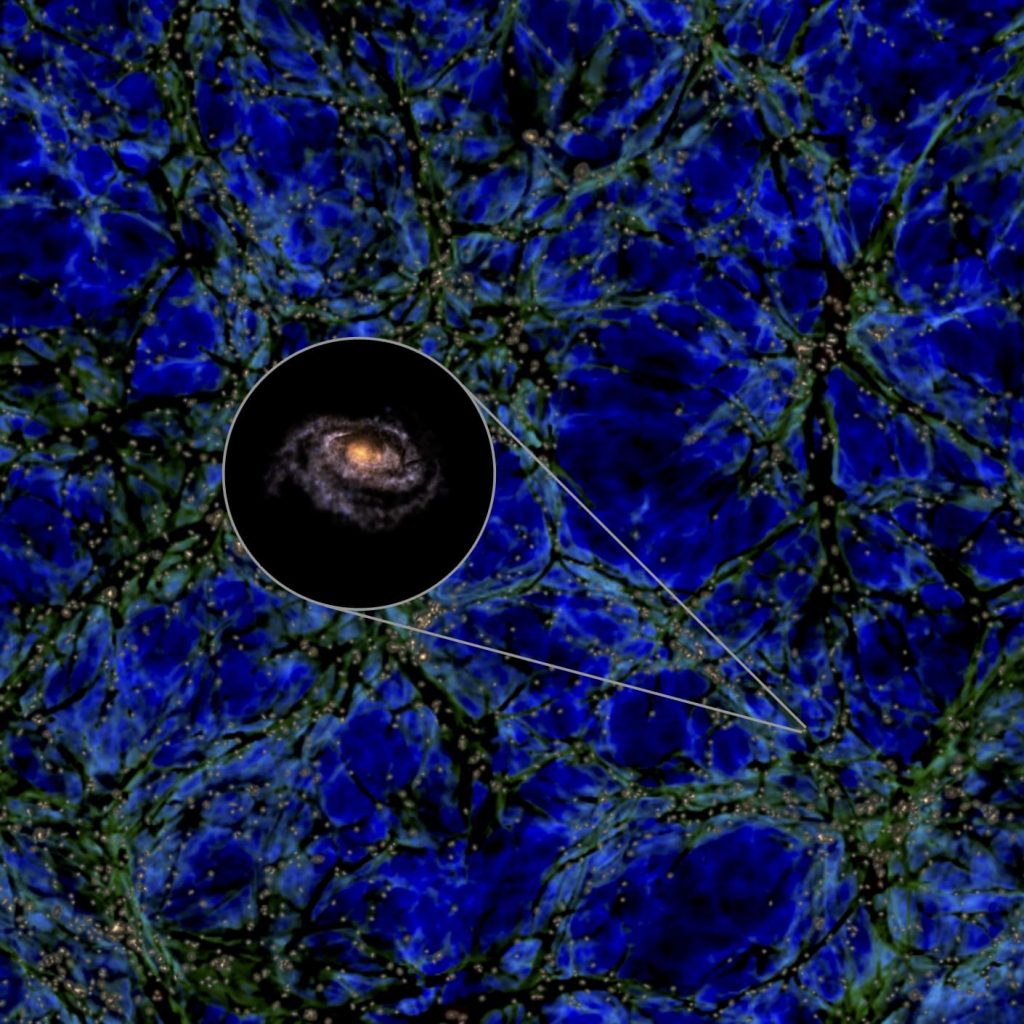 A rare galaxy similar to the Milky Way -too big for its surroundings. The background image is a computer simulation that shows the distribution of dark matter (green and blue) and galaxies (tiny yellow dots). Image: Miguel A. Aragon-Calvo, Illustris TNG project
The researchers used computersimulation based on known data collected during the observation process. They modeled the volume of the universe nearly a billion light-years across, which contains millions of galaxies. The study found that in this entire array, only about one in a million galaxies would be similar to the Milky Way: as massive and embedded in a group similar to the Local List of galaxies.
The Milky Way is not distinguished by its mass or type.There are many spiral galaxies that are roughly similar to it. But this is rare, given his surroundings. We have found that other galactic filaments in the universe, such as the Local Leaf, very rarely contain within them a galaxy as massive as the Milky Way.
Joseph Silk, British-American astrophysicist and co-author of the work
Read more:
Benefits of vitamin D for cancer prevention vary by weight
Hidden colony of penguins accidentally discovered from space images
A giant sunspot is turning towards the Earth. It is visible to the naked eye