The modern human brain evolved as stone tool culture in Africa became increasingly
Modern people are fundamentally different from theirclosest living relatives, great apes: we live on earth, we walk on two legs, and our brain is much larger. The first populations of the genus Homo appeared in Africa about 2.5 million years ago. They were already walking upright, but their brains were about half the size of modern humans. These earliest populations possessed primitive ape-like brains, like their extinct ancestors, the Australopithecines. So when and where did the typical human brain evolve?
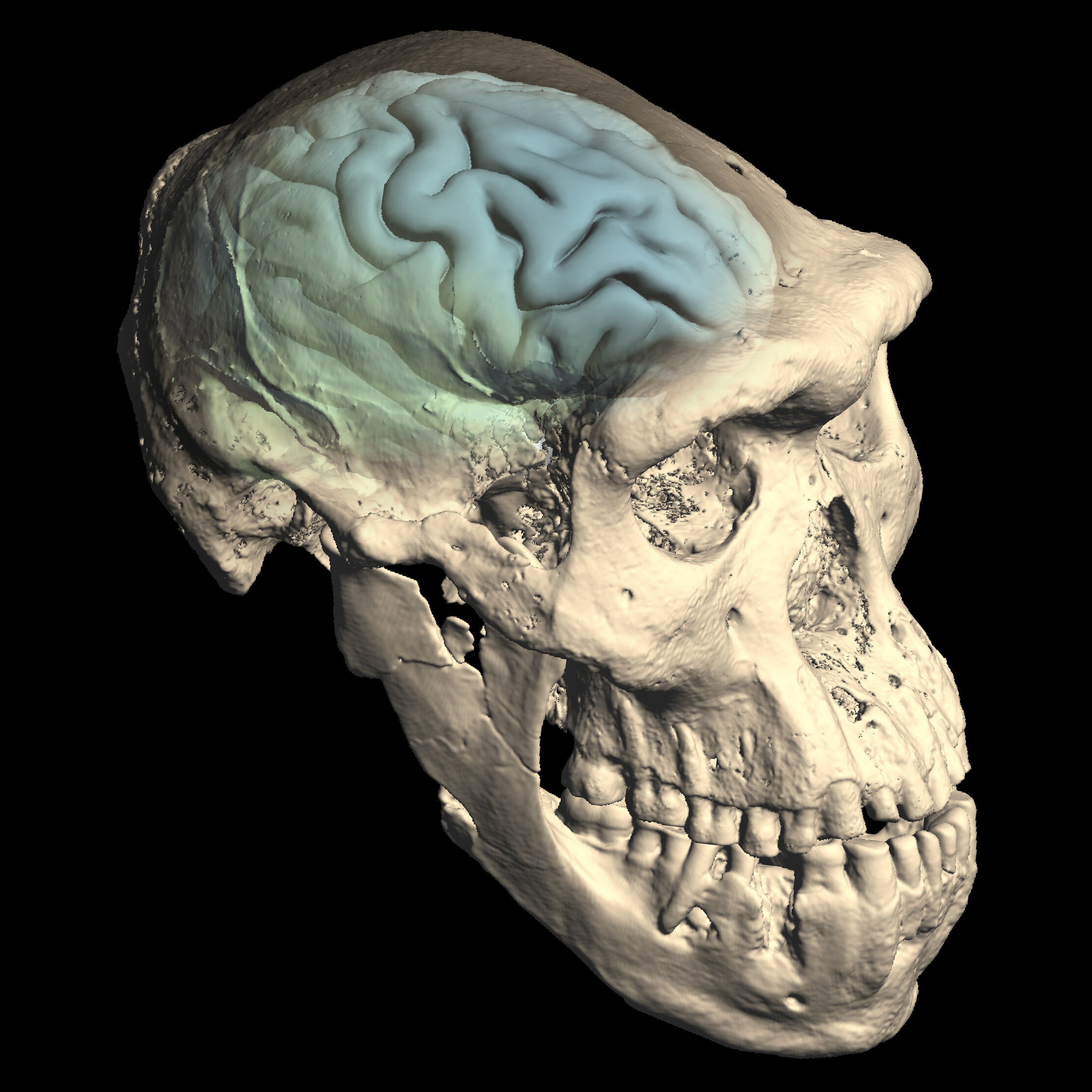 Early human skull from Dmanisi, Georgia,showing the internal structure of the corpus of the brain and the putative morphology of the brain. This was discovered by computed tomography and virtual reconstruction. Credit: M. Ponce de Leon and C. Zollikofer.
An international team of scientists led byChristoph Zollikofer and Marcia Ponce de Leon from the Department of Anthropology at the University of Zurich (UZH) were able to answer these questions. “Our analysis shows that modern human brain structures arose just 1.5–1.7 million years ago in African Homo populations,” says Zollikofer. Researchers used computed tomography to study the skulls of Homo fossils that lived in Africa and Asia 1-2 million years ago. They then compared the fossil data with reference data for apes and humans.
Besides size, the human brain differs fromapes, in particular by the location and organization of its individual areas. “Typical human features are primarily those areas of the frontal lobe that are responsible for planning and executing complex patterns of thought and action, and ultimately for language,” notes the first author of the work Marcia Ponce de Leon. Because these areas are much larger in the human brain, neighboring areas are moved further back.
The first Homo populations outsideAfricans—in Dmanisi on the territory of present-day Georgia—possessed the same primitive brain as their African relatives. It follows that the brains of ancient humans did not become particularly large or particularly modern around 1.7 million years ago. However, these early people were quite capable of making numerous tools, adapting to the new environmental conditions of Eurasia, developing sources of food for animals, and caring for group members in need of help.
 Early human skulls from Georgia with an ape-like brain (left) and from Indonesia with a human brain (right). Credit: M. Ponce de Leon and C. Zollikofer
During this period, African cultures became morecomplex and diverse, as evidenced by the discovery of various types of stone tools. Researchers believe that biological and cultural evolution may be interdependent. “It is likely that the earliest forms of human language also developed during this period,” says anthropologist Ponce de Leon. Fossils found in Java indicate that the new populations were extremely successful: soon after their first appearance in Africa, they had already spread to Southeast Asia.
Previous theories were not supported due tolack of reliable data. “The problem is that the brains of our ancestors are not preserved in fossil form. Its structures can only be determined by the imprints left by folds and grooves on the inner surface of fossil skulls,” concludes the head of the study. Because these prints vary significantly between individuals, until now it has been impossible to definitively determine whether a particular Homo fossil has a more ape-like brain or a more human-like brain. Using computed tomography analysis of multiple fossil skulls, researchers have closed this gap for the first time.
Read more
The first accurate map of the world was created. What's wrong with everyone else?
NASA told how they will deliver samples of Mars to Earth
Scientists explain the appearance of "spiders" on the surface of Mars