Small cell lung cancer (SCLC) is one of the deadliest forms of the disease, but now scientists have
Small cell lung cancer is the most commonin smokers and it is one of the most aggressive forms of the disease with a low survival rate. While chemotherapy is effective early in the disease, cancer quickly develops drug resistance, leading to relapse and progression of the disease.
Staff at the University of WashingtonLouis, the University of Grenoble Alps, and the University of Texas studied how SCLC cells resist chemotherapy-induced damage and how this can be counteracted.
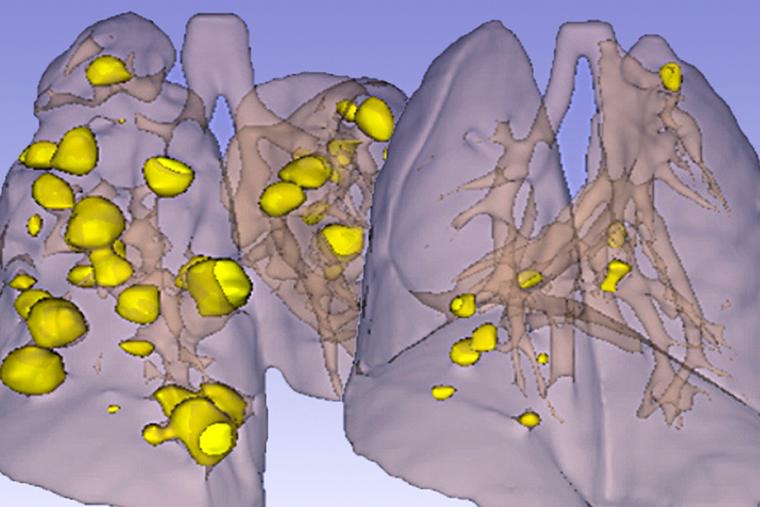 Computed tomography of the lungs of a mouse with small cell lung cancer (marked in yellow). The lung on the right was treated with the new combination therapy. Photo: Simone Hausmann and Pavel Mazur
In previous work, scientists found that the proteinRNF113A plays an important role in the ability of cancer cells to repair damage caused by alkylation. It turned out that RNF113A is regulated by another protein, SMYD3, which is highly expressed in SCLC cells. However, high levels of SMYD3 are associated with more aggressive cancers and stronger drug resistance.
With this in mind, biologists have studied whether blocking SMYD3 would improve the effects of chemotherapy drugs.
Team transplanted human SCLC cells into miceand waited until they had tumors in their lungs. They then treated some mice with cyclophosphamide, others with an SMYD3 inhibitor, another with both drugs, and some were not treated at all.
In mice that received only chemotherapy,the tumors stopped growing for about two weeks and then started growing again, indicating the development of drug resistance. But in mice given both cyclophosphamide and an SMYD3 inhibitor, the tumors stopped growing throughout the experiment for several months. Interestingly, the treatment worked just as well on tumors grown in a person whose cancer had already developed resistance to chemotherapy drugs.
Read more:
NASA reveals what the future of the solar system looks like
Physicists have cooled atoms to record temperatures. They are a billion times colder than outer space.
Researchers explain why India and Asia collided very quickly