A cook, a two-year-old boy or a flight attendant - each of them may turn out to be patient zero. But here
What is patient zero?
The term patient zero itself comes frominaccuracies in translation. When the HIV epidemic began, the first sick person was referred to in official documents as “Patient O,” short for “out of California,” that is, a person not from California.
But the media translated this wording as patient zero. Today, scientists use the term index case for the first case of infection, and the patient is called the primary case.
At the same time, a person may not even know thathe's infected with something. Since symptoms do not always appear with this. For example - Mary Mallon is one of the most famous zero patients. This woman worked as a cook and has infected more than 50 people with typhoid fever without knowing it. Later it turned out that the woman did not pay enough attention to hygiene.
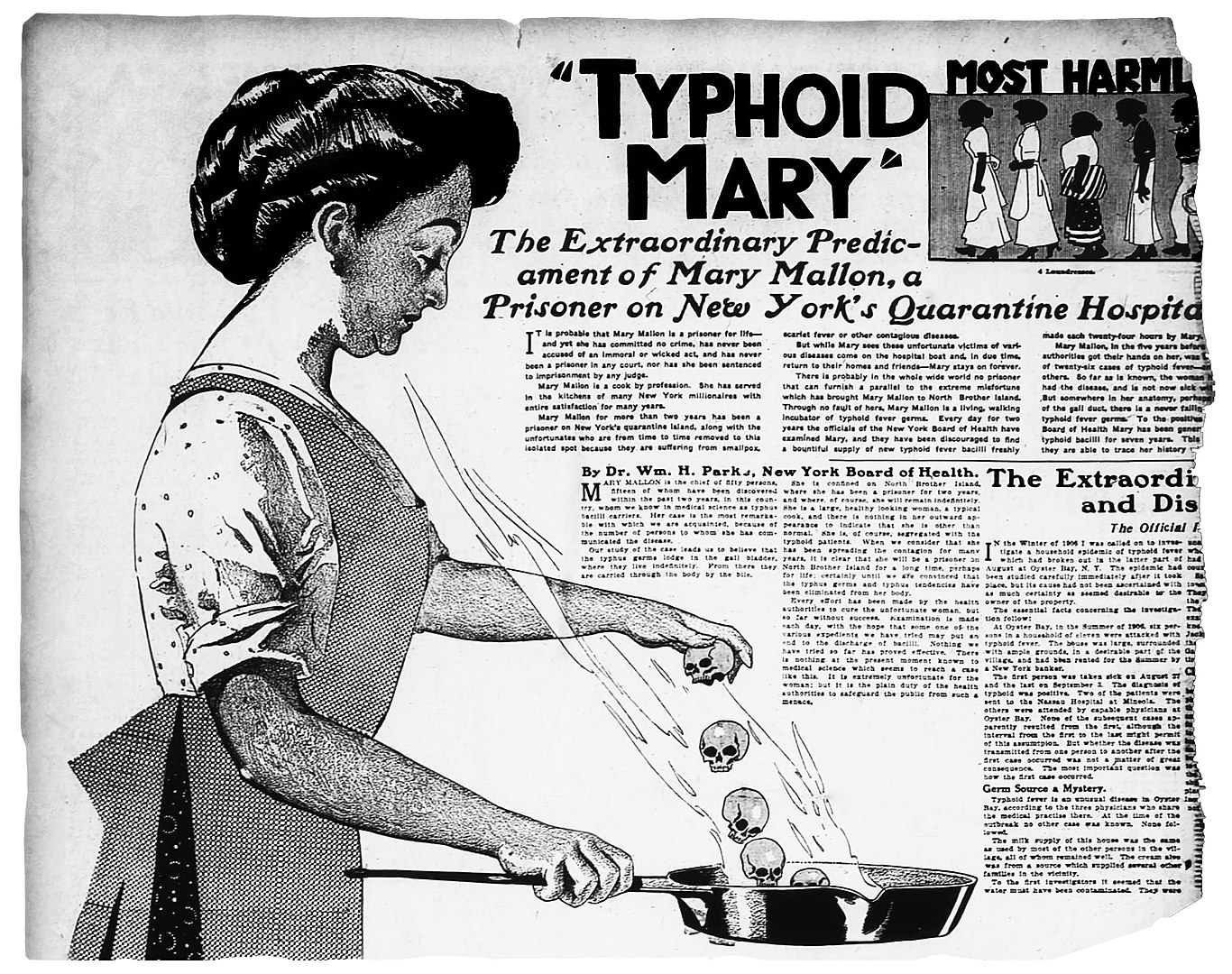 Newspaper illustration in an article about Typhoid Mary, 1909
How to search for patient zero?
First you need to determine the type of pathogendiseases. For example, in the case of coronavirus, this is zoonosis - a disease that occurs due to pathogens that have passed from animal to person. This happens for various reasons, for example, due to the fact that a person entered the habitat of animals, changed his eating habits or climatic conditions. Similar diseases that have been transmitted from animals to humans are Ebola, HIV, and swine and bird flu.
After this, researchers begin to look forgenetic characteristics of patient zero. To do this, they compare the DNA of the pathogen that caused the disease in humans and animals. By the number of matches, you can understand how similar the DNA of the pathogens is and, if they match as much as possible, then determine the animal that transmitted the virus to humans. In the case of SARS-CoV-2, it may be the bat virus RaTG13, which is 96% identical to the new type of coronavirus.
It seems that 4% difference is not much, but, according to scientists, the genome should be 100% identical, then conclusions can be drawn.
Is it always possible to find patient zero?
- Typhoid fever:
In short, no, and there are various reasons for this.In the first chapter we talked about Mary Mallon, a cook from Ireland who went to America to work there. From 1900 to 1907, Mary managed to change five families for whom she prepared food, as soon after Mallon began working, they began to suffer from typhoid fever. Mary, who was spared illness, helped take care of everyone. Due to a series of such suspicious coincidences, Mallon was first taken into custody and then sent to prison, where tests were taken. A focus of typhoid-like bacteria was found in the cook's gall bladder.
- HIV:
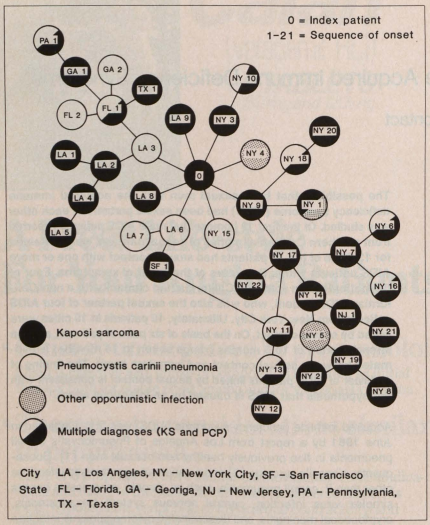
But this doesn't always happen.In the case of HIV, scientists have information about individual superspreaders, but we still don’t know anything about the very first vector. For example, an active carrier of HIV was Canadian flight attendant Gaetan Dugas. Information about him is in the very article in which the term “patient 0” was first used.
Its authors built a tree of the spread of HIV,to understand how the infection is transmitted. Dugas found himself at the center of this scheme only because he provided doctors with information about several dozen of his partners.
- Ebola:
In the case of Ebola, scientists were lucky.The fever spread in 2014 to Guinea, Liberia and Sierra Leone. Researchers studied the routes of transmission and found that fever began to occur in Guinea.
All the data pointed to the fact that he was the first to suffer Ebolatwo-year-old boy: he loved to play in the hollow of a tree. It is in it that animals carrying the virus could be located. But the tree burned down a few months after his death. In the remains of the ash, researchers found DNA from Mops condylurus bats. They were carriers of ebolaviruses, which means the puzzle fits.
- COVID-19:
In the case of a new type of coronavirus, so farscientists don't know for sure. But at the end of October 2021, it became known that the first case of COVID-19 was working in the market in Wuhan, information about this appeared in the journal Science.

According to the study authors, they studiedavailable data on the first cases of a new type of coronavirus in China and determined who first contracted the virus in December 2019. It was a woman who sold seafood. She fell ill on December 11. In the coming days, other traders and people visiting the market began to get to local hospitals with similar symptoms.
Such findings cast doubt on the Wuhan versionauthorities: they previously stated that the first case was a man who lived 30 km from this market, which means that trade in food and animals, according to local authorities, had nothing to do with it.
So far, the scientific community agrees,that a new type of coronavirus was not developed in a laboratory. If this were the case, then the virus would contain noticeable blocks of changes or introduced sequences from another viral source.
Today, the search for patient zero is complex andlong event. Therefore, precautions are needed, which, unfortunately, are not always observed. For example, active information about how the virus spreads, protective masks, contraception, hand washing, hygiene, and so on. For now, we can prevent the virus from spreading further, but in the future, any potentially dangerous outbreaks must be prevented.
Read more:
The Chinese launched a missile from a hypersonic glider. Previously, no one succeeded
A flying robot beetle has appeared. This design increases its lifting force.
Scientists have proposed to create an artificial magnetosphere for Mars