One of the main functions of the James Webb Space Telescope is to find the earliest galaxies, expanding our
These star systems are much farther awaythan all previously observed objects in the universe. Scientists write about galaxies with redshifts from 12 to 17. But there is a fly in the ointment in this celebration of scientific triumph: some researchers believe that the age of objects can be distorted and the results require careful verification.
Which galaxy is the most distant?
Prior to the launch of the James Webb Space Telescope infor a long time the most distant confirmed galaxy was GN-z11. It was discovered in 2016 using the Hubble telescope. It is about 25 times smaller than the Milky Way and is about 1% of its mass. At the same time, star formation in it proceeded 20 times more actively.
GN-z11 is located in the constellation Ursa Major,and astrophysicists estimate the redshift to be 11.1. This means that we are observing it as it was 13.4 billion years ago - just 400 years after the Big Bang. As the Universe continually expands, galaxies in space are moving away from each other. Therefore, the proper distance to GN-z11 is about 32 billion light years.
Even before the launch of the new telescope in the spring of 2022astrophysicists have announced the discovery of an even more distant candidate, HD1. It was discovered using the Subaru Space Telescope and observations from ground-based observatories. According to spectroscopy, its redshift is 13.27, which corresponds to a distance of 13.5 billion light years. And the galaxy itself is now 33.4 billion light-years from Earth.
Just a week after the publication of the first dataAt the James Webb Telescope, researchers at the Harvard-Smithsonian Center for Astrophysics announced the discovery of the galaxy GLASS-z13, which is tentatively redshifted at 13. This is about 300 million years after the Big Bang. A week later, a message was received about a galaxy with a redshift of 14 and even 16.7. If this is true, then we see these galaxies as they existed about 200 million years after the Big Bang.
True, all these results are preliminary: so far none of these redshift values has been confirmed. To establish the distances to these galaxies, spectroscopic analysis will be required.
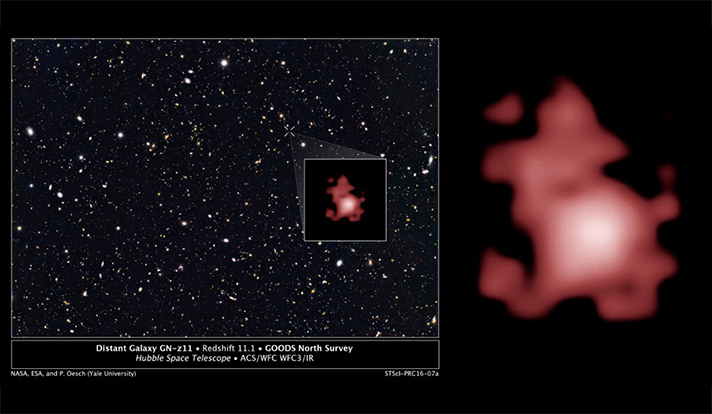 Galaxy GN-z11 as seen by the Hubble Space Telescope.Image: NASA, ESA, P. Oesch (Yale University), G. Brammer (STScI), P. van Dokkum (Yale University), and G. Illingworth (University of California, Santa Cruz)
How are new galaxies found?
In their work, scientists used different methods.For example, astrophysicists at the University of Missouri-Columbia used the gravitational lensing effect created by the massive galaxy cluster SMACS J0723. A massive object distorts the movement of light, magnifying distant objects, just like a normal optical telescope lens. Using this method, scientists have found 88 candidate galaxies with a redshift of at least 11. Some of them, according to the researchers, may have a redshift of up to 20.
Other scientists analyzed images of variousareas of the sky where the effect of gravitational lensing was not used. These images are part of the Cosmic Evolution Early Release Science (CEERS) study, which consists of images of 10 different regions of the sky taken by the telescope's near-infrared camera (NIRCam).
To confirm the real age of distantobjects require spectroscopic analysis, which splits the light from the object into a spectrum. To do this, scientists will use the James Webb Telescope's Near Infrared Spectrograph (NIRSpec) as well as the Space Telescope's Mid-Infrared Instrument (MIRI).
 The effect of gravitational lensing in the image of the cluster SMACS J0723. Image: NASA, ESA, CSA, and STScI
What is redshift?
In the study of the early universe, the mainThe indicator that scientists use is the redshift. It helps to understand how fast an object is moving away from us. Just as the signal of a steam locomotive or ship sounds lower as they move away from the observer, the light wave from a receding object also changes.
The universe is constantly expanding, which meansdistant galaxies are moving away from Earth. At redshift, electromagnetic radiation from a receding object increases its wavelength. This means that all the details of the spectrum shift towards the red region.
The further away the galaxy, the earlier we see it andthe more its light was stretched due to the expansion of the Universe. As a result, blue and ultraviolet light from hot young stars appears infrared to us 13.5 billion years later.
The James Webb telescope is equipped with sensitive instruments that detect radiation in various parts of the infrared range and that is why they can capture the radiation of the early universe.
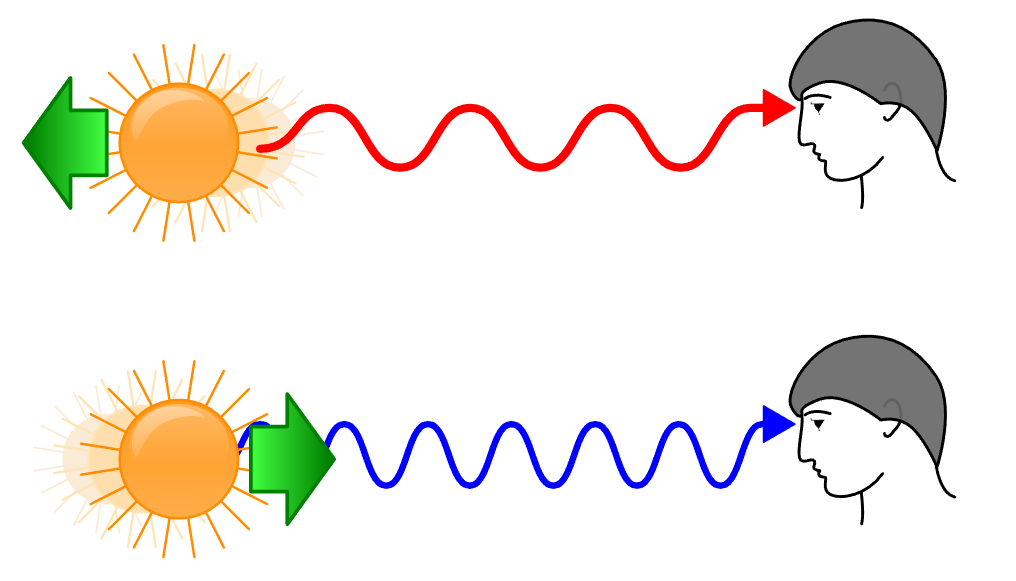 Red and blue shift. Image: Aleš Tošovský, CC BY-SA 3.0, via Wikimedia Commons
Why can the first results be wrong?
Preliminary studies are based onsingle observations and may be inaccurate. For example, dusty star-forming galaxies that existed billions of years after the Big Bang can masquerade as record-breaking distant ones. And besides, the light emitted by galaxies can be distorted by other objects.
For example, based on how redThe CEERS-DSFG-1 galaxy appears on the James Webb telescope images, astronomers have determined the redshift from 17 to 18. This means that we see it 220 million years after the Big Bang. However, Japanese astronomers used the NOEMA submillimeter telescope to find the same galaxy and show that it contains a huge amount of dust.
Dust absorbs shorter and bluer wavelengthsstarlight, letting in longer and redder ones. This means that when visually observed from Earth, such a galaxy will appear redder. After adjusting the observational results to take into account the influence of dust, scientists showed that the real redshift is only about 5. This means that the galaxy is visible 1.3 billion years after the Big Bang.
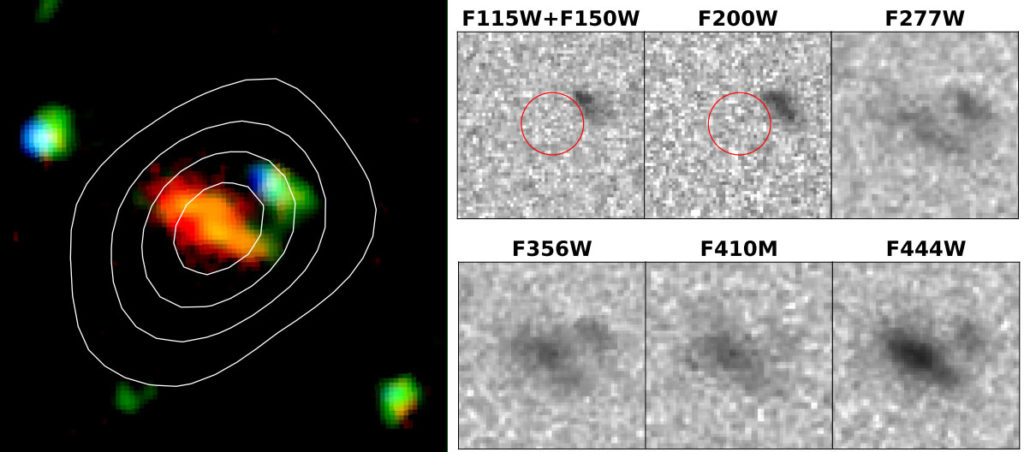 Galaxy CEERS-DSFG-1 in the image of the telescope"James Webb" with NOEMA observations superimposed over it as contour lines. On the right is how the candidate looks when viewed through different filters: it does not show up in shorter wavelength filters, but becomes more visible in redder filters. Image: J. Zavala et al.
Researchers came to similar resultsstudying the candidate galaxy CEERS-1749. They called their discovery the Schrödinger galaxy. The thing is that the redshift for it can be equal to either 5 or 17. If we are talking about a separate distant galaxy, then this is one of the most distant known similar systems, and if it is part of a cluster, then we are again talking about a billion years after the Big Bang. Everything will become clear after new research.
Regardless of whether they are confirmeddeclared records, new discoveries will make a significant contribution to understanding the processes of development of the early Universe. Even "close" distant galaxies with a redshift of about 5 open up new data.
Interstellar dust is a by-product of the cyclethe birth and death of stars. To affect the redshift, there must be a lot of such dust. And this means that extremely intensive star formation should occur in such galaxies. Previously, scientists did not know about such processes.
A large number of distant galaxies from different periods of the life of the Universe will help to understand how the first star systems were formed and developed.
Read more:
"James Webb" sent a photo of the collision of two huge galaxies
"Useless" bacteria on Earth will provide life to the colonists of Mars
On the pyramid in China found a portrait of the "king of ancestors". He ruled over 4,000 years ago