What is an icebreaker and how does it work?
Icebreakers are a special class of ships that are designed to
In order to break the ice effectively, such ships must be very powerful, relatively short, wide, and extremely heavy.They break the ice using inertia and force.In essence, a nuclear-powered icebreaker is a steamship.A nuclear reactor heats water, which turns into steam, which spinsturbines that excite generators that generate electricity that comes ininto electric motors that turn 3 propellers.
The thickness of the hull in places of ice breaking is 5 centimeters, but the strength of the hull is given not so much by the thickness of the plating as by the number and location of frames.The icebreaker has a double bottom, so in the event of a hole, water will not enter the ship.
And how is the icebreaker different from other ships?
Icebreakers are distinguished by their sloping bow, large displacement (weight) for their size, and power.In addition, they are specially reinforced to withstand the ship's impact on ice at high speed.The body is very thick and made of steel that is resistant to low temperatures.At the same time, for maneuvering in icy water, icebreakers have sloping sides and a stem. Moreover, some icebreaking vessels haveA hull that is wider in the bow than in the stern to increase the width of the ice channel it creates.
The pointed hull of a conventional ship helps it cut through waves and reduce friction between the ship and the water.While other vessels have a pointed bow, the bow of icebreakers will behave a more rounded design so that the vessel can break the ice with its weight as well as move on it.Older icebreakers had hull plating up to 50 millimeters thick, modern vessels use high-strength steel with a yield strength of up to 500 MPa, providing increased strength with less weight and thickness of steel.
Likewise, despite the sturdy hull, additional structural reinforcement is required in order for the separator to perform its duties effectively.In fact, the design of the bow of icebreakers is an important element as the vessel needs to navigate icy waters.
With two propellers mounted both bow and stern and a bow thruster, these vessels stand out from the crowd and maneuver efficientlyon the ice.
Another important feature of modern icebreakers compared to other ships is the power they provide to pave the way for other ships in icy waters.
So icebreakers need power. Where to get it from? It's simple - from nuclear energy.
For example, the nuclear icebreaker "50 Let Pobedy" has 2 nuclear reactors with a capacity of 170 megawatts each The capacity of these two installations is enough to supply electricity to a city with a population of 2 million people.Nuclear reactors are reliably protected from accidents and external shocks passenger aircraft or collision with the same icebreaker at speeds of up to 10 km/h.
By the way, the reactors are refueled with new fuel once every 5 years.
Which countries are building nuclear icebreakers?
Russia or the Soviet Union is the onlycountry in the world that builds nuclear icebreakers. Such vessels were specially built taking into account the strategic importance of the Northern Sea Route and the more obvious need to guarantee the safety of Russian merchant ships in winter and the dependence of Arctic settlements on supplies.
Russia has the only nuclear power plant in the worldthe icebreaker fleet, called upon to use advanced nuclear achievements to solve the tasks of ensuring a national presence in the Arctic. With its appearance, the real development of the Far North began. This is due to the fact that all the northern borders of the state are maritime and they pass through the waters of the Arctic Ocean, the seas of which are covered with ice almost all year round, with the exception of a part of the Barents Sea.
About 30 years ago more than fiftySoviet convoys of ships were stuck in the ice of the eastern Arctic region. Many populated areas of the USSR depended on the cargo and food that the ships were supposed to deliver, and the situation itself posed a danger to the crew. Fortunately, the fleet included the nuclear-powered icebreaker Lenin. Thanks to its power and nuclear fuel source, it saved hundreds of lives in one of the largest and most successful rescue operations in history. The ship was taken out of service in 1989 and left at the nuclear icebreaker base in the Murmansk fjord, and then became a museum.
Why are icebreakers needed?
In general, the idea of an icebreaker has existed for a very long time, sincethe first days of polar exploration. Marine Insight reports that back in the 11th century, people created the first prototypes of special ships for sailing the northern seas. Of course, for the most part these were boats with reinforced hulls.
Today to the main functions of the icebreaker shipis the clearing of trade routes in icy water, especially in winter. Although ships sailing along these trade routes, such as the Baltic Sea, St. Lawrence Seaway, Great Lakes and Northern Sea Route, are designed to sail in icy waters, seasonal ice conditions make it difficult for ships to navigate.
Thus, icebreakers accompany tradevessels when crossing these areas to ensure the smooth sailing of vessels. In addition to clearing the passage for cargo ships, icebreakers are also widely used to support research programs in the polar regions.
What is the most powerful icebreaker?
The answer is unequivocal - “Arctic”.
Six out of ten Russian nuclear powered civilian ships currently belong to this class. The first four classes have been retired, while two remain in service as of 2020.
Now the lead ship of the second series of nuclear-powered icebreakers of the LK-60Ya type is the most powerful icebreaker in the world.
These icebreakers have a double hull, thicknessthe outer hull in icebreaker areas is about 48 mm, and in other areas - 25 mm. Between the inner and outer hulls there is water ballast, which can be moved to facilitate icebreaker assistance. Arktika-class ships can break ice by moving forward or backward. Although they have two reactors, usually only one is used to supply energy while the other is in standby mode.
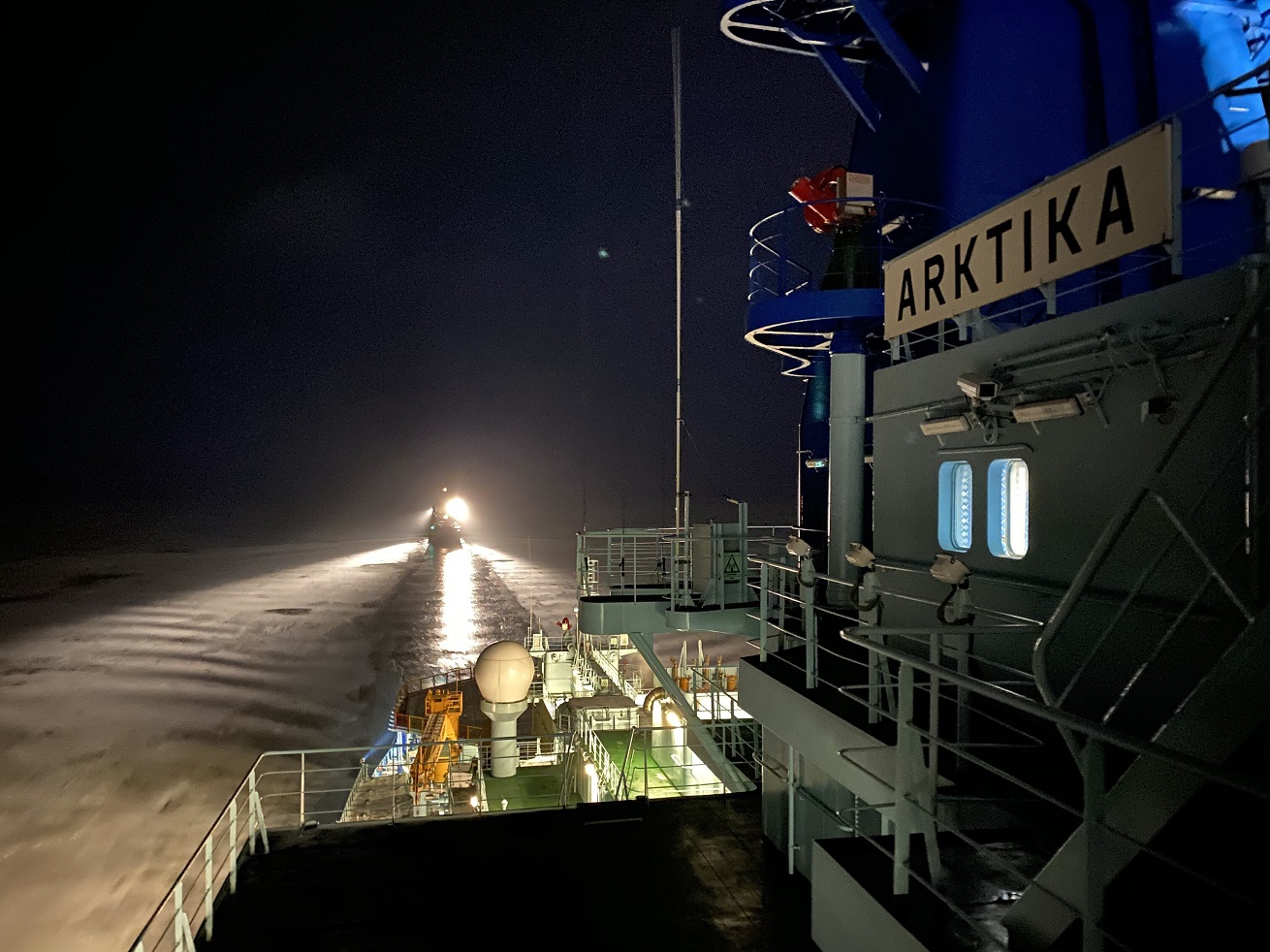
A nuclear icebreaker can serve several purposes.These ships were used in a number of Arctic scientific expeditions and regularly forced cargo and other ships passing through the ice along the Northern Sea Route. The main feature that makes these marvels of shipbuilding so special is their almost complete independence from any traditional fuel, so they can operate autonomously for almost 70 years.
Which icebreaker is the newest?
“50 Anniversary of Victory” is the newest of sevenships of the Arktika class nuclear icebreaker series. Built at the Baltic and Admiralty shipyards in St. Petersburg. Construction of the ship began in October 1989 at the Baltic Shipyard, but was stopped in 1994 due to financing problems and resumed in 2003. Construction of the icebreaker took almost 18 years, and at the end of 2007 the icebreaker was ready for operation.
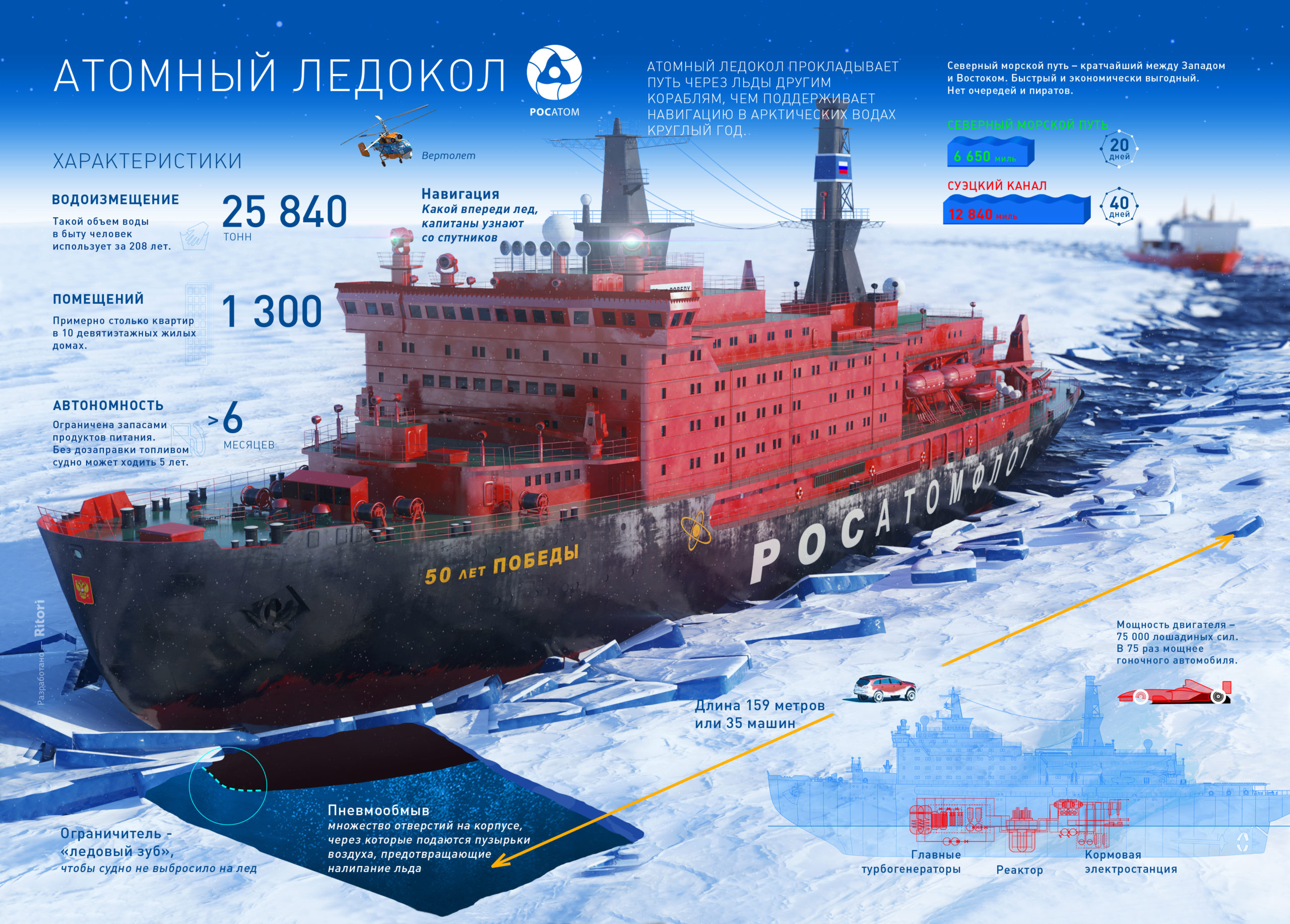 Photo: rosatom.ru
The ship is a modernizedA variant of the Arktika-class icebreaker, it has a double hull and a spoon-shaped bow. The shape of the vessel increases icebreaking capabilities, and the hull is coated with polymer paint to reduce friction. It has a total length of 160 m, a width of 30 m, a draft of 11 m and a depth of 17.2 m. Displacement 25 840 tons. The vessel can break through ice up to a depth of 2.8 m at a constant speed.
In the Arctic Ocean, an icebreaker canreach any point at any time of the year. According to the shipbuilder's specifications, the ship can move freely, overcoming flat ice up to 2.8 meters thick. But a ship, as a rule, does not encounter flat ice all the time; ice ridges can reach a thickness of from 5 to 20 meters, and an icebreaker can pass through them not smoothly, but cutting through the ice like an ax chopping wood: slowly, chopping one piece, then another. The ship's superstructure is strong and stable, and it is capable of this approach.
Pobeda is equipped with a digital automatedcontrol system. The biological protection complex was modernized and an environmental compartment was added. The ship has a helipad suitable for an MI-2 or MI-8 helicopter. The ship's power plant includes two reactors: one for supplying energy, and the other in standby mode.
Which icebreaker will be next?
The whole world is waiting for the construction of nuclear icebreakers of the project10510 "Leader" (LK-120Ya) is a project of Russian atomic icebreakers with a capacity of 120 MW with a nuclear power plant. The main tasks of these vessels are to provide year-round navigation along the Northern Sea Route and expeditions to the Arctic. Due to the increased width of the hull, it is planned to carry out large-capacity vessels.
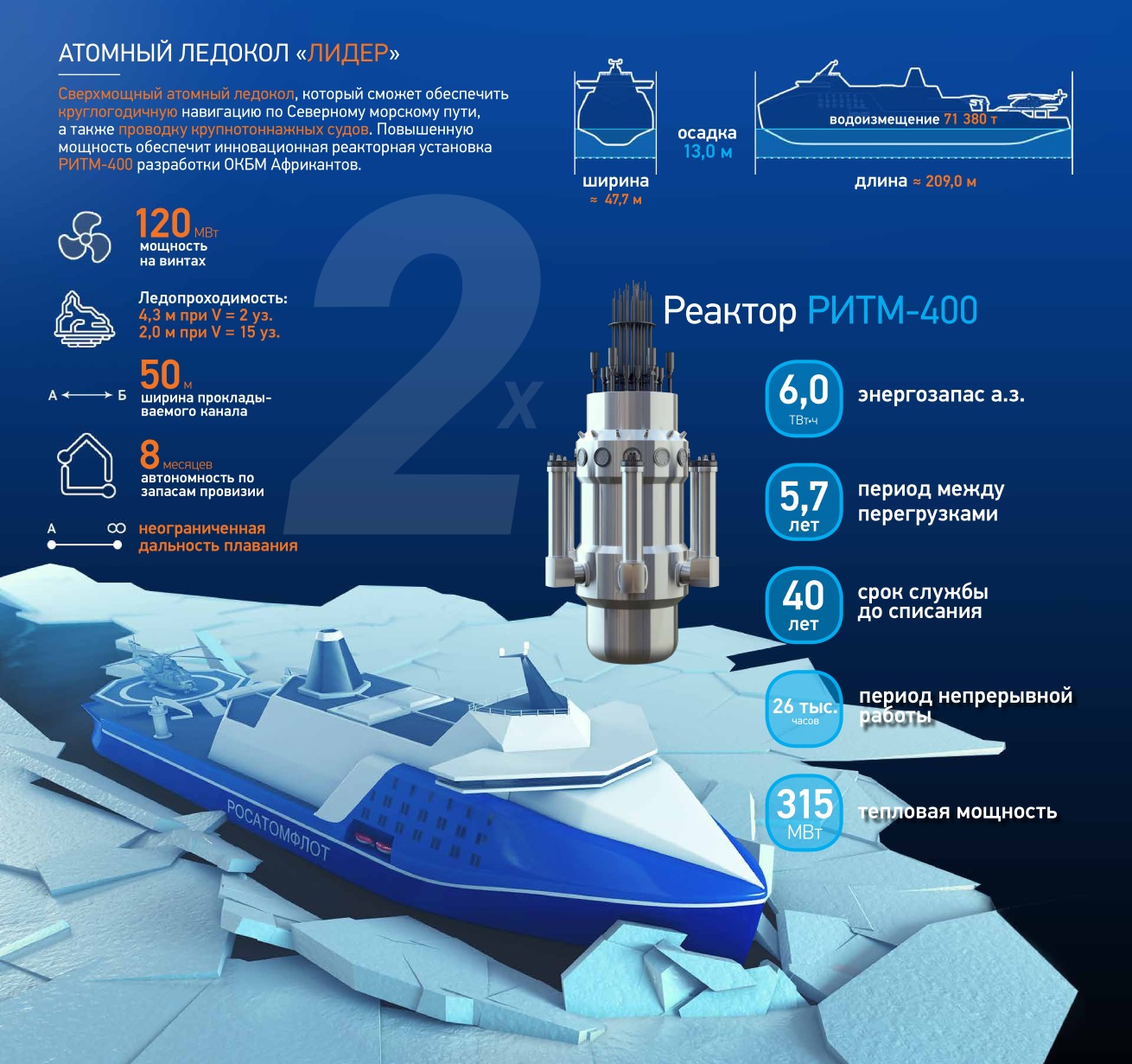 Photo: rosatom.ru
A series of three icebreakers is planned to be built oncapacity of the Far Eastern shipbuilding complex "Zvezda" under construction in the Primorsky Territory. It is being built by a consortium led by Rosneft. Financing will be 100% from the federal budget of Russia in accordance with Decree of the Government of the Russian Federation dated January 15, 2020 No. 11 «On budgetary investments in the construction of the lead nuclear icebreaker of project 10510 “Leader” (signed by D. Medvedev in a few hours until resignation on January 15, 2020); the cost of construction is estimated at 127.5 billion rubles. Further icebreakers of the Leader project can be built under a concession.
 Model of the icebreaker "Leader".
Construction of the first icebreaker began on July 62020; the commissioning date is set for 2027. In 2023, it is planned to lay down the next icebreakers, and hand over to the customer FSUE Rosatomflot by 2033.
Significant expectations are expected from Leader class icebreakersincreased icebreaking capacity: according to calculations, the new icebreakers will be able to navigate freely in continuous ice up to 4.3 meters thick. In practice, it means “wherever and whenever, throughout the Arctic”.
Is it possible to travel on an icebreaker?
Yes. But it doesn't come cheap.
Find yourself on the top of the planet, crossThe Arctic Ocean on one of the most powerful nuclear icebreakers in the world, exploring historical sites on Franz Josef Land, riding Zodiac boats, looking at polar bears and walruses is possible. Various travel companies offer to take a nuclear icebreaker to the “top of the world” for $28,000–$45,000 (2–4 million rubles). Usually trips are planned for the summer.
Read more
The first accurate map of the world was created. What's wrong with everyone else?
Climate change has shifted the axis of the Earth
NASA told how they will deliver samples of Mars to Earth
Pack ice - sea ice with a thickness of at least 3meters, which existed for more than 2 annual cycles of growth and melting. In the form of extensive ice fields, it is observed mainly in the Arctic basin. A more correct name is perennial ice.
Ship superstructure - a closed structure on the main deck of a ship, located from side to side, or at a short distance from the sides, not exceeding 4% of the ship's breadth.
If such a structure is located at a greater distance from the sides, then it is called a deckhouse.