A handwritten manuscript believed to be the work of astronomer Galileo Galilei, created in the early 1600s.
According to the official statement of the university,the single sheet of paper was the “gem of the collection” of the University of Michigan library. But an internal investigation by a history professor revealed that it was a fake: the watermarks on the paper dated back to the 18th century or even later. This means that they appeared almost a hundred years after the death of the famous astronomer.
The manuscript is in the possession of the university1938, when Tracy McGregor, a university trustee and businessman from Detroit, donated it to the library. He himself purchased the document at auction from another collector in 1934. The Archbishop of Pisa then confirmed the authenticity of the manuscript by comparing it with other letters of Galileo in his collection.
At the top of the manuscript is a drafta letter that Galileo wrote before presenting the new telescope to the Doge of Venice in 1609. Recall that the doge was the title of the elected head of the Republic of Venice for more than ten centuries, from the 8th to the 18th centuries.
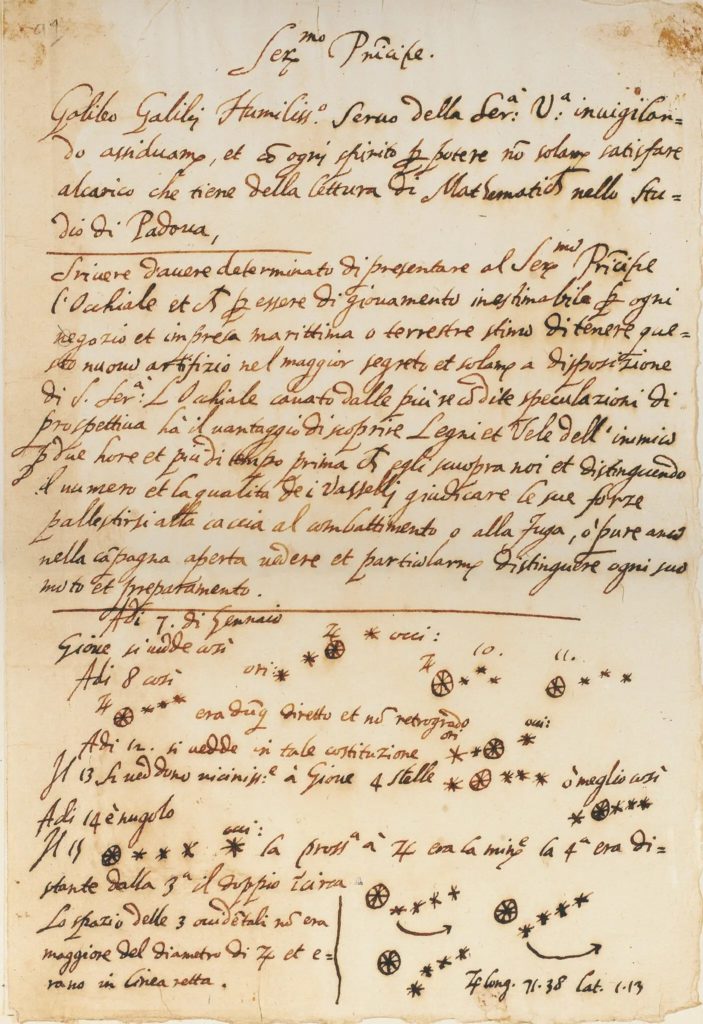 Photo: University of Michigan Library
The famous astronomer actually wrote a versionof this letter - the final version is in the State Archives of Venice, Italy. The bottom half of the document is a set of data about Jupiter's moons, also based on actual recordings by Galileo. The final version of these notes is also in Italy, in the National Central Library of Florence.
But when Nick Wilding, a historian at the Universityof Georgia, saw an image of the document, he suspected something was wrong. The ink, handwriting and some word choices seemed strange for a 17th-century document, he told the New York Times. In May 2022, Wilding emailed University of Michigan library curator Pablo Alvarez with his concerns, and the university launched an internal investigation. Three months later, a university spokesman announced that Wilding was right. The document was not written by Galileo, but most likely by Tobia Nicotra, an Italian forger active in the 1920s and 1930s.
The conclusion was confirmed by a watermark onpaper. According to the University of Michigan Library, old paper often contains watermarks that identify the manufacturer. The watermark on Galileo paper reads “AS,” the initials of the paper manufacturer, and “BMO,” an abbreviation for Bergamo, Italy. The earliest known documents bearing the BMO monogram date back to 1770.
Moreover, the university could not findevidence that Galileo's document existed before the 1930s. Worse, the two documents that Muffy claimed to have compared the manuscript to to verify its authenticity also turned out to be forgeries of Nikotra. According to the university, Wilding also found a similar forgery - a letter believed to be from 1607 - in the collections of the Morgan Library in New York.
The University of Michigan Library is currently rethinking how to display Galileo's paper. However, experts note that a fake can be useful for research.
“In the future,” the library said in a statement, “it can serve research, teaching and learning interests in forgeries and hoaxes, a timeless discipline that has never been more relevant."
Read more:
Scientists have found a black hole that is 50 times larger than galaxies
Physicists have shown that water turns into two liquids at low temperatures
Russia has invented an alloy that can withstand the energy of a thermonuclear reactor