In 2009, data from NASA's Solar-Terrestrial Relations Observatory STEREO showed that the asteroid's behavior
This already surprised scientists, since the tailscharacteristic of comets (due to their icy composition), and not of rock-metal asteroids. For a long time it was believed that this was dust ejected from the surface of the object. A new study has shown that it's not about her; it is actually a tail made up of sodium gas.
"Our analysis shows that the comet-like"Phaethon's activity cannot be explained by any dust," said Qicheng Zhang, lead author of the study and graduate student at the California Institute of Technology. “Comets often glow brightly due to sodium radiation when they come very close to the Sun, so we suspected that it played a key role in increasing the brightness of Phaethon.”
An earlier study showed that sodium isthe cause of the "hiss" on the asteroid's surface. When Phaethon, whose diameter is almost 6.3 km, approaches the Sun, its surface temperature heats up to 750 ° C, which leads to the evaporation of certain substances.
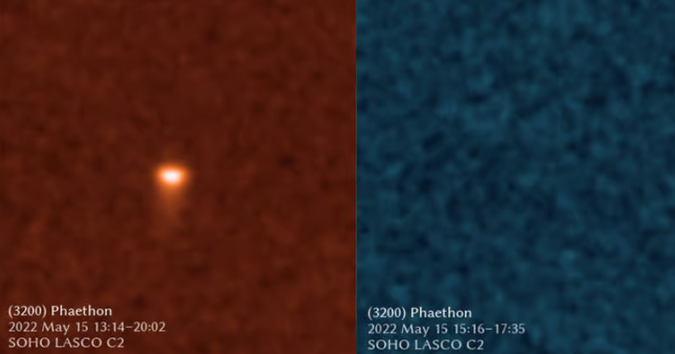 On the left is an image with an orange filter, sensitive to sodium. On the right is an image with a blue filter that is sensitive to dust. Photo: ESA/NASA/Chicheng Zhang
Scientists made a discovery using two solarNASA observatory. The SOHO Solar and Heliospheric Observatory spacecraft helped astronomers observe the asteroid through two filters that identified sodium and dust. Then the astronomers studied the STEREO and SOHO image archives and found data on Phaeton's tail during 18 approaches to the Sun from 1997 to 2022. The study is published in The Planetary Science Journal.
Read more:
A photo appeared inside the second deepest underwater sinkhole in the world
See what happened to Mercury when it got as close as possible to the Sun
Scientists are ready to recognize the new tree as the oldest in the world
Cover photo: NASA/JPL-Caltech/IPAC