The atomic nucleus is an unusual place. It is known that it contains protons and neutrons. These particles, or
Mysteries of the strong interaction, whichdetermines the movement of these particles, force scientists to look for new ways to look inside the atom to understand what is happening there. Physicists came up with a new method that uses mirror atoms and found that protons collide with their fellow protons, and neutrons with their fellow neutrons, more often than expected.
What is a strong interaction?
The strong nuclear force is one offundamental interactions along with gravity, electromagnetism and the weak interaction. It is best studied at the quantum level. The interaction between quarks (elementary particles that make up matter) and gluons (massless carriers of the strong interaction) is described by quantum chromodynamics.
Scientists believe that every quark iscarrier of a specific quantum charge. It is called color, although this is a conventional term that has nothing to do with optical properties. In addition, it has a defined state vector in complex 3D color space.
The strong interaction is a process in whichquarks exchange charge (color) carried by the gluon. Unlike the photon in electromagnetic interaction, which is unique and has no charge of its own, each gluon carries a specific color. Researchers identify eight types of such particles with different charges.
 Scheme of strong interaction. Image: Manishearth, CC BY-SA 3.0, via Wikimedia Commons
As the name suggests, the strong force isthe most powerful, but it acts only at short distances, comparable to the size of an atomic nucleus and less. An amazing feature of this interaction is that as the distance between quarks increases, it increases, and as it decreases, it weakens.
This effect causes confinement - the locking of quarks inside hadrons (compound particles). Therefore, a quark cannot exist in free space, but only as part of more complex particles.
 The disruption of the interaction between two quarks under the action of energy leads to the birth of a new pair of quark and antiquark. Animation: Manishearth, CC BY-SA 3.0, via Wikimedia Commons
Although the strong force is the most well developed theory in particle physics, the interactions of compound particles such as hadrons and nucleons (protons and neutrons) are very difficult to calculate.
How is the interaction of nucleons measured?

Conditional model of an atom (left) and helium-4 (right). Gray color is the electron cloud, the enlarged image shows the nucleus. Right image: User:Yzmo, CC BY-SA 3.0, via Wikimedia Commons
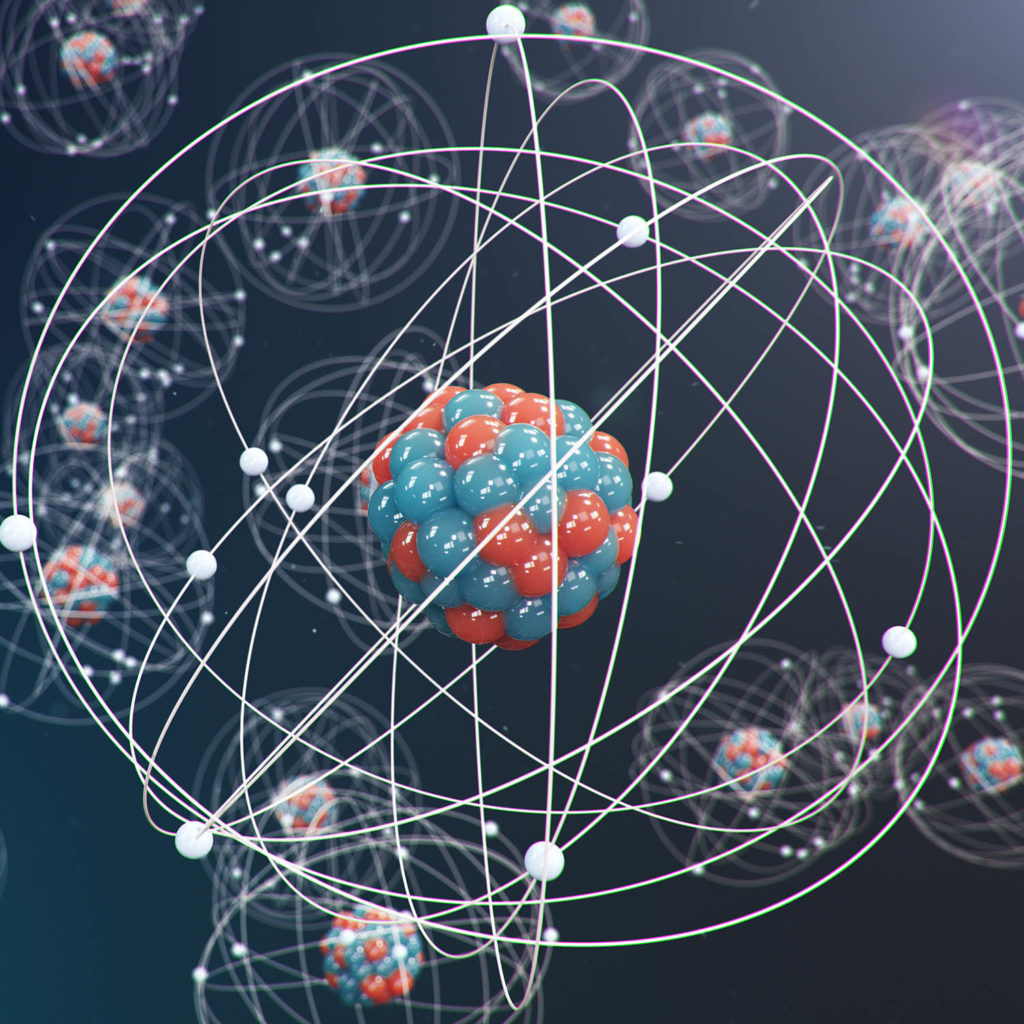
Atomic nuclei are often depicted as denseclusters of protons and neutrons stuck together, but in fact these nucleons are constantly revolving around each other. At the same time, they collide and scatter again, but on the "elastic band" of strong interaction they return back. In most nuclei, scientists estimate that nucleons spend about 20% of their lives in high-momentum excited states caused by these collisions.
The correct interpretation of the set of physicalexperiments, such as those conducted at the Large Hadron Collider and other particle accelerators, depend on how well scientists understand such collisions.
To study them, physicists work onatomic nuclei with beams of high-energy electrons. If you measure with what energy and in what direction an electron began to move when it collided with a positively charged proton of an atomic nucleus, you can determine how fast it moved.
In addition, a highly charged electron hassufficient momentum to break the strong interaction and knock the “excited” proton out of the atomic nucleus. In the process of breaking the connection, in a number of cases, his “partner” is thrown out after him - the particle with which he last encountered and is connected by a strong interaction.
In classical experiments, physicists usecounting such "ejected" pairs of two protons, or a proton and a neutron, to determine how the nucleons interact in the atoms of the nucleus. Experiments in which nuclei of various atoms from carbon with 12 nucleons to lead with 208 were irradiated with electrons showed approximately the same distribution: almost 95% of all collisions occur in proton-neutron pairs, and 5% are interactions between identical nucleons.
The disadvantage of this method is that suchexact collisions in which both particles are emitted from the nucleus are quite rare, and other factors can affect particles in atoms. Therefore, the measurements contain little data, and the results have a high error.
What did the experiment with mirror nuclei show?
To get around this limitation, scientists came up withnew method. They decided to irradiate “mirror” atomic nuclei. An atom of helium-3 (a stable isotope of helium) has the same number of nucleons as tritium (an isotope of hydrogen). But if in the first case the nucleus consists of two protons and one neutron, then in the second case everything is exactly the opposite.
Scientists have realized that if each of theseatoms, then the difference in nucleon sets will help to more accurately determine how protons and neutrons of atomic nuclei interact with each other. In the new experiment, it was possible to collect much more data than in previous ones, because the analysis did not require rare triple coincidence events, when both excited particles flew out of the nucleus; even one was enough.
The researchers report that the new method has increasedmeasurement accuracy 10 times. However, they did not expect that the interactions of nucleons in simple atoms would be very different from the complex ones that were tested in previous experiments.
In a paper recently published in the journalNature, physicists report that the proportion of interactions between identical particles (proton-proton and neutron-neutron collisions) turned out to be much higher: it is about 20%.
We wanted to take significantly more accurate measurements, but did not expect them to be very different.
John Arrington, Berkeley Lab researcher and co-author of a new paper
What's next?
Researchers believe that the difference inthe interaction of particles can be explained precisely by the size of the nuclei. The main scattering processes - changes in the direction of movement of particles when colliding with others - occur with pairs of protons and neutrons, Arrington said. But during irradiation, there are other causes that can cause scattering and affect all types of nucleons.
For example, they may depend on the distance betweenparticles that are larger in light nuclei than in heavy ones. To confirm this hypothesis or find an alternative explanation, scientists plan to conduct similar experiments with other light atoms.
Understanding the principles responsible for interactioncomposite particles is of not only theoretical but also practical interest. These details are important for data analysis in high-energy experiments on quarks, gluons, and other elementary particles such as neutrinos. In addition, it is these processes that explain the interaction of nucleons that form neutron stars.
Read more:
The first images of the underground part of Mars surprised scientists
A galaxy located 12 billion light-years from Earth 'curled up' into an Einstein ring
Plant on Mars produces oxygen at the rate of an average tree