To learn about the future of the Earth's climate, geologists study its past. To do this, scientists examine samples from
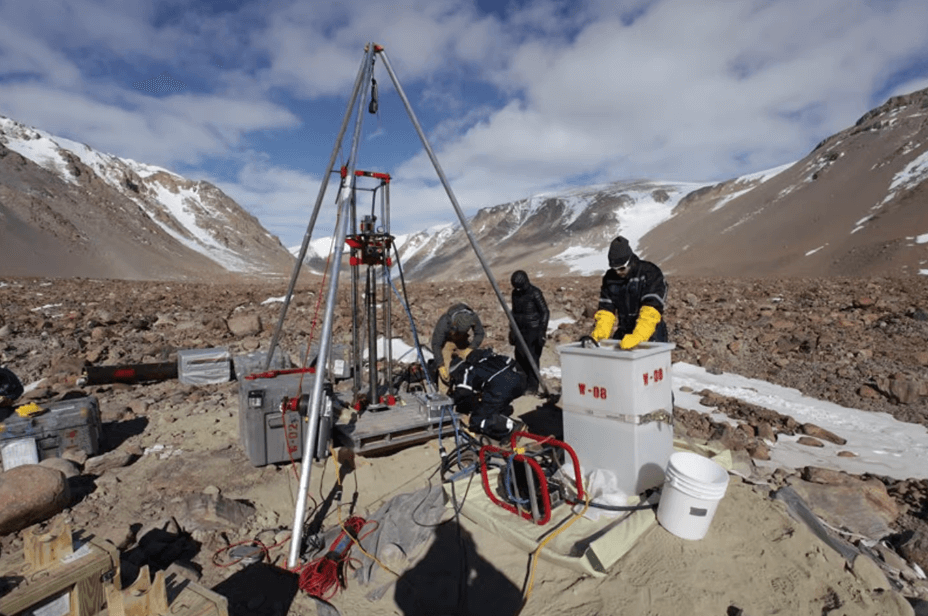 Researchers have recovered an ice core from the Ong Valley in Antarctica. Photo: Jaakko Putkonen
The sample was taken from the Ong Valley in Antarctica, ancientthe ice was relatively close to the surface, protected by a layer of rock. In the summers of 2017 and 2018 in the Southern Hemisphere, the team drilled a 9.5 m long ice core and has since analyzed the age of the material at different depths.
Researchers studied isotope accumulationberyllium, neon and aluminum throughout the core. They appear as a result of the action of high-energy cosmic rays on rocky material. Their concentration tells us when the layer was last exposed on the surface.
 A section of the Antarctic ice core that may be the oldest in the world.
Photo: Jaakko Putkonen
Based on this, a team of expertscalculated that the core consists of two large ice masses stacked on top of each other, which were formed as a result of two separate glaciations. The age of the upper part is estimated at about 3 million years, and the lower part is estimated at 4.3 to 5.1 million years. This is almost twice as old as the previous record holder—2.7 million years.
Read more:
On the pyramid in China found a portrait of the "king of ancestors". He ruled over 4,000 years ago
The length of the earth day is increasing. Scientists don't know why
Engineers have created a "perpetual motion machine" for portable atomic clocks
Cover photo: flickr