Researchers from the National Astronomical Observatory of the Chinese Academy of Sciences reported a rare
Short Event Duration - Primarythe burst lasts only a few milliseconds to tens of seconds, making real-time observations difficult. Optical observatories, as a rule, simply do not have time to aim at the desired area and observe only the afterglow.
The researchers used an array of groundwide-angle cameras (GWAC), located at the Xinglong Observatory, to study the gamma-ray burst GRB 201223A. This telescope can cover an ultra-large area of the sky with a time resolution of 15 seconds, the scientists explain. It can quickly focus on the desired area when receiving the first data from the gamma ray sensors.
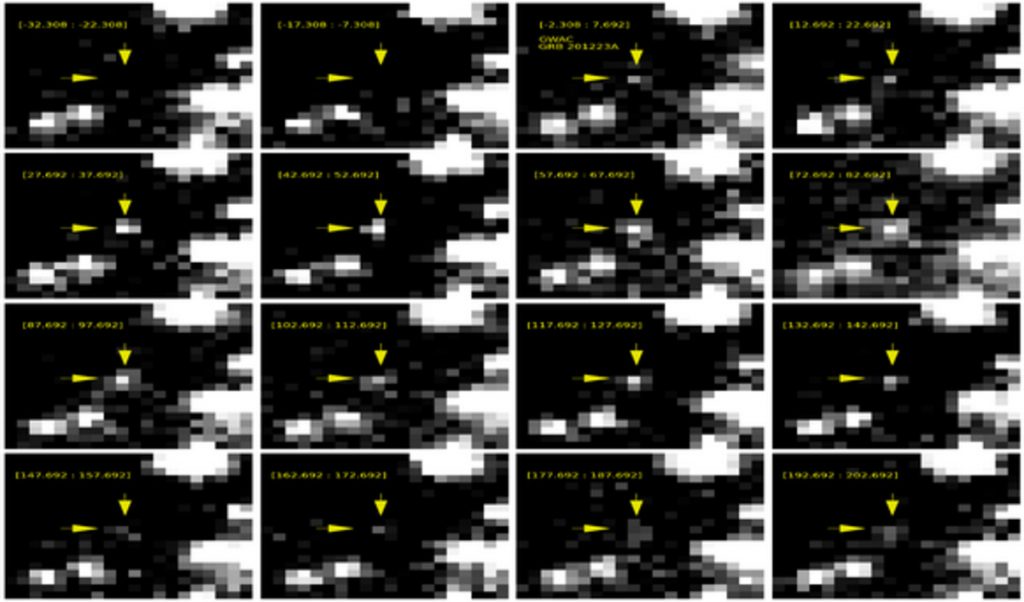 Data from optical observation of the gamma-ray burst with a time resolution of 15 s between images. Image: NAOC
Using a telescope, researchersobserved GRB 201223A before, during and after a powerful burst. A series of images shows an early phase coinciding with gamma-ray bursts and exceeding the extrapolation of its luminosity, as well as a transition to afterglow, expressed as a jump in brightness. A clearly detected transition makes it possible to differentiate the physical processes that contribute to early optical emission and to diagnose the composition of the jet, the scientists note.
Researchers believe that the useThe GWAC observatory, together with the SVOM satellite, which should be launched before the end of the year and is designed to detect sources of gamma-ray bursts, will help to find and describe more such events, to better understand the physics of collapsing stars.
Gamma-ray bursts are the result of an explosionsupernova during the collapse of massive stars (long gamma-ray burst) or the merger of binary neutron stars or a black hole and a neutron star (short gamma-ray burst). This is one of the brightest events in the universe, during which a huge amount of energy is emitted within a few seconds. It includes the instantaneous radiation caused by the shock wave in the jet and the afterglow that occurs when interacting with the environment.
Read more:
Bears separated in childhood reunited: the zoo told how it all went
A photo appeared inside the second deepest underwater sinkhole in the world
Light in the early universe: a new theory changes the way it was
On the cover: artistic illustration of a gamma-ray burst. Image: ESA/Hubble, M. Kornmesser