The body of an unidentified rocket collided with the Moon on March 4, 2022 near the Hertzsprung crater. In new photos
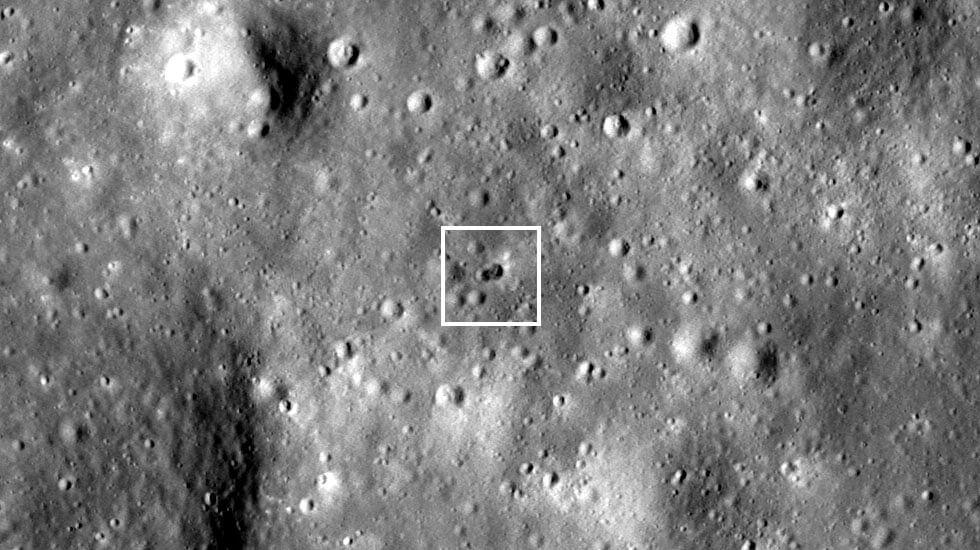 Double crater. Image: NASA, Goddard, Arizona State University
As the researchers note, a similar trace fromexplosion is very unusual. All previous collisions of spacecraft with the Moon left a single funnel. For example, the four Apollo SIV-B craters were somewhat irregular (Apollo 13, 14, 15, 17) and were significantly larger (more than 35 meters) than each of the twin craters.
"The double crater was unexpected and may indicate a large mass at each end of the rocket body," says Mark Robinson, a researcher at Arizona State University.
Researchers explain that usuallyspent rocket mass is concentrated at the end of the engine. The rest of the rocket stage consists mostly of an empty fuel tank. The dual nature of the explosive funnel can help identify the missile.
 Traces from previous collisions. Source: NASA, GSFC, Arizona State University
The origin of the unknown object is still up to nowthe end is unclear. Researchers who discovered the rocket body approaching the Moon initially assumed it was an old stage of the SpaceX Falcon 9 rocket that launched the Deep Space Climate Observatory satellites in 2015.
Further analysis rejected this version:the orbit in which the unknown object moved did not correspond to the orbit of the Falcon 9. As the most likely, the researchers name the second stage of the Chinese Chang'e 5-T1 rocket, launched in 2014.
Pictures before and after the collision. Source: NASA, Goddard, Arizona State University
Read more:
The space probe flew 200 km from Mercury. Look what he saw
The satellite of Jupiter was looked at in a new light: what scientists saw there
Scientists uncover how vitamins affect the incidence of cancer