In his article published inProceedings of the National Academy of Sciences, scientists studied the birth rate in the 22 most
In the early days of the pandemic, experts assumed thatthe world is waiting for a baby boom, as people are forced to stay at home and not go to work. In self-isolation, there are not many options for what to do, experts believed. However, historians have disagreed with this hypothesis. They recalled that during the 1918 flu pandemic, some countries experienced a fertility crisis - in the UK, India, Indonesia, Japan, New Zealand, Norway, Sri Lanka and Taiwan. People who live in uncertain times tend to postpone having babies until things get back to normal. So, the end of World War II led to the baby boom. The new work of scientists has confirmed the correctness of historians: at least in rich countries.
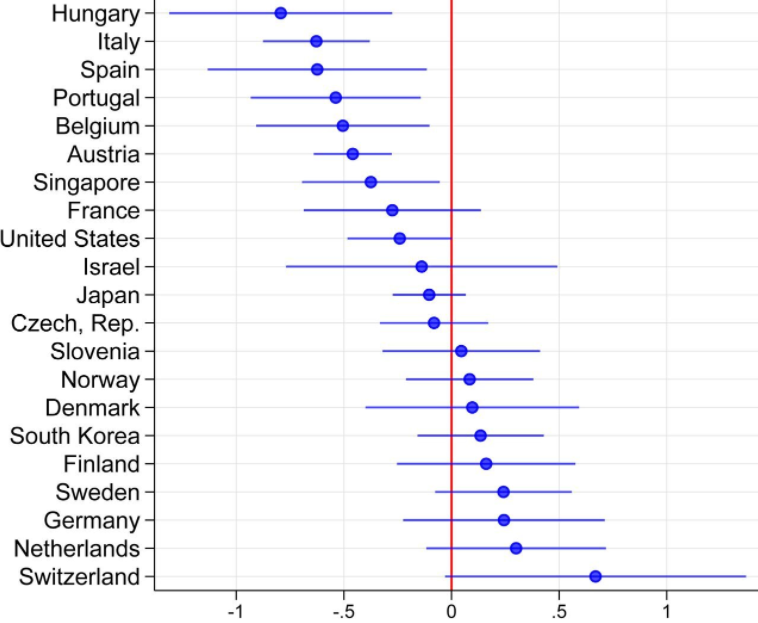 For illustrative purposes, Iceland (β = −0.61β = −0.61) was excluded due to the large confidence intervals (−2.23, 1.01). Photo :: DOI: 10.1073 / pnas.2105709118.
The work involved examining birth records from 22the richest countries in the world, and then comparing them from 2016 to the beginning of this year. At the same time, scientists have not forgotten about the existing known seasonal fluctuations in fertility.
The researchers found that, inOverall, fertility rates have fallen during the pandemic, with some countries reaching crisis levels. For example, in Italy the difference was 9.1%. The scientists also noted that the decline began about nine months after the start of the pandemic. They suggested that people responded to the unstable situation in the world and refused to have children.
At the same time, American scientists found that forthe last year and a half in some northern countries of Europe, the birth rate has even increased. According to the researchers, the reason for this may be in the relatively small scale of the pandemic in these states, as well as in the presence of a developed system of social support on their territory.
As of March 2021, in Niger -highest average birth rate in the world. In second place is Somalia, in third is Congo. Also in the top ten are Mali, Chad, Angola, Burundi, Nigeria, Gambia.
Researchers say it's too earlytalk about whether the decline will be compensated by a future mini-boom when the situation with coronavirus stabilizes. However, no one knows when this will happen.
To read Further
New electric car drives 800 km without recharging: this is Tesla's main competitor
Scientists have been unable to catch Rambo's fox for three years. It prevents rare animals from being released into the forest.
A spaceship several kilometers away: everything that is known about China's new project
Hungary
Italy
Spain
Portugal
Belgium
Austria
Singapore
France
United States
Israel
Japan
Czech
Slovenia
Norway
Denmark
South Korea
Finland
Sweden
Germany
Netherlands
Switzerland