Although Parker Solar Probe's focus is on the Sun, Venus plays a critical role in the mission. Space
But - along with orbital dynamics - these passagesmay also provide some unique and even unexpected views of the inner solar system. During the third mission, the onboard wide-angle thermal imager for the Parker Solar Probe, or WISPR, captured an unexpected image of the night side of the planet from a distance of 12,380 km.
WISPR is designed for imagingthe solar corona and the inner heliosphere in visible light, as well as the solar wind and its structures as they approach and fly past the spacecraft. On Venus, the camera detected a bright rim along the edge of the planet, which may be a night glow. This is light emitted by oxygen atoms high in the atmosphere, which recombine into molecules on the night side of the planet. The prominent dark feature in the center of the image is Aphrodite Terra, the largest mountainous region on the surface of Venus. The element appears dark due to its lower temperature - the region is approximately 30°C lower than the surrounding environment.
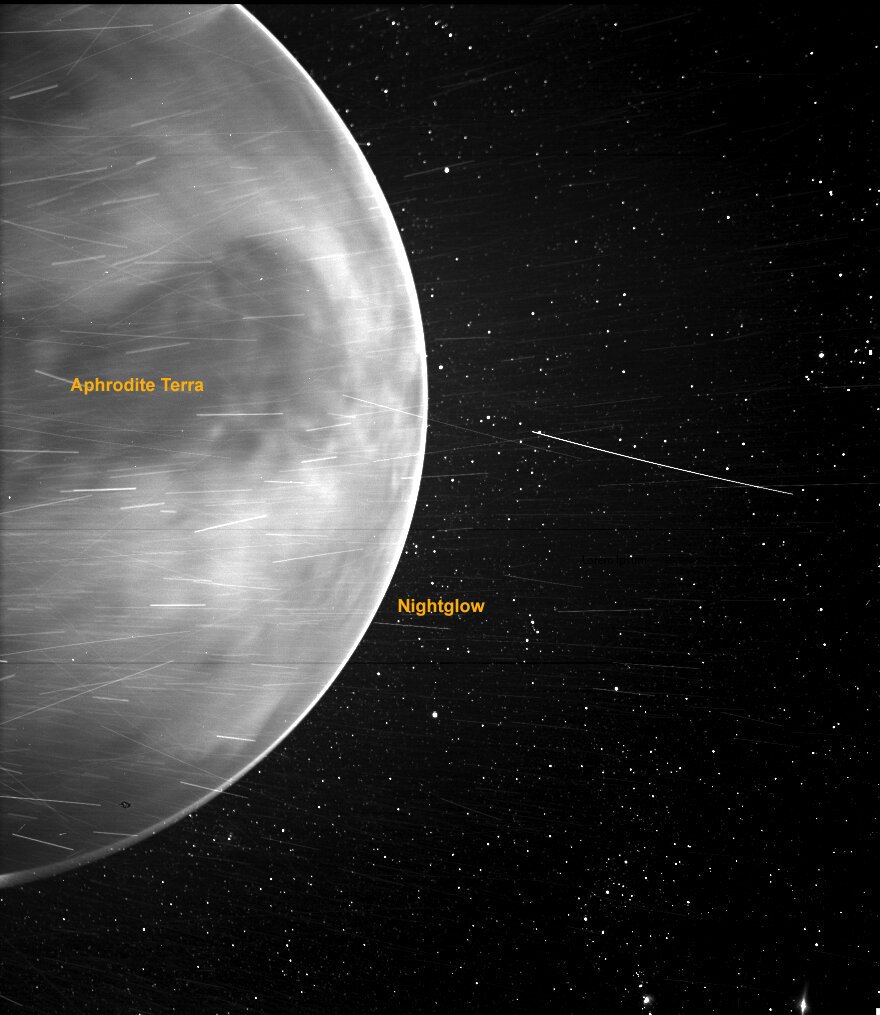 NASA's Parker Solar Probe smogview Venus up close as it flew over the planet in July 2020. This image highlights some of the features that scientists have noticed. The dark spot appearing at the bottom of Venus is a WISPR artifact. Credit: NASA / Johns Hopkins APL / Naval Research Laboratory / Guillermo Stenborg and Brendan Gallagher.
This aspect of the image took the team by surprise.said Angelos Vourlidas, a WISPR project scientist at the Johns Hopkins Applied Physics Laboratory (APL) in Laurel, Maryland, who coordinated the WISPR imaging campaign with Japan's Akatsuki mission orbiting Venus. “WISPR has been adapted and tested for visible light observations. We expected to see clouds, but the camera looked directly at the surface."
“WISPR effectively detected thermal radiationsurface of Venus,” added Brian Wood, an astrophysicist and a member of the WISPR team at the US Naval Research Laboratory in Washington, DC. “This is very similar to the near-infrared images taken by the Akatsuki spacecraft.”
Read also
Physicists have created an analogue of a black hole and confirmed Hawking's theory. Where it leads?
Abortion and science: what will happen to the children who will give birth
Scientists have discovered the speed limit in the quantum world