Researchers from Tohoku University and the Australian National University found that
In RF motors with magnetic nozzlethe latter directs and accelerates the plasma, allowing spacecraft to generate thrust. Electric propulsion technology shows great potential to usher in a new era of space travel. However, further development was hindered by the so-called “plasma separation” problem, the scientists explain.
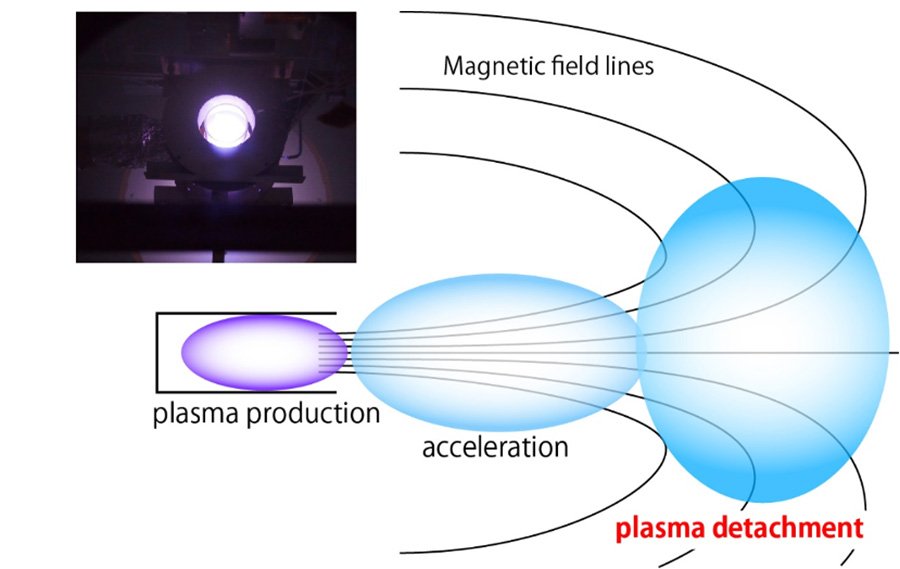 An illustration of the operation of a plasma engine with a magnetic nozzle. Image: Kazunori Takahashi, Tohoku University
Since the magnetic field lines are alwaysform closed loops, those that are inside the magnetic nozzles inevitably return to the engine design. For this reason, the plasma flow must be separated from the magnetic nozzle. Ions with a large radius are easily detached from the magnetic nozzle. But electrons, with their small mass and small radius, are tied to the lines of force, creating an electric field that pulls the ions back and reduces the net thrust to zero.
In their work, physicists analyzed detaileddata of plasma density signals and electric field fluctuations. They found that spontaneously excited waves caused the transport of magnetized electrons inward in a transverse direction to the main axis of the magnetic field. This movement is useful for plasma separation, since it reduces the divergence of the expanding plasma beam.
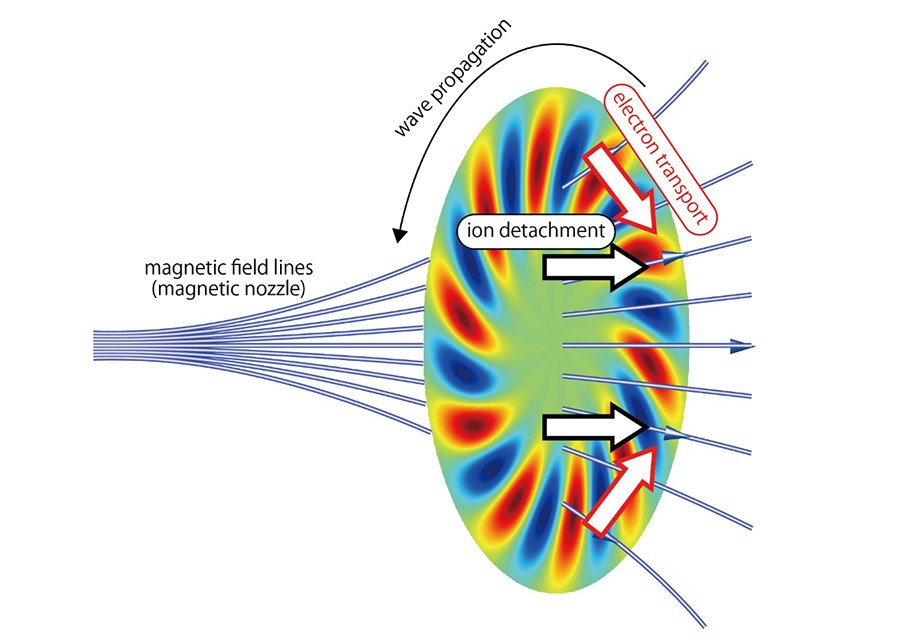 Schematic illustration of the movement of electrons in a detached plasma. Image: Kazunori Takahashi, Tohoku University
Plasma instability, transport featuresplasma and losses due to waves and turbulence have been a major problem for confining plasma in fusion reactors, but in this case they proved to be useful.
Our discovery is a rare case whenPlasma instability does indeed have a beneficial effect on engineering. Our results provide a new insight into the role of instability in plasma and will help in the development of RF plasma thrusters with a magnetic nozzle.
Kazunori Takahashi, study co-author at Tohoku University
Read more:
Does science exist in extreme conditions? We answer in numbers
The Yellowstone supervolcano turned out to be many times more dangerous than scientists thought
The egg was dropped from space: look what happened to it