Researchers from Northwestern University have discovered for the first time a rare mineral, azovskite, in the teeth of a chiton.
This mineral has only been observed in geologicalsamples in very tiny quantities and never before in a biological context. It has a high water content which makes it strong at a low density. This is what makes the teeth of the tunic hard, but light.
Derk Joster, senior author of the study
To study a chiton tooth, scientists usedMössbauer spectroscopy. This is a method of nuclear gamma resonance, which is based on the Mössbauer effect, which consists in the resonant absorption without recoil by the atomic nucleus of monochromatic gamma radiation emitted by a radioactive source. The nuclear gamma resonance method is used in physical materials science, geology, chemistry and biology.
He helped scientists discover azovskite dispersed in a long, hollow structure that connects the head of the tooth to the flexible sheath of the radula.
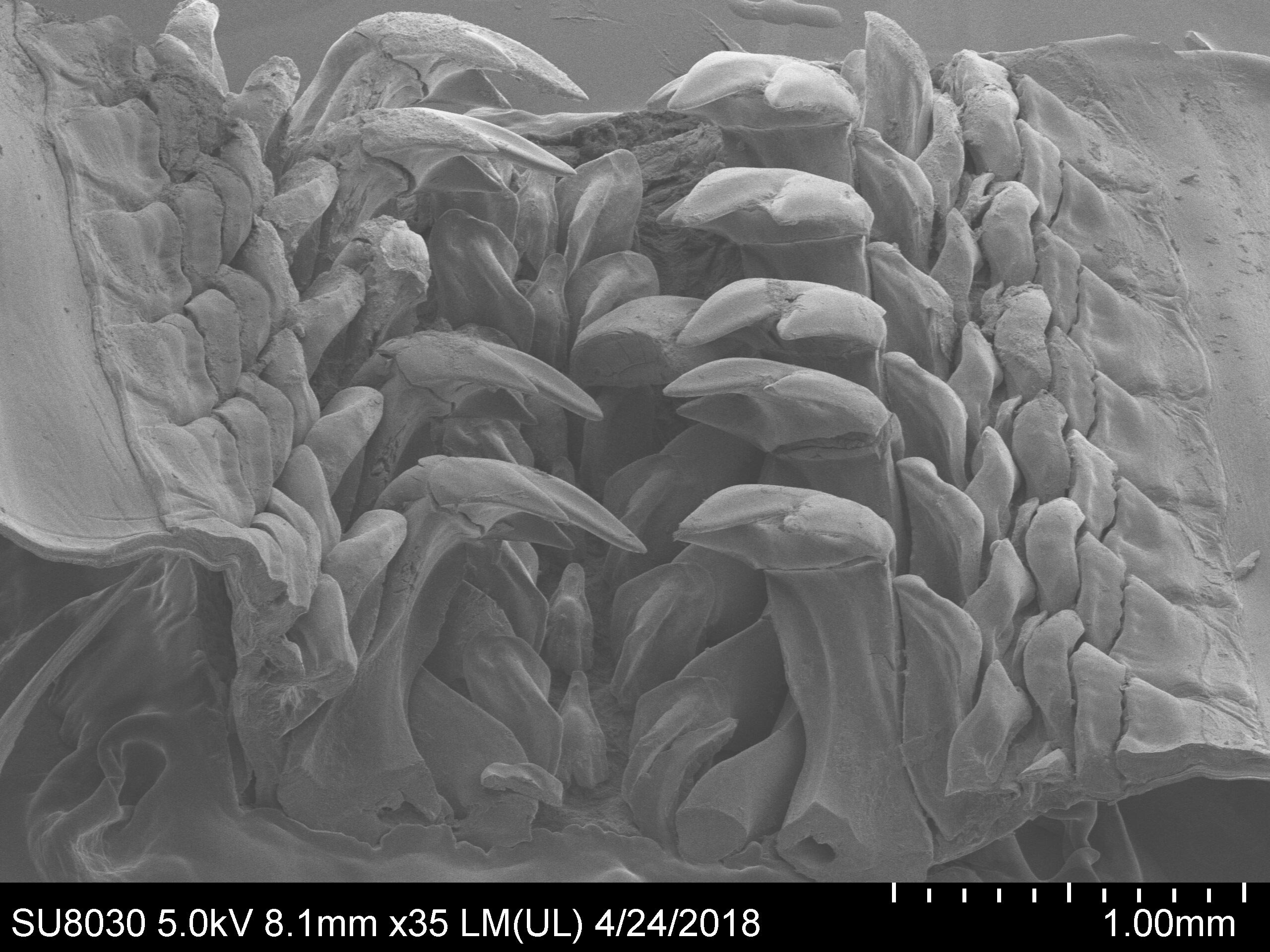 electron microscopic image of chiton teeth. Credit: Northwestern University.
Chitons, or shell mollusks, have an oval body, which is covered from the back with a shell of eight movably articulated calcareous plates; in case of danger, they curl up into a ball.
 Part of the Crytochiton stelleri radula showing hard, strong teeth. Credit: Northwestern University.
Azovskite (in English-language sourcescalled "santabarbaraite") is a mineral, the main iron phosphate. It is formed due to the oxidation of vivianite. It was found in deposits of brown iron ore on the Taman Peninsula, hence the Russian name of the mineral. The foreign name for azovskite is santabarbaraite, which comes from the area of Santa Barbara in Tuscany, Italy.
Read more
A combat drone for the first time without a human order tracked down the enemy and attacked
New exoskeleton reduces human stress while walking
A mathematical model of the brain will allow AI to think like a human