During excavations at the Plaza of the Columns complex in Teotihuacan, Mexico, archaeologists discovered complete remains
Spider monkey skeleton was buriedalong with a golden eagle and several rattlesnakes, surrounded by unique artifacts such as beautiful jade figurines made in the Motagua Valley in what is now Guatemala. In addition to these, numerous shell and snail artifacts were found, as well as lavish obsidian objects such as blades and projectile points.
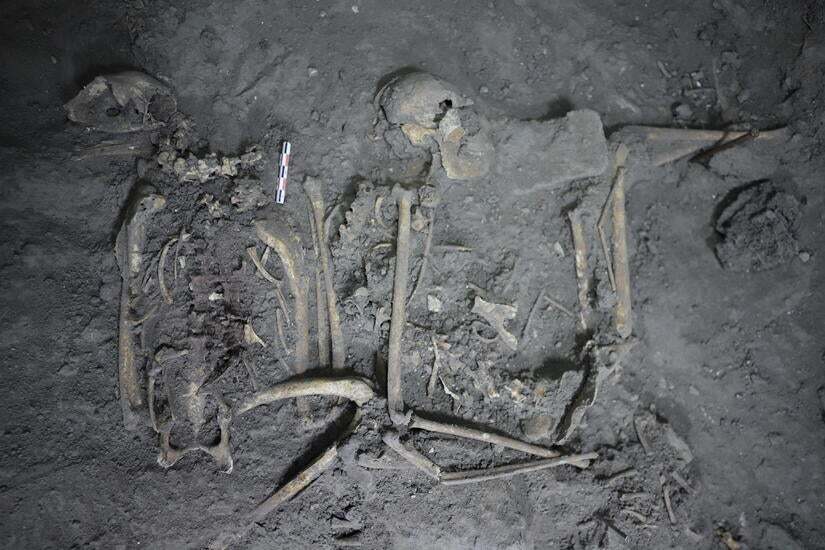 The remains of a spider monkey at the excavations. Image: Nawa Sugiyama, UC Riverside
Researchers have used various methodsto study the life of a spider monkey. At the time of death, the female was between 5 and 8 years old. In this case, the results of the examination of two teeth, the upper and lower fangs, show that the spider monkey ate, among other things, corn and chili peppers. Bone chemistry, which provides insight into diet and environmental information, indicates that they have been in captivity for at least two years. Before arriving in Teotihuacan, the monkey lived in a humid environment, feeding mainly on plants and roots.
In addition to studying ancient rituals and uncoveringfragments of history, the discovery helps to reconstruct larger historical processes and understand how these powerful, advanced societies coped with social and political factors. For example, the discovery disproves the popular hypothesis that the Mayan presence in Teotihuacan was limited to small migrant communities.
It helps us to understand the principles of diplomacy,understand how urbanism developed... and how it failed. Teotihuacan has been a successful system for over 500 years, understanding past sustainability, its strengths and weaknesses is relevant in today's society. There are many similarities between the past and the present. Useful lessons can be learned from past societies; they give us clues as we go along.
Nava Sugiyama, anthropologist-archaeologist at the University of California at Riverside, co-author of the study
Read more:
A magnetic storm is about to hit Earth
Created a navigation system that is more accurate than GPS
An ancient amulet rewrote the history of Europe's most mysterious language
On the cover: the pyramid at Teotihuacan