A team of researchers from the Massachusetts Institute of Technology, Harvard University, and
During the hot mixing process, lime chipsform a fragile nanoparticle architecture, creating an easily breakable and reactive source of calcium that provides the concrete's ability to recover. Tiny cracks that form in concrete pass through lime chips with a large surface area. When reacted with water, this material forms a solution saturated with calcium, which turns into calcium carbonate and quickly fills the crack.
In their work, the engineers paid attention to the fact thatthat ancient concrete samples contain small, characteristic bright white millimeter-scale mineral elements. These formations are formed from lime, one of the key components of the ancient concrete mix. Previously, scientists believed that these formations are the result of poor-quality mixing of the mixture.
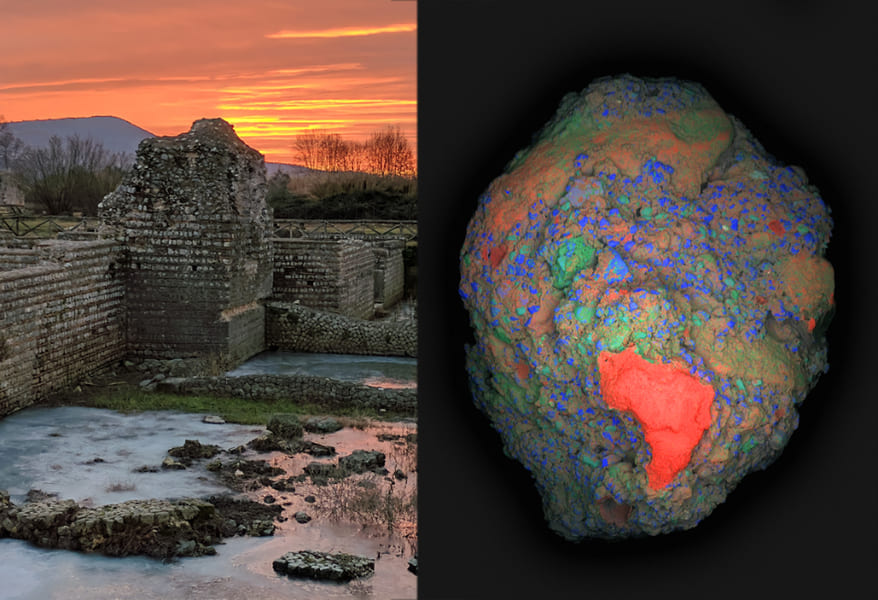 Enlarged and colored imagea two-centimeter piece of concrete (right) obtained at the excavation site at Privernumu in Italy (left). Red is calcium, blue is silicon, and green is aluminum. Image: MIT
A new study suggests that thesetiny pieces of lime provide concrete with the ability to self-heal. The scientists studied lime clasts using high-resolution imaging and chemical mapping techniques. The study showed that the white inclusions are indeed made up of various forms of calcium carbonate that were formed at extreme temperatures.
It was previously thought that when lime was added toRoman concrete, it was first mixed with water to form a paste-like material in a process known as slaking. The presence of trace materials that formed at high temperatures indicates the use of quicklime instead of or in addition to slaked lime in the mixture.
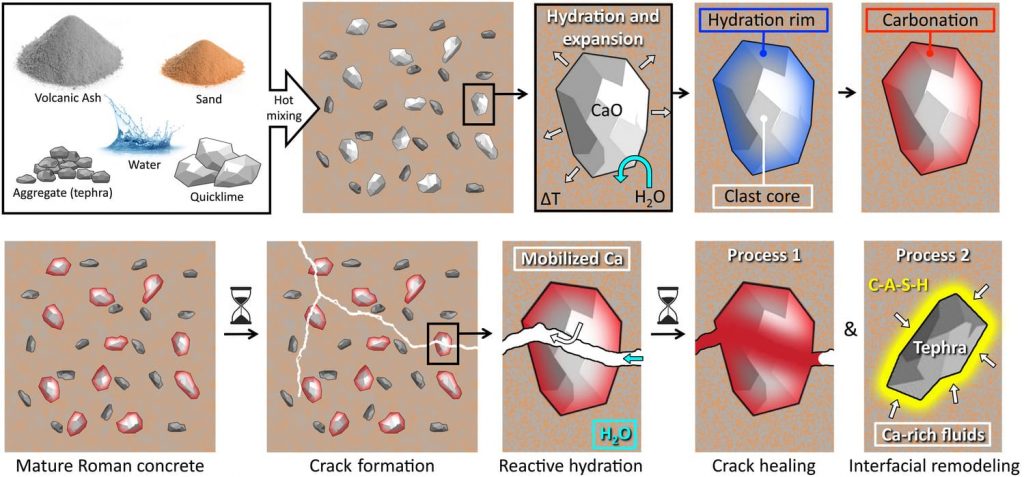 Formation of active capsules during hot mixing (top) and their activation during crack formation (bottom). Image: Linda M. Seymour et al., Science Advansec
This is possible in the hot mixing process,note the authors of the work. In this process, all concrete is heated to high temperatures. As a result of chemical reactions, chemicals are formed associated with the high temperature of the connection, which otherwise would not be formed.
Experiments with materials prepared according toancient technology, confirmed the hypothesis that concrete made using hot mix demonstrated the ability to recover and better strength. This approach can be used for modern production, the authors of the work believe.
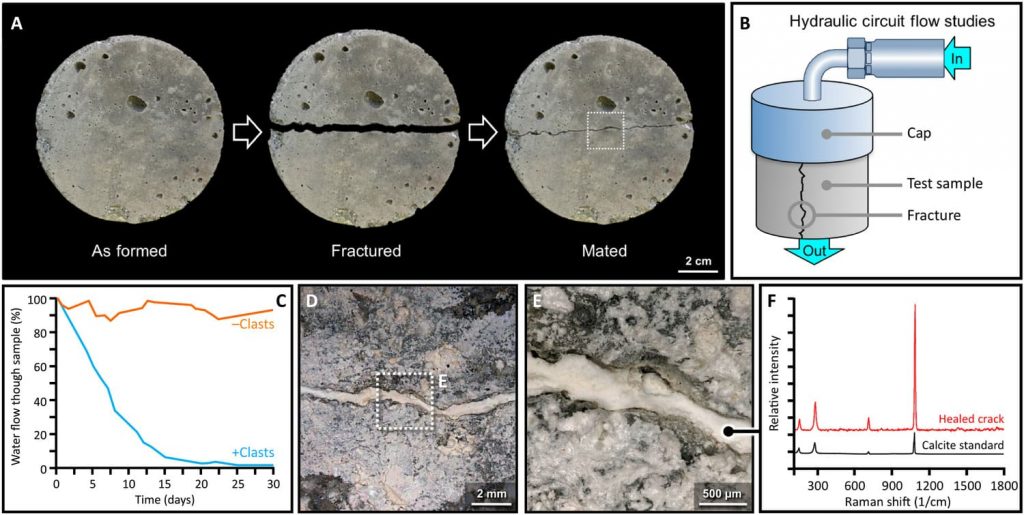 An experiment to restore concrete created using ancient technology. Image: Linda M. Seymour et al., Science Advansec
Read more:
See the most powerful volcanic eruption on Jupiter's moon
A new kind of quantum entanglement has been discovered: photons "remember" the structure of atoms
The metallicity of the Sun turned out to be higher than it was thought: what astrophysicists learned