Researchers from Washington University in St. Louis have optimized one of the classic
ICA is based on the principle of thin-layerchromatography and includes a reaction between an antigen and its corresponding antibody in biological materials. As a rule, during such tests, the test strip is placed in a sample of biological fluid. Plasmonic fluorophores are composed of metallic nanoparticles that act as antennas to attract light and amplify fluorescent emission. This is similar to amplifying the sound on conventional test strips, the authors say.
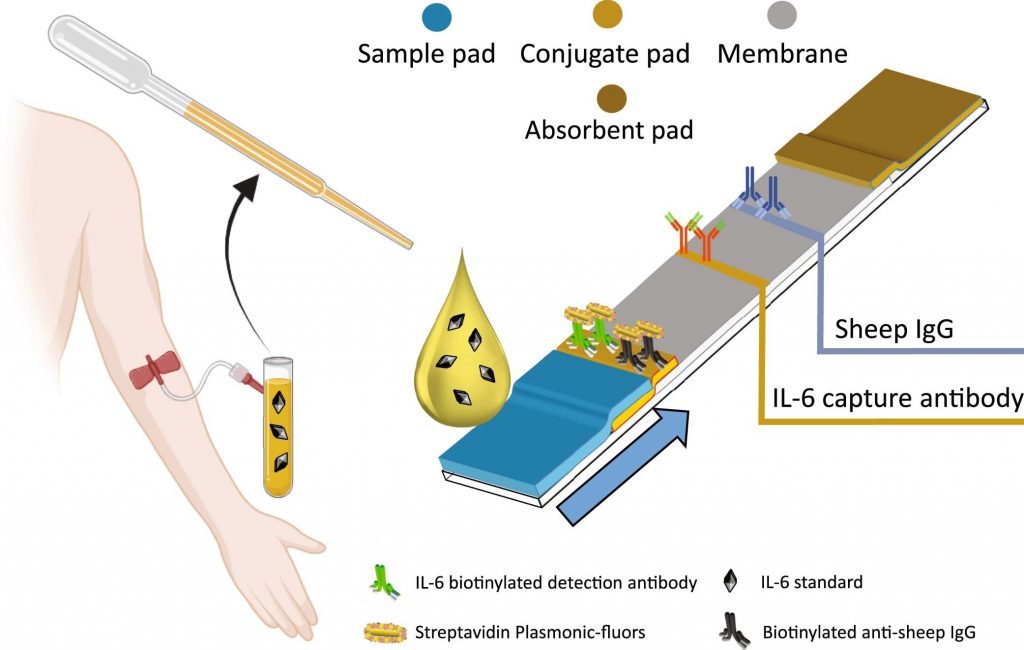 An example of a strip with plasmons to search for interleukin (IL-6) molecules in the blood of people infected with a coronavirus infection. Image: Rohit Gupta et al., Nature Biomedical Engineering
In a study published in the journal NatureBiomedical Engineering, the authors demonstrate that the developed plasma ICA technology is 1,000 times more sensitive than conventional test strips. What's more, when analyzing a test with a fluorescent scanner, these systems provide results in as little as 20 minutes with comparable accuracy to the most common laboratory antigen and antibody testing systems.
It's like turning up the volume on standardtest strips that change color. Instead of producing a faint line indicating only a positive or negative result, new plasma ICAs produce clearer results with fewer particles. This allows you to go from a simple “yes” or “no” to a precise answer of «how many particles?» using an inexpensive portable scanner.
Jeremy Morrissey, study co-author
The researchers believe that ready-made test systems will be put into mass production within one or two years.
Read more:
A powerful flare erupted on the Sun: it has already affected the Earth
Medieval fortress accidentally discovered in the forest: the find surprised scientists
An unusual layer has been found in the Earth's mantle. Turns out he's sticky.
On the cover: a modified test system. Image: Singamaneni lab, Washington University in St. Louis