According to the SpaceWeather.com portal, at least eight solar flares have occurred on the Sun over the past 24 hours. One
Most of the outbreaks recorded inlast day, are M-class flares - this is the second in descending type after the X-class. The most powerful of them, the M6 flare, caused a short-term blackout of radio communications over the Atlantic Ocean on December 14 at 17:42 Moscow time.
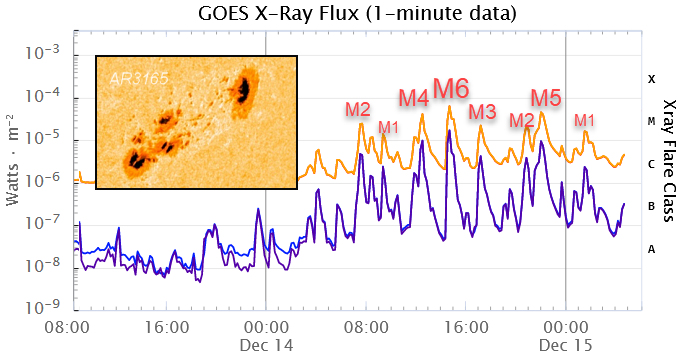 Sunspot activity AR3165 (Greenwich Mean Time, Moscow time differs by 3 hours upwards). Image: SpaceWeather.com
Some flares were accompanied by a coronalmass ejection, the researchers note, but this time all the streams of charged particles are directed not in the direction of the Earth. All flares originated from sunspot AR3165, scientists say. This area remains active and may generate new events in the coming days.
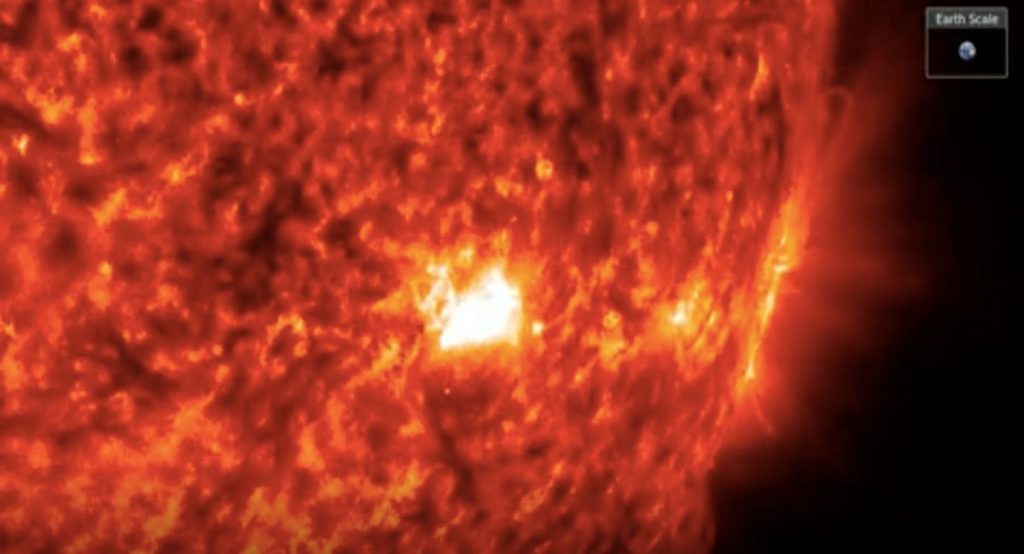 Solar flare from AR3165 on December 14th. Image: NASA/SDO
AR3165 - active region or sunspot,which recently appeared on the visible disk of the Sun. Sunspots are darker, cooler areas in the lowest layer of the solar atmosphere where the solar magnetic field lines are curved and strained. Flares occur when magnetic lines explode, releasing energy.
Solar flares are sometimes accompaniedcoronal mass ejections, which are clouds of magnetized plasma that travel much slower than flares and reach Earth in about three days.
Read more:
Does science exist in extreme conditions? We answer in numbers
Scientists have found out who benefited from the death of dinosaurs
Look at the photo of the Earth from space: it was made by the first private module
Cover image: Alan Friedman, NASA Goddard Space Flight Center