NASA's Solar Dynamics Observatory released a photo of the smiling Sun. Despite the joyful
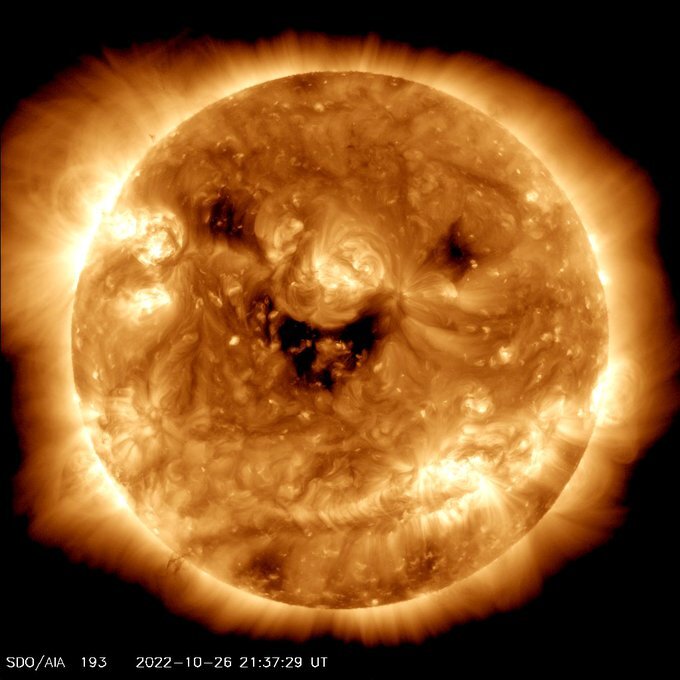 Coronal holes on the Sun. Image: Solar Dynamics Observatory
Sunspots are areas where you enter the photosphere.powerful magnetic fields. They suppress the convective motions of the plasma and heat transfer, which leads to cooling of these regions to about 2000 K. The three dark spots that form the "face" of the Sun in the new image are such coronal "holes" - areas of open structures of magnetic field lines, which allow the solar wind to escape easily.
Streams of solar material can escape fromcoronal holes with speeds from 400 to 800 km/s (from 1.5 to 3 million km/h). The Earth is located on the line of movement of streams of charged particles from all three coronal holes. According to the American meteorological service, this will lead to the formation of a class G1 solar storm as early as October 29.
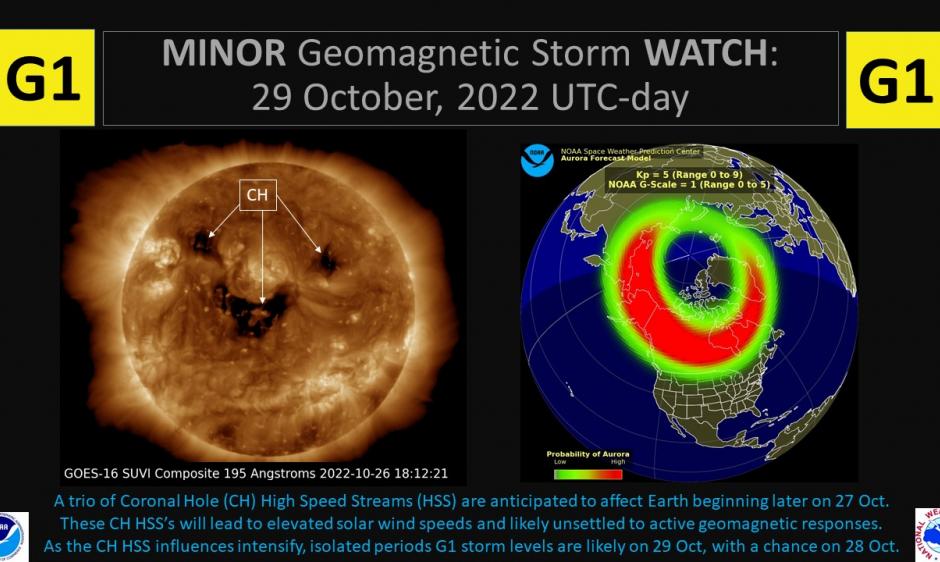 Solar flare and magnetic storm, showing areas most likely to have auroras on the right. Image: NOAA
Geomagnetic storms of this type do not bringsignificant problems. As a rule, the main consequence of such an impact is minor fluctuations in the power grid. In addition, some weather-sensitive people may feel worse, and at the poles of the Earth, auroras will begin.
Read more:
NASA satellite detects massive gas release near Russia
Scientists have seen what is on the territory of the Mayan capital. The find surprised them.
Britain's oldest human DNA reveals who migrated to the country BC
Cover image: NSO/NSF/AURA, CC BY 4.0, via Wikimedia Commons