NASA has published a photo of the Sun, supplemented with radiation invisible to the eye. The new image unites
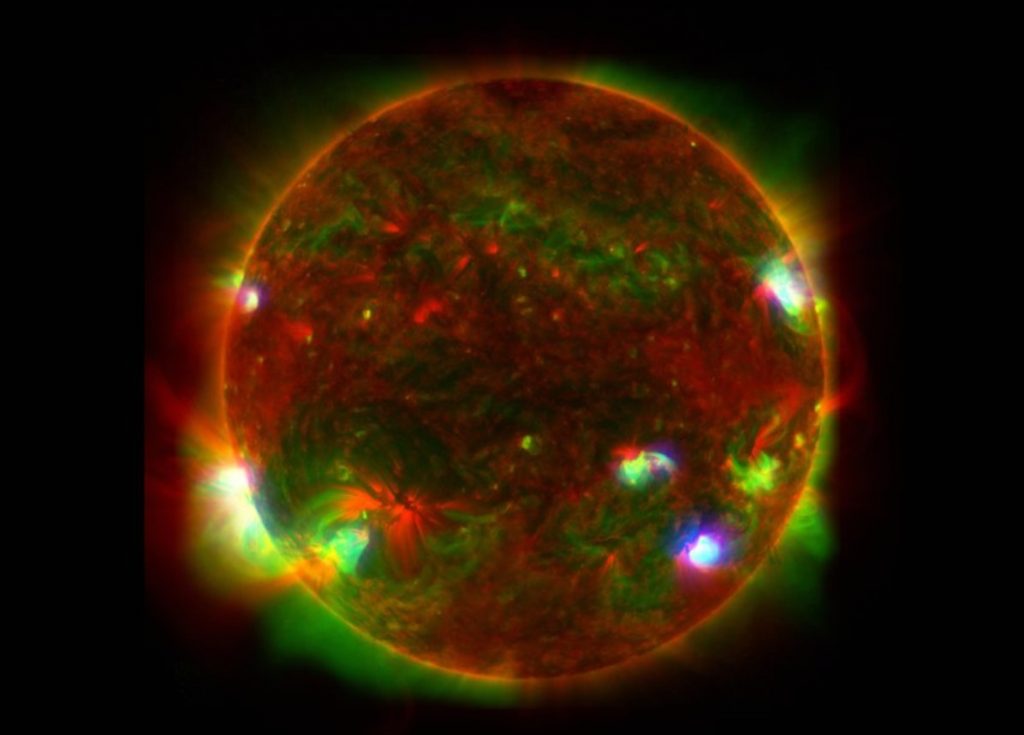 Combined image of the Sun.Blue corresponds to high-energy X-rays, green to low-energy, and red to ultraviolet. Image: NASA/JPL-Caltech/JAXA
high energy x-rays,observed by the NuSTAR observatory appears only in a few places in the Sun's atmosphere. These areas correspond to the hottest regions in the solar corona. Such a high-temperature material is thought to form when a large number of nanoflares occur close together.
Flares are large bursts of heat, light, andparticles seen by a wide range of solar observatories. Nanoflares are much smaller phenomena, but both types produce material that is even hotter than the average coronal temperature. Normal flares don't happen often enough to keep the corona at the high temperatures observed by scientists, but nanoflares happen much more frequently.
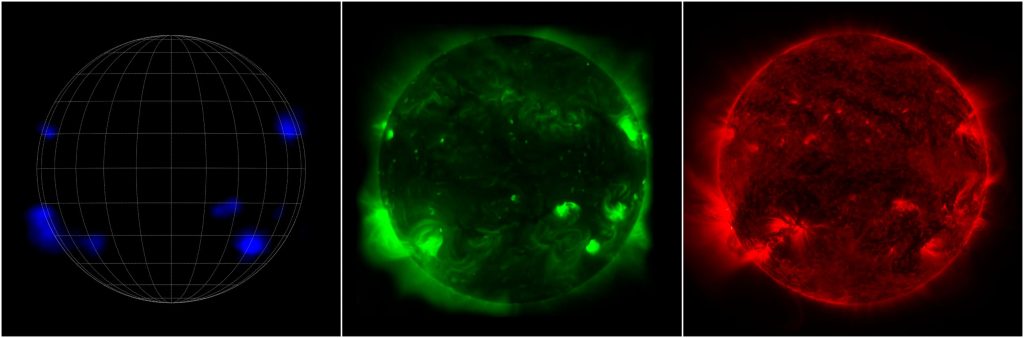 High-energy X-ray radiation atNuSTAR image (left), low-energy X-rays from Japan's Hinode mission (center), and ultraviolet data from NASA's Solar Dynamics Observatory (right). Image: NASA/JPL-Caltech/JAXA
The researchers believe that the NuSTAR observationswill help solve one of the biggest mysteries of the Sun: why its outer atmosphere, the corona, reaches a temperature of more than a million degrees, which is at least 100 times more than at the surface. The sun heats up due to thermonuclear reactions that take place inside the star, while heat spreads from its depths to the outside. Finding enough nanoflares would explain the temperature paradox.
Read more:
Two photos of the Earth with a difference of 50 years were compared at NASA: what scientists found
Mysterious green rays were noticed in the sky over the USA: where did they come from
Scientists transplanted human “brain” into rats and told what happened in the end