Researchers from the University of Paris-Saclay in France have found that in some cases, the film of soapy
To study soap films and bubbles, scientistscreated mixtures consisting of dishwashing liquid, water and glycerin, with varying concentrations of the latter. The resulting bubbles were tested at various temperatures and air humidity. The study showed that in some cases the difference between the soap film and the ambient air was significant, reaching up to 8°C.
Previously, it was found that soap films loseliquid as a result of evaporation to release excess energy (just like people when they sweat to cool off). But physicists believed that the temperature of these films corresponds to the environment, the authors of the work say. Experiments have shown that the temperature first decreases and then increases until a balance is established.
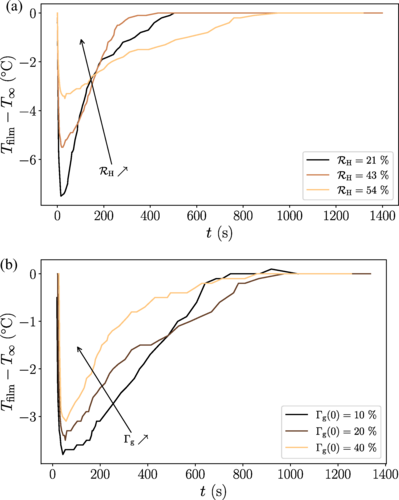 Change in bubble temperature compared toair over time at different concentrations of glycerol (top) and air humidity (bottom). Image: Francois Boulogne et al., Physical Review Letters
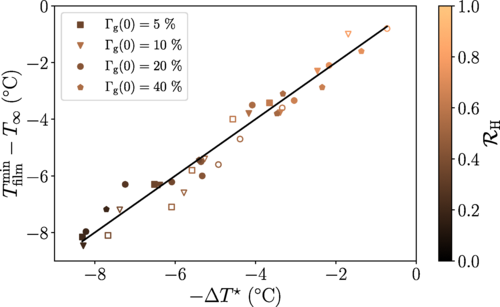 The dependence of the maximum difference between the temperature of the bubbles and air at different concentrations of glycerol and air humidity. Image: Francois Boulogne et al., Physical Review Letters
The magnitude of the cooling effect depends on both the relative humidity and the initial glycerol concentration: decreasing the values of these two parameters leads to an increase in the difference in temperature.
The researchers note that the new effect affects the viscosity and surface tension of soap films. It is important to consider it in industrial processes that use bubbles.
Read more:
The "Christmas Comet" flies to the Earth. Last seen by Neanderthals
The tomb of the “midwife of Jesus” was unearthed: scientists told what they found there
Two genes found in humans that are unlike any known