Researchers from the University of Cambridge and Imperial College London have created devices that mimic
Hydrogen is one of the promising types of fuel,however, it is now mainly produced from fossil hydrocarbons. The researchers note that many works have been devoted to the creation of green hydrogen, including through the splitting of water under the influence of sunlight. But all of them have encountered the fact that light-absorbing materials that can be used in production quickly decompose in water.
One such material is bismuth oxyiodite.Unlike popular perovxites, it is not toxic, but decomposes extremely quickly in water. Researchers have found a way to improve the stability of these artificial sheet devices by sandwiching oxyiodite between two oxide layers. The rugged design of the device has been additionally coated with water-repellent graphite paste to prevent moisture penetration.
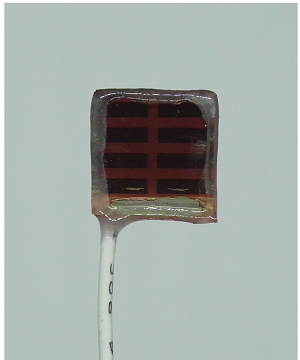 "Sheet" with several pixels. Image: Dr Virgil Andrei, St John's College, University of Cambridge
As a result, the period of stable operation of the device forbased artificial "leaves" of oxyiodite grew from a few minutes to two months. Such a result, as the authors note, turns the new device into a viable system for the industrial production of green hydrogen.
The researchers also found thatthe performance of devices consisting of several areas of light collection (called "pixels") turned out to be higher than that of a large "sheet" of a similar area. This discovery, as the authors believe, can greatly simplify and accelerate the scaling of new systems for the production of fuel.
This is an exciting development!To date, few solar fuel systems have demonstrated stability compatible with real world applications. Through this work, we are taking a step forward towards a zero-waste fuel economy.
Erwin Reisner, professor of chemistry at the University of Cambridge and one of the authors of the study
Read more
Chinese AI predicts the course of hypersonic missiles. The retaliatory strike will be ahead
From a mixture of HPV, cancer and syphilis, "immortal" cells turned out: what is known about them
Astronomers from Japan have found an unknown structure in the galaxy