An international team of scientists, including experts from the University of Adelaide in Australia, has developed a quantum
The study was led by Dr. James K.Quach from the University of Adelaide, Research Fellow in the School of Physical Sciences and the Institute for Photonics and Advanced Sensors from the University of Adelaide.
The theoretical design of a quantum thermometer is based on the same technology used to create quantum computers.
Einstein had previously predicted that the speedThe way you perceive the passage of time depends on the way we move. Relatively speaking, a person who moves very quickly ages slower than someone who stands still. The assumption helped him develop the general theory of relativity. According to it, space and time together act as a fabric that can bend and deform.
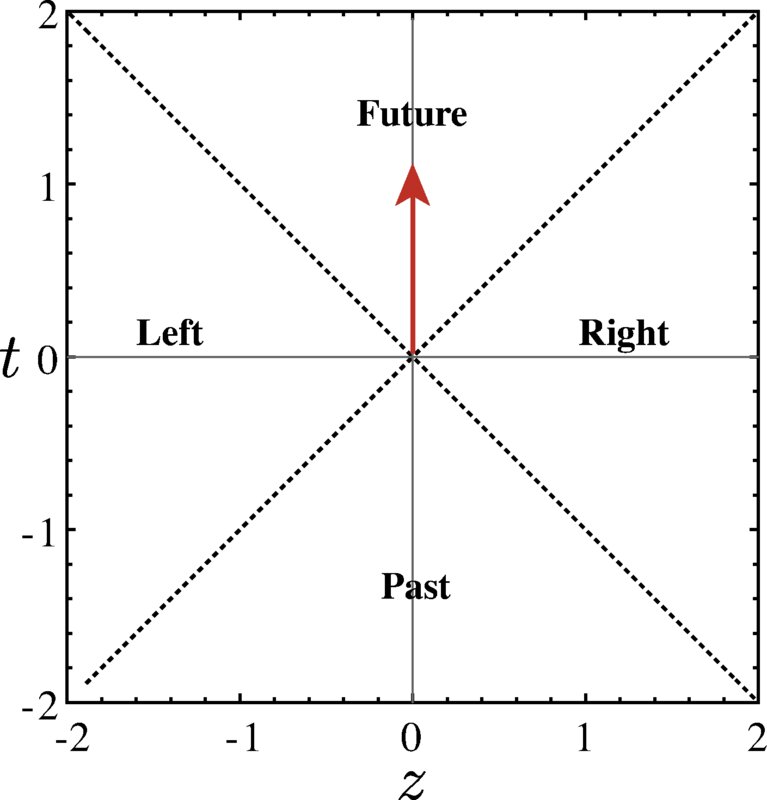 Spacetime diagram divided intofour quadrants: left and right Rindler wedges, and future and past light cones. The vacuum state can be described as an entangled state between Rindler wedges or between light cones. For an observer in one of these quadrants (such as the future), tracking unobserved modes (e.g. in the past) leads to a (time-like) Unruh effect. The arrow represents the spatiotemporal trajectory of the detector. Credits: DOI: 10.1103/PhysRevLett.129.160401
Relationship between temperature and accelerationsimilar to the relationship between time and speed. Different observers moving with different accelerations perceive different, albeit insignificant, temperature differences.
In 1976, Canadian physicist William Unruhcombined Einstein's work with another fundamental theory of modern physics, quantum mechanics, and predicted that the fabric of space-time is very cold. It is noteworthy that it changed depending on how fast the object was moving.
To observe this, you need to move very quickly.At the same time, in order to see a change in temperature by even one degree, you need to move at a speed close to the speed of light. Until now, these extreme speeds have prevented scientists from testing Unruh's theory. Now a quantum thermometer can be built using modern technologies, scientists emphasize.
The team's work has important implications for future research. A quantum thermometer can be used to measure ultra-low temperatures with an accuracy not available with conventional devices.
Read more:
Living organisms have made Mars uninhabitable
The most powerful black hole collision in the universe proved Einstein's theory
The bones in the Midnight Terror Cave were carefully examined and found inexplicable footprints.