Physicists from Pacific Northwest National Laboratory and Polytechnic University
Tungsten is a metal with one of the highestmelting points, but in its pure form it is very brittle, the authors explain. By mixing tungsten with small amounts of other metals such as nickel and iron, an alloy can be obtained that is stronger than the pure metal, while maintaining a high melting point.
To further increase the tensile strengthalloys, the researchers suggest using a special method of hot rolling. With its help, it is possible to create special microstructures inside the alloy that imitate mother-of-pearl - the inner layer of freshwater and marine mollusk shells. It is known that this structure is not only distinguished by beautiful patterns and modulations, but also gives the shells strength.
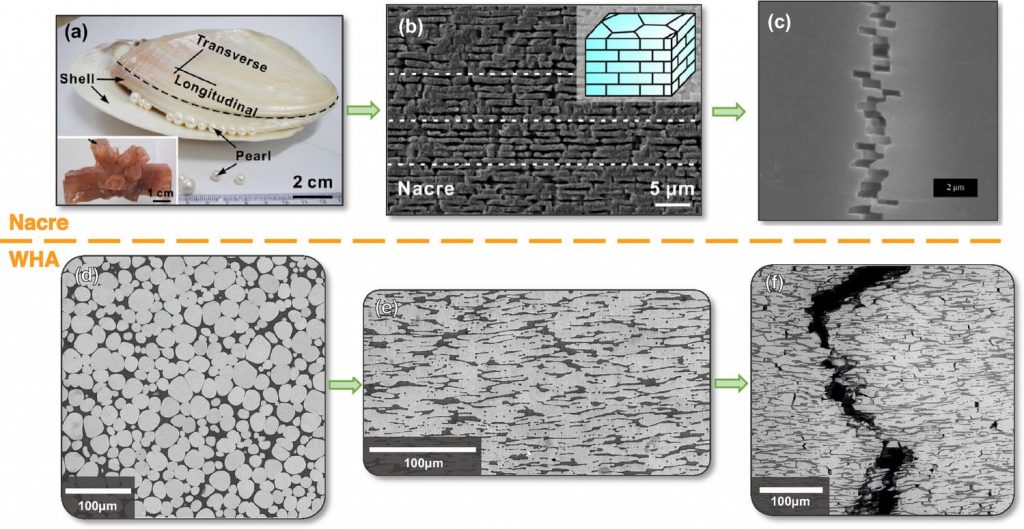 Microstructure of natural mother-of-pearl (top) and rolled mother-of-pearl in tungsten alloys. Image: J. V. Haag IV et al., Scientific Reports
The researchers analyzed the "pearlescent" microstructure of the alloys using scanning transmission electron microscopy to observe the behavior of the atoms.Inside the pearlescent structure, the heavy tungsten alloy consists of two distinct phases: a "solid" phase of nearly pure tungsten and a "ductile" phase containing a mixture of nickel, iron, and tungsten.
Research results show that highThe strength of tungsten heavy alloys is due to the excellent bonding between dissimilar phases, including closely related "hard" and "ductile" phases. In their work, the researchers showed that by controlling the crystal structure, geometry, and chemical composition of the alloy, it is possible to create strong material interfaces in heavy tungsten alloys.
Such changes will improve material design andwill help create alloys strong enough, durable and reliable enough to withstand the enormous temperatures and exposure to electromagnetic radiation inside a fusion reactor. The authors note that the laboratories are already working on creating a prototype reactor vessel made of tungsten alloys.
The proposed solution is not the only one, scientists onaround the world are working on various technologies for a fusion reactor. For example, Hi-Tech previously said that Russian scientists from NRNU MEPhI have developed a special solder that increases the strength of an alloy of tungsten and steel for similar purposes.
Read more:
Earth's core will soon be spinning in a different direction
Watch the hydrogen superyacht 'fly' over the water at 75 knots
The Milky Way is abnormally large for its galactic filament
On the cover: construction of the ITER fusion reactor. Image: ITER Organization