Unlike the skin, the nervous tissue of the brain does not regenerate after damage. However, the new type
Developed by a group of scientists from JapanHokkaido University biocompatible polymer gel consists of equal parts of positively and negatively charged monomers. This combination was found to provide the best adhesion for cells.
Scientists have adjusted the ratio of moleculescross-linking agent in the hydrogel to give it rigidity to the brain tissue. The study authors also created tiny pores in it for “nesting” of cells. The gel was then soaked in growth factor serum to stimulate blood vessel growth. Eventually, it was surgically implanted into damaged areas of the mice's brains.
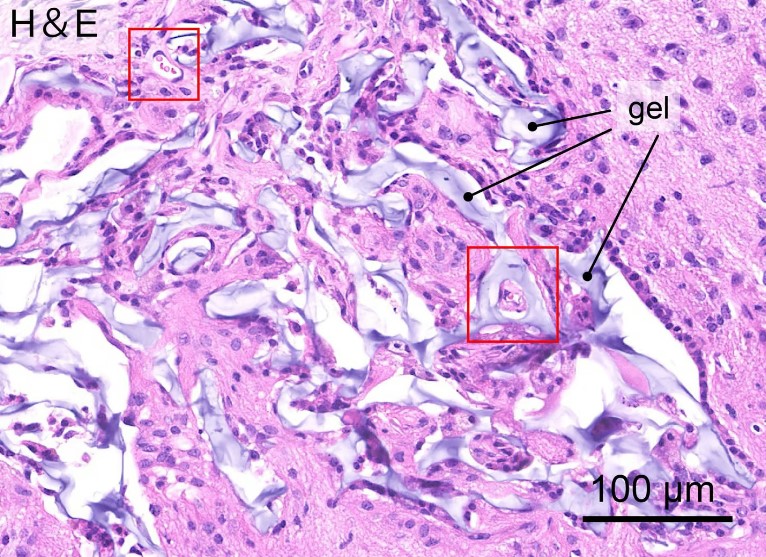 Neural stem cells 64 days after transplantation into the hydrogel—red boxes represent blood vessels. Photo: Satoshi Tanikawa et al., Scientific Reports, February 14, 2023.
Three weeks later, immune cells and cellsneurons from the surrounding brain tissue migrated into the implanted hydrogel, and blood vessels began to grow in it. The researchers then injected neural stem cells into the gel.
After 40 days, the vast majority of these cellssurvived, and some of them differentiated into neurons and astrocytes that support neurons. In addition, the grown neuronal cells migrated from the hydrogel into the surrounding brain tissue. This means that the material has become really well integrated into the brain.
Nerve tissues form the nervous system and are part of the nerve ganglia, spinal cord and brain. They are made up of nerve cells called neurons.
Read more:
Giraffe mating is even stranger than previously thought
Land in China drilled to a record depth
It's not about the Earth: scientists explained why the solar system is the rarest
Cover: Photo of a hydrogel sample, Satoshi Tanikawa et al., Scientific Reports, February 14, 2023.