Ediacaran period (named after the Ediacaran Hills of South Australia, where scientists found fossils
What makes the Ediacaran so special is thatthe first appearance of larger and more complex life forms. In addition, the fossils that scientists found during this period are really very strange. Traces of the Ediacaran biota have been found not only in Australia, but also at Cape Mistaken in Newfoundland (Canada) and in the White Sea in Russia.
What happened during the Ediacaran period?
By studying rocks from this period around the world, geologists have imagined what happened millions of years ago. The ice sheets were retreating, ending the Cryogenic Period (also known as “Snowball Earth”).
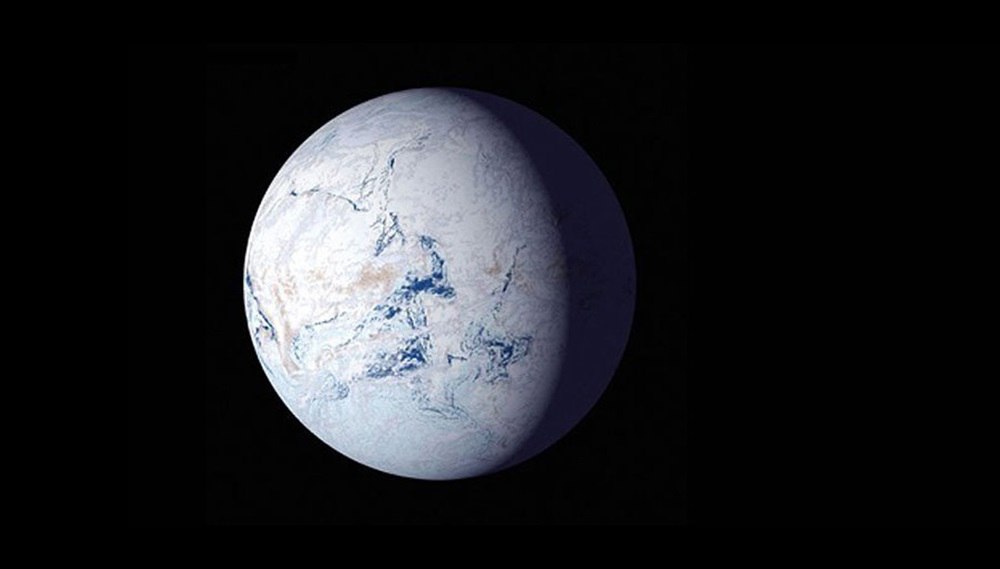 It is believed that before the Ediacaran period, the Earth was almost covered in ice. Source: NASA
Analysis of the rocks of that period shows thatAtmospheric oxygen levels began to rise substantially during the Ediacaran. This may have led to a marked decrease in the content of carbon isotopes in marine sediments of that time. All because of the increased acidification of the oceans.
The period was also incredibly active withtectonic point of view, which led to the final formation of a supercontinent called Pannotia (it was located approximately above the south pole of the Earth). This gigantic land mass remained intact until it began to break apart about 550 million years ago.
Why are Ediacaran fossils so important?
They are very rare and witness one of thethe most important steps in the evolution of life on the planet. Fossils found in the sediments of this period are traces of the first complex multicellular life on Earth.
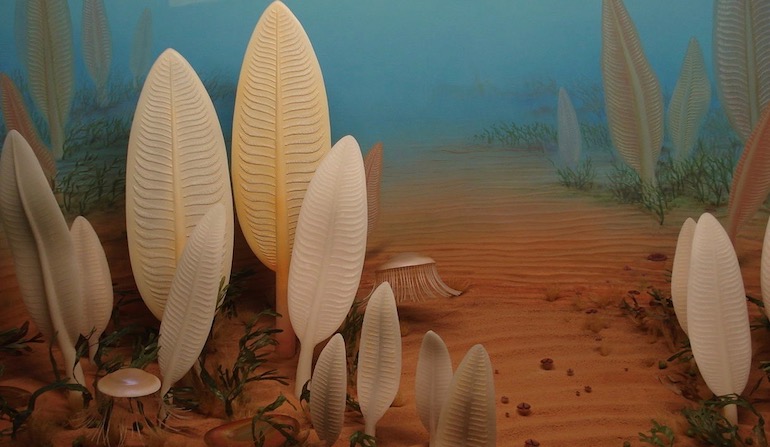 Source: Museum Mensch und Natur in München, CC BY-SA 3.0, via Wikimedia Commons
Although multicellular life existed beforeEdiacaran, it was the creatures of this period that had specialized cells inside the body to perform various tasks. So, in humans, hair cells are different from brain cells. Also, both of them are unlike the muscle and other cells of the body. The Ediacaran biota was the first set of organisms to develop this differentiation strategy. This is an incredibly important step in the evolution of more complex life forms. The organisms that arose at this time were the forerunners of those that developed the skeleton.
Кроме того, большинство, если не все сохранившиеся окаменелости организмов того времени настолько странные, что ученые не в состоянии однозначно классифицировать их на эволюционном «Древе жизни».
What animals lived during the Ediacaran period?
Many of them are so unusual that they have no analogies today. Most of all they look like aliens.
Arkarua adami
One of the strangest creatures of this period is the Arkarua adami. Based on fossilized footprints, this animal was disk-shaped and distantly related to modern echinoderms such as sea urchins.
It had a raised center with a series of ridges alongedge. The creature also had a five-pointed indentation marked with lines of small dots. The size of the specimens found so far varies from 3 to 10 mm.
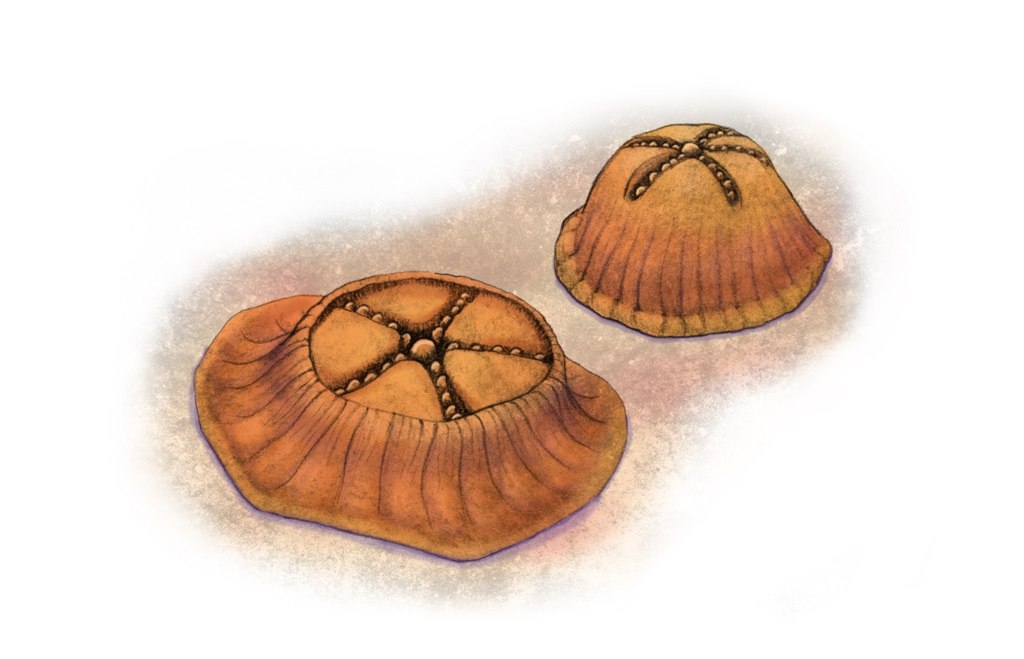 Arkarua adami. Source: Domenic Pennetta/Wikimedia Commons
The name Arkarua comes from the namea giant snake from Australian Aboriginal mythology called "Arkaru". Experts do not yet have an idea of its internal structure, which makes classification of the organism problematic, to say the least. Recently, scientists have conducted research that will allow us to learn more about how the animal ate during life.
Tribrachidium heraldicum
Another strange creature of that period is Tribrachidium heraldicum. Unlike Arkarua adami, scientists cannot even roughly attribute it to any type of living beings today.
Those fossils that experts have found haveunique three-beam symmetry and are believed to have a hemispherical shape. As with other representatives of the Ediacaran biota, the only fossils of this creature found by scientists are impressions on sandstone layers.
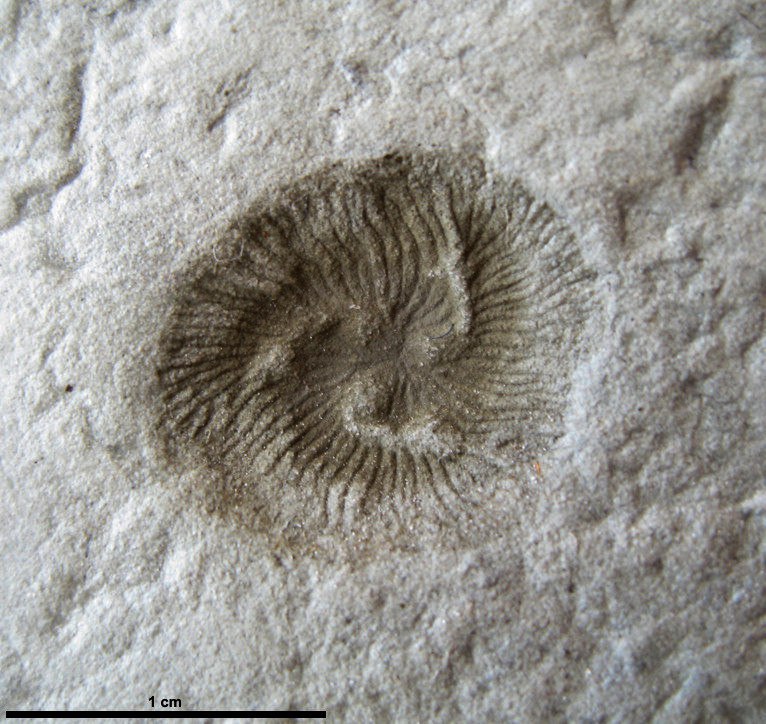 Tribrachidium heraldicum. Photo: Aleksey Nagovitsyn/Wikimedia Commons
The creature had three hook-shaped ridges orsleeves, and their parts are twisted in a spiral. Sample sizes vary from 3 to 40 mm. Tribrachidium is believed to have fed in an unusual way during its lifetime. Water flows into the central recesses of the body were directed through its three "arms".
 Source: wikipedia.org
Some scientists classify it as a distant relative of the Cnidaria type (corals and anemones), but there is no consensus among researchers.
Specimens of this creature were first discovered in the Ronsley Quartzite and Flinders ranges in South Australia. Then they were found in other Ediacaran formations in Ukraine and Russia.
Spriggina
Another amazing organism from the Ediacaran is Sprigginia. Scientists do not know where on the evolutionary “Tree of Life” to place this creature.
 Springina. Photo: Verisimilus/Wikimedia Commons
Its most notable features are bilateral symmetry.and something like an armored "head". First discovered in Ediacaran rocks in Australia, this organism is between 3 and 5 cm in size. Some experts believe it was a predator, its underside covered with two rows of rigid, interconnected plates.
 Source: James St. John
Scientists have already tried to connect it with modern species. Some scientists have argued that it was an early annelid (annelids), or a rangeomorphic branch of some extinct plant.
"Real Miracle"
All the animals described above are just a few of thestrange creatures that inhabited the Earth during the Ediacaran period. Although scientists can't know for sure what they looked like or fit into the grand scheme of life on the planet, the very fact that people know about them is a miracle in itself.
Read more:
Scientists have found a black hole that is 50 times larger than galaxies
Physicists have shown that water turns into two liquids at low temperatures
Russia has invented an alloy that can withstand the energy of a thermonuclear reactor