Scientists have not yet found life on Mars, but one researcher believes that within the next quarter century
Speaking at a press briefing, the scientistspoke about the technological projects that are currently under development. As a result, they will finally answer the question of whether we are alone in the Universe.
How did exoplanet research begin?
In 1995, Nobel Prize winner Didier Queloz discovered the first planet outside the solar system. Today, about 5,000 exoplanets are known, and scientists are discovering new ones every day.
Almost half of them helped to find spaceNASA's Kepler telescope launched in 2009. Its goal is to find out how common Earth-like planets are in the Milky Way galaxy. In 2018, the observatory received a successor, the TESS mission. This space telescope is designed to discover exoplanets using the transit method. It was developed at the Massachusetts Institute of Technology as part of the NASA Small Research Program.
The discovery of the first true "alien Earth" has been a long-time dream of astronomers, and recent exoplanet discoveries have shown that there are many small, rocky worlds like ours in the galaxy.
What is needed for life?
Scientists have many more exoplanets to discover.Astronomers believe that each of the more than 100 billion stars in the Milky Way galaxy has at least one companion planet. Many of them, just like Earth, are rocky and at just the right distance from their host stars. As a result, there may be such an important condition for life as the presence of liquid water.
However, it is not known whether theseThe atmosphere of the terrestrial planets and what it consists of. To do this, we need to study the atmospheres of these planets. Scientists have long waited for telescope technology to improve enough to study the composition of a planet's atmosphere and the activity of its parent star. With the launch of the James Webb Telescope, this moment has arrived.
Will the Webb telescope help?
Recently, the James Space Telescope teamWebb has published the first direct image of an exoplanet orbiting a distant star: the massive gas giant HIP 65426 b. It is 12 times larger than Jupiter and orbits 100 astronomical units from its sun. The image helped clarify the parameters of the planet and prove the high efficiency of the observatory in direct observations of exoplanets.
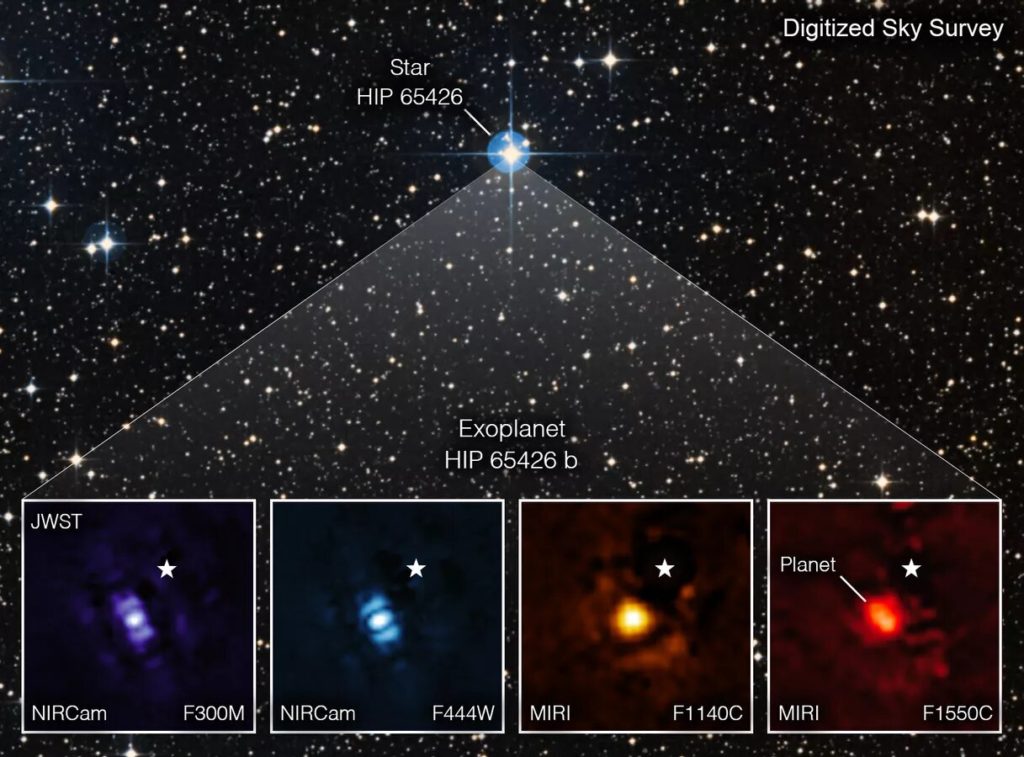 "James Webb" received images of a planet outside the solar system for the first time. Photo: NASA
In general, the James Webb Space Telescopebuilt not to study exoplanets, but to search for the oldest stars in the universe. But he has already made several breakthroughs in exoplanet research, including detecting carbon dioxide and water in some of their atmospheres.
The problem is that Webb, although the most powerfulthe observatory ever launched into space is not powerful enough to observe the much smaller, Earth-like planets that orbit at optimal distances from their stars.
Planet HIP 65426 b, which was “found”telescope is very special. It is gigantic and orbiting very far from the star. However, Webb is not powerful enough to photograph small Earth-like planets.
There is hope?
However, scientists are already building new instruments tofill this gap in the capabilities of the James Webb Space Telescope. Thus, Sasha Quantz and his team of engineers are leading the development of the METIS spectrograph (mid-infrared ELT imager and spectrograph).
This is the first device of its kind that will becomepart of the Extremely Large Telescope, ELT. It is currently being built in Chile and the project will be completed by the end of this decade. The main instrument of the ELT will be a telescope with a segmented mirror with a diameter of 39.3 m. It will consist of 798 hexagonal segments with a diameter of 1.4 meters each.
The main purpose of the device is to take the first picturepotentially Earth-like planets around one of the closest stars. But in the future, scientists plan to use it for dozens of stars, as well as to study the atmospheres of terrestrial exoplanets.
 NASA
NASA
A ground-based telescope such as the ELT would have tocombat interference from the Earth's atmosphere that distorts measurements of the chemical composition of exoplanet atmospheres. And since Webb has its own limitations, a completely new mission will be required to search for life in space, Sasha Quantz said at a press conference.
What mission are we talking about?
The new mission is already being discussed under the auspices ofEuropean Space Agency (ESA). It was called LIFE (Large Interferometer for Exoplanets, Large Interferometer for Exoplanets). The project appeared in 2017. However, it is still at an early stage of study. Officially, it was not approved and financed. Anyway, for now.
The LIFE Space Telescope will study a huge number of exoplanets and look for traces of molecules in the atmospheres of distant worlds that could have appeared as a result of the life of organisms.
What's the bottom line?
The new center at ETH Zurich will lay the groundwork for a future mission, Quantz said, improving our understanding of the chemistry of life and how it affects planetary atmospheres and environments.
“We need to get more detailedinsight into the possible building blocks of life, the pathways and timescales of chemical reactions, and environmental conditions. This will help highlight priority stars and planets for study,” explains the researcher.
To do this, you need to understand the nature of bioindicatorslife. It is known that there are other processes that lead to the formation of gases in the atmospheres of exoplanets. It will take 25 years to implement the project and search for the first alien life, the scientist said, although he admitted that it is “ambitious.” Time will tell how realistic this is.
Read more:
The space plane will deliver cargo to the ISS and land at a regular "airport"
The star approached the black hole and it was torn apart: scientists observed this from three telescopes
Scientists have found traces of genetic mutations in the blood of every person who has been in space
Cover photo: ESA