What city are we talking about?
The city was built during the reign of Amenhotep III, the ninth pharaoh
The "Golden City" was known in the era of the pharaohs Amenhotep IV (Akhenaten), Tutankhamun and his successor, Pharaoh Ey, and was considered the largest administrative and economic center of its time.
Johns Hopkins University Egyptologist Professor Betsy Brian called the discovery of the city the most important find in Egypt since the discovery of the tomb of Tutankhamun.
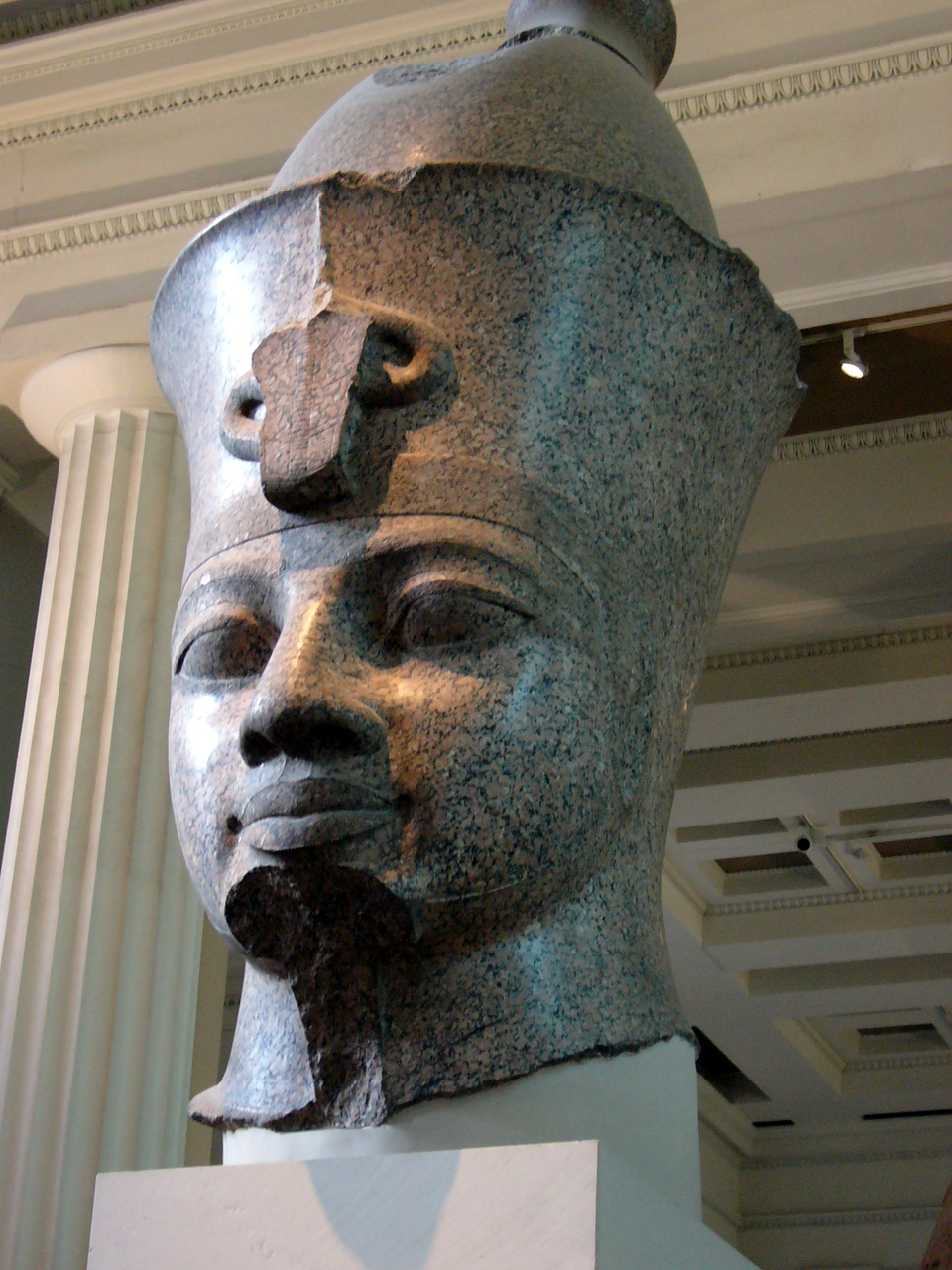
Who built the "golden city"?
Scholars claim that Amenhotep III.In the art of Amenhotep's time, the desire for the huge (gigantic columns and buildings) was combined with strict slenderness.And the images on the plane were given outlines of unprecedented softness and smoothness.
In front of the Temple of Amun in Karnak, Amenhotep erected another pylon, built a temple to Amun's wife, the goddess Mut, next to the horseshoe-shaped lake.
It is possible that the middle aisle of the so-called Hypostyle Hall at Karnak, between two rows of gigantic columns 24 m high, risesto Amenhotep III, and only later was it enlarged into a huge palace.
In the south of Thebes, the temple of Ipet-Res (Luxor Temple) was built - one of the most exquisite creations of Egyptian architects. A majestic passage between two rows of stone columns 16 m high also led to it.
 Temple of Amenhotep III in Luxor
Similar passages were erected by him in front ofthe neighboring temple of Mut, and in front of the temple in Sulba (between the 2nd and 3rd rapids). All construction works in Karnak, Luxor and Thebes as a whole were supervised by two architects - two twin brothers Hori and Suti.
On the west bank of the Nile, near the capital, the country palace of Amenhotep was built.It was a huge one-story structure made of raw bricks, with excellent paintings on the ceilings, walls and floors.
The palace complex also included courtiers' houses,workshops, craftsmen's houses. The construction of this palace, which received the name "House of Jubilation", is not without reason associated with the celebration of the "Thirty Years of Reign" (cheb-sed). A little north of the palace, a magnificent memorial temple for Amenhotep III was built.
- Deification
Amenhotep, reveling in his dominion over"Peace", reached in self-deification to the cult of his own idols. True, this worship of the pharaoh was planted mainly in Nubia, where, together with Amon, the magnificent temple in Sulba was dedicated to the pharaoh, but divine honors were also created in Memphis to the royal idol.
In Nubia, in the neighboring Sulba Sedange, a temple was built in which, as a goddess, the beloved wife of the Pharaoh, Queen Tia, was honored.
Since ancient times, pharaohs have been compared to the sun and calledtheir “sons of Ra (the sun),” but no one before Amenhotep called themselves the visible Sun. This idea of oneself as the bright Sun was echoed by the persistent emphasis on one’s commitment to “truth” (Maat).
Of the five royal names, three were dedicated to her:in the first name, the pharaoh styled himself “Shining in Truth”, in the second - “Establishing Laws”, the fourth, usually a state name, “Neb-Maat-Ra” meant “Lord of Truth, the Sun.”
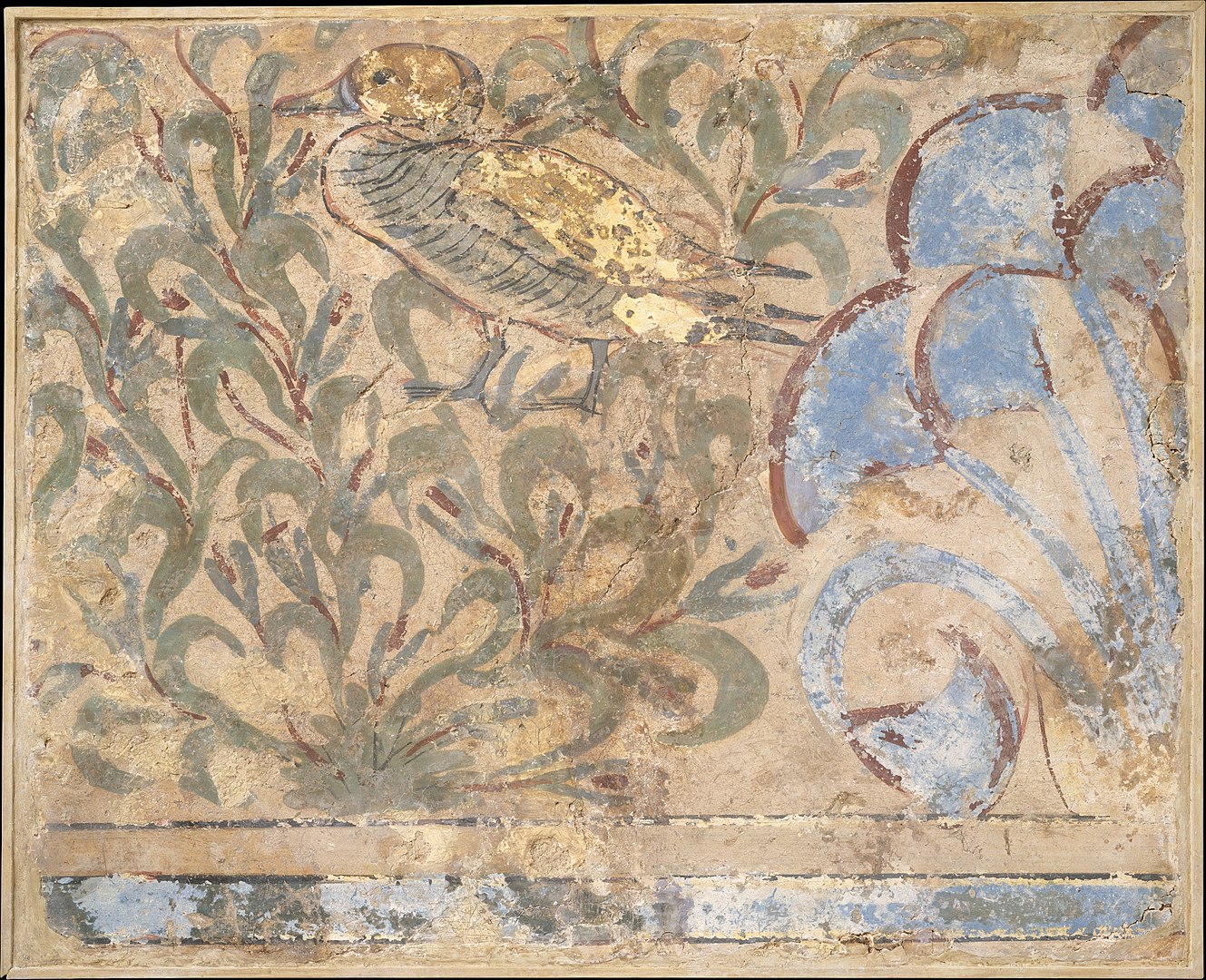 Fragment of a mural from the Malkata Palace
"Golden City" under Ehanton
The city also existed under Ehanton. In the 5th year of his reign, the pharaoh changed his name Amenhotep (“Amon is pleased”) to Akhenaten (“Useful for Aten”) and 300 km north of Thebes began the construction of a new capital - Akhetaten
- Transfer of the capital
In the new capital, a huge palace of Akhenaten was built, built mostly of white stone. This palace is considered the largest of all civil buildings of antiquity.
The walls of the palace were covered with plot andornamental paintings, decorated with colored tiles; floors, ceilings and stairs are colorfully painted; columns with intricate capitals are painted and inlaid with colored faience. At the entrance to Akhenaten's residence stood a huge, gold-plated statue of the Pharaoh himself.
Akhetaten was declared by the pharaoh to be a place that was notbelonged neither to a god, nor a goddess, nor a ruler, nor a ruler; the place that the sun itself chose for itself. The proportions of the city corresponded to the proportions of the “House of Aten”. Thus, the city itself became sacred.
However, the other gods were not completelyrejected. The city's border plates, carved at the founding of Ahetaton, mention gods and goddesses. In addition, the pharaoh vowed to build a tomb in the new capital for the sacred bull, revered in Heliopolis as a manifestation of the sun.
- Amarna art
The years of Akhenaten's reign were accompanied by breakdownold canons of art, a new artistic style was developed. Amarna art is characterized by realism and secularism, which can be seen in portrait images of the royal family.
In Akhetaton, Akhenaten created a favorable climate for the development of the arts of an original style that combined dynamics, flexibility of lines and sensuality, which did not coincide with the previous monumental canon.
For the first time in Egyptian art appearsecular images of the royal couple; unusual for Egyptian art is the appearance of the queen in a military crown. The most striking example of the art of the Amarna period is the bust of Nefertiti, attributed to the royal sculptor Thutmose.
The images attracted a lot of attentionAkhenaten, in which he has an effeminate figure, a deformed skull, a heavy lower jaw, a disproportionately large head, and a saggy, puffy belly. There is no unity among researchers in the interpretation of Amarna art. Some believe that the strange images of people, and especially the king, carry religious symbolism. According to this version, the androgyny of Akhenaten’s portraits reflects his closeness to Aten, who was called “the mother and father of all people.”
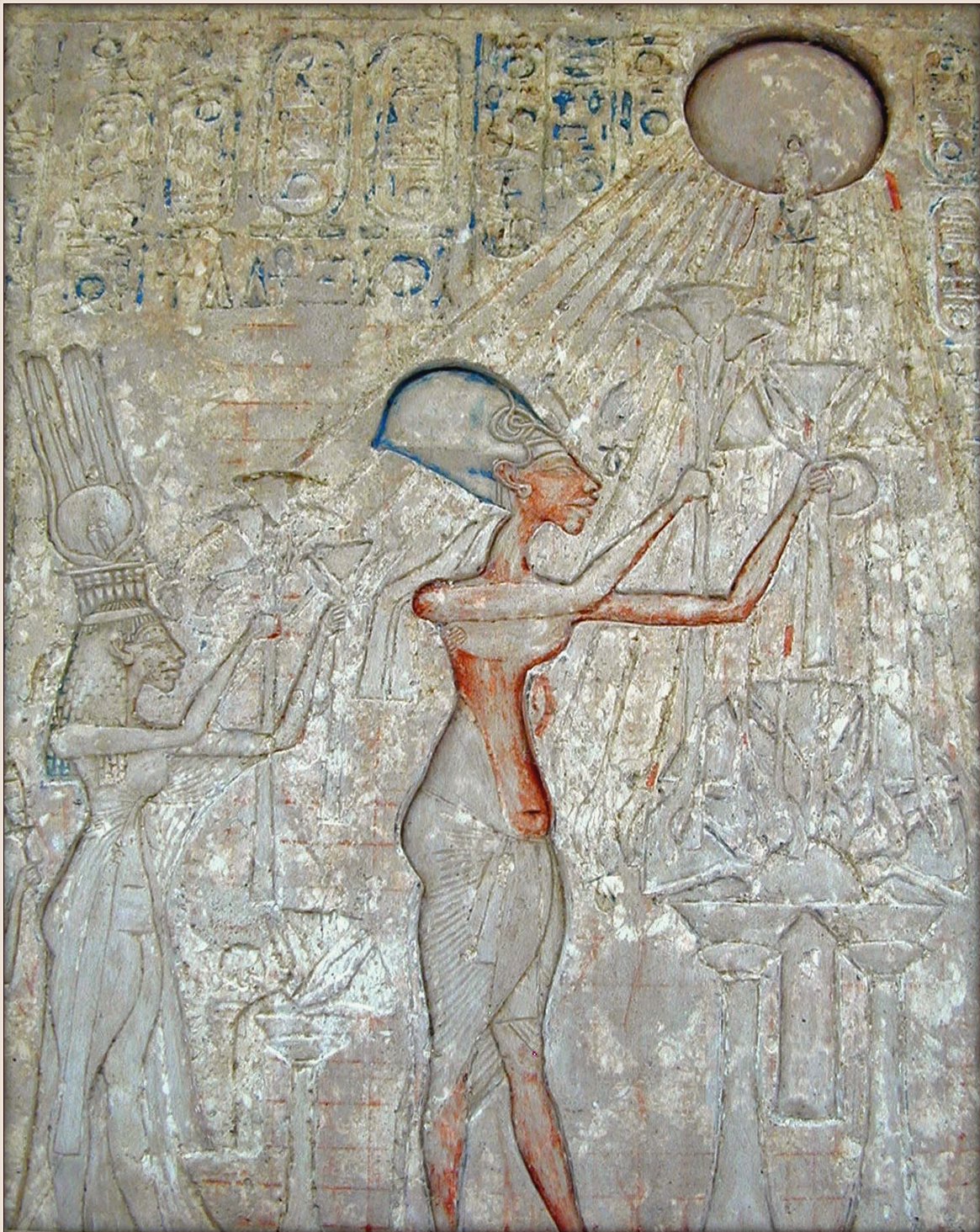 Pharaoh Akhenaten with his family make offerings to Aton. Aton is represented by a solar disk with rays ending in palms.
"Golden City" under Tutankhamen
Under Tutankhamun, there was an intensive restoration of the sanctuaries of the former gods, abandoned during the reign of Akhenaten, not only in Egypt, but also in Kush - for example, the temples in Kava (Gempaaton) and in Faras.
In view of the pharaoh's election of Memphis as his actualcapital, in the necropolis of Saqqara, numerous tombs of nobles were built, among which the tombs of the military leader Horemheb, the treasurer and the architect Maya, known for their elegant relief decoration, stand out. In Thebes, the tomb of the nobleman Amenhotep Khevi, who was at that time the royal governor of Nubia, is well preserved.
In addition to restoration work in many sanctuaries, on the orders of Tutankhamun, the finishing of the processional colonnade of Amenhotep III in the Luxor Temple was completed, and a small temple of Horon was built in Giza.
In Nubia - a giant temple was completedthe complex of Amenhotep III in Soleb, the temple of Amun was erected in Kava and the sanctuary of the deified Tutankhamun himself in Faras. The mortuary temple of the king, decorated with beautiful polychrome sandstone colossi, was located in Thebes near Medinet Abu.
Later, the temple was usurped by the successors of the pharaoh - Aye and Horemheb (the latter included Tutankhamun in the list of heretics, consigned to oblivion).
What was happening all this time in the “Golden City”?
The city was founded by one of the greatestrulers of Egypt, King Amenhotep III, the ninth king of the 18th Dynasty, who ruled Egypt from 1391 to 1353 BC. The “Golden City” was active during the joint regency of the great king with his son, the famous Amenhotep IV Akhenaten.
Many foreign archaeological missions have searched for this city without success.
Zahi Hawass, scientist and former Minister of Archeology of Egypt
The “Golden City” was known in the era of the pharaohs Amenhotep IV (Akhenaton), Tutankhamun and his successor Pharaoh Aye and was considered the largest administrative and economic center of its time.
Scientists have discovered three-meter walls under the sandhouses - they stretch to the west, right up to the famous necropolis of Deir El Medina. Household items of ancient Egyptians were found inside dwellings and office buildings.
Zahi Hawass Announces Discovery of 'Lost Golden City' in Luxor
The Egyptian mission found the city that was lostunder the sands and called: The Rise of Aten. The city is 3k years old, dates to the reign of Amenhotep III, and continued to be used by Tutankhamun and Ay. pic.twitter.com/MTsyTZG7MJ— Ministry of Tourism and Antiquities (@TourismandAntiq) April 8, 2021
The discovery of the lost city, Hawass says, is notonly provides an opportunity to see how the ancient Egyptians lived at the time when the country was at the peak of its prosperity, but it will also help us shed light on one of the greatest mysteries of history: why Akhenaten and Nefertiti decided to move to Amarna
As the newspaper notes, near the "Golden City"also found mass graves. Household items of ancient Egyptians were found inside dwellings and office buildings. It is possible that archaeologists will discover untouched treasure tombs.
Excavation began in September 2020, and byTo the great surprise of the team, they began to find clusters of mud bricks in different places. As a result, they discovered a large city with almost entire walls and rooms filled with everyday objects.
Having studied the hieroglyphic inscriptions on the clayvessels for wine, scientists found out that the palaces of Amenhotep III are located in the city. The dating was confirmed by other finds, including bricks on which there were prints of a cartouche with the name of Amenhotep III. Later inscriptions confirmed that the city continued to exist during the time when Amenhotep III ruled with his son Akhenaten.
In the course of further excavations, it was possible to find andother districts of the city - administrative, residential and "industrial", where the site for the manufacture of bricks was located and molds for the manufacture of objects from metal and glass were found.
Hawass notes that one of the vessels found in the city was made a year before Akhenaten moved the Egyptian capital from Thebes to Akhetaton (now the settlement is known as Amarna).
Read more:
The first accurate map of the world was created. What's wrong with everyone else?
NASA told how they will deliver samples of Mars to Earth
Scientists explain the appearance of "spiders" on the surface of Mars