What did the scientists find?
We are talking about Stanleycaris hirpex - this is a 20-centimeter distant relative of modern
Now Canadian paleontologists have discovered a hugethe number of fossils that are very well preserved. From them, paleontologists have found clues about how the brain, vision, and body structure of arthropods have changed over time.
“You can see the visual signal processing centers inside the eye stalks! This is unbelievable for a fossil that is half a billion years old,” he said.
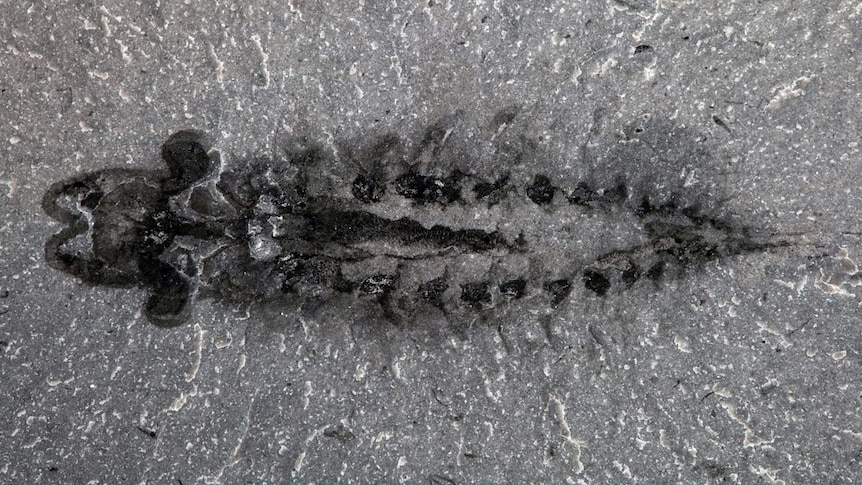 Jean-Bernard Caron/Royal Ontario Museum
Where did the three-eyed predator live?
During the Cambrian period - 541-485 million years ago - there were many unusual creatures in the ocean.
It was a time when rapid evolution took place: simple creatures changed their form to a more complex one: this was the basis for groups of animals that have survived to this day.
Another oddity that was in the ocean of thattime, - radiodonts - an extinct group of arthropods. These fearsome shrimp-like animals are famous for their serrated teeth, grasping claws, and bulging eyes. They were also quite large by Cambrian standards, some reaching 1m in length.
But scientists have typically only found isolated fragments of radiodont fossils, making it difficult to study them in detail and describe their physical characteristics.
"You could find their appendage or body flap, butthey were all separate disconnected elements,” said John Paterson, a paleontologist at the University of New England who was not involved in the study.
Moysyuk first came across unexplored fossils that were in the collection of the Royal Ontario Museum in Toronto. At that time he was still working as a student volunteer.
The original 268 fossils were discovered in the 1980s.and the 1990s in the Burgess Shale in the Canadian Rockies. Moysiuk was so impressed by this collection that he decided to study it for his doctoral dissertation at the University of Toronto.
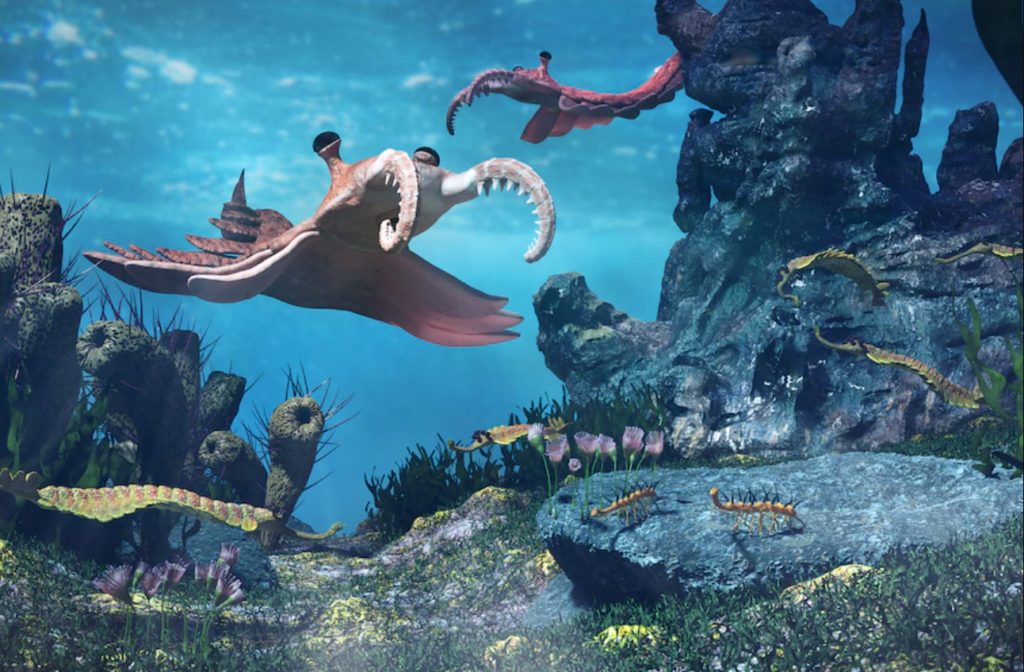 The Cambrian period is famous for its strange and wonderful creatures, including X-ray dentists (pictured above left) (dottedhippo)
Based on the results of the study of fossils, it turned out thatthat Stanleycaris had three eyes: two were located on special processes, and one huge one grew right in the middle of the head. According to Moysiuk, this strange feature has never been seen before in other radiodonts.
“The three eyes are one of the most amazing facts about this animal,” he said.
With this extra eye began seriousevolutionary changes, today we know that many modern arthropods have multiple eyes. For example, spiders - most species have eight eyes, but there are those who have four or six.
According to Moysiuk, the main pair of eyes helps insects and spiders form images of the environment, while smaller additional eyes help to navigate in space.
What is known about the three-eyed predator?
Dozens of specimens that paleontologists have found are outwardly almost completely preserved. So we managed to find out that the length of Stanleycaris was about 20 cm. For the Cambrian period, this was a small size.
Based on 84 fossils, scientists have madedetailed images of the brain and nerves of Stanleycaris. Under the microscope, it was possible to discern that the brain of Stanleycaris consists of two segments - protocerebral and deutocerebral.
The deutocerebrum that the researchers found inthe back of the brain, contained bundles of nerves connected to the claws and eyes of a predator. According to Professor Paterson, the structure of the brain of this ancient creature and how it connects to various parts of the body has greatly interested researchers. From these data, one can understand how the brain of a modern arthropod, which already consists of three segments instead of two, has evolved over time.
Another important characteristic of Stanleycaris - segmented body. This is a classic trait of modern arthropods.
According to Professor Paterson, no one previously knew whether the bodies of radiodonts consisted of segments.
“But now it has become known that these creatures had a segmented body, which means they were more modern, despite their strange appearance,” he said.
However, there is still a lot of work to be done with the fossils. The next step is to study how Stanleycaris developed.
In the huge collection of fossils, there are specimens ranging from 1 cm to tens of centimeters in length. Based on them, paleontologists want to understand how Stanleycaris grew into a formidable predator.
Read more:
The oldest Voyager 1 mission has a strange glitch that cannot be fixed
The James Webb telescope took the first picture of Jupiter: it shows 9 moving targets at once
Scientists have found a "Pandora's box" in the bowels of the Earth: the energy from there feeds life on the planet