An international group of researchers based on data from NASA's TESS (Transiting Exoplanet Survey Satellite) satellite immediately discovered
The researchers used the transit method tosearching for exoplanets orbiting stars. This effect is reminiscent of a partial solar eclipse. When a planetary plane comes between the Earth (or the satellite from which the observation is being made) and its star, the light from the latter becomes less bright for some time.
If such "eclipses" occur with a givenperiodicity, it is possible to confirm the presence of an exoplanet, and by how exactly the light changes and with what frequency this happens, it is possible to determine its size, properties and orbital parameters.
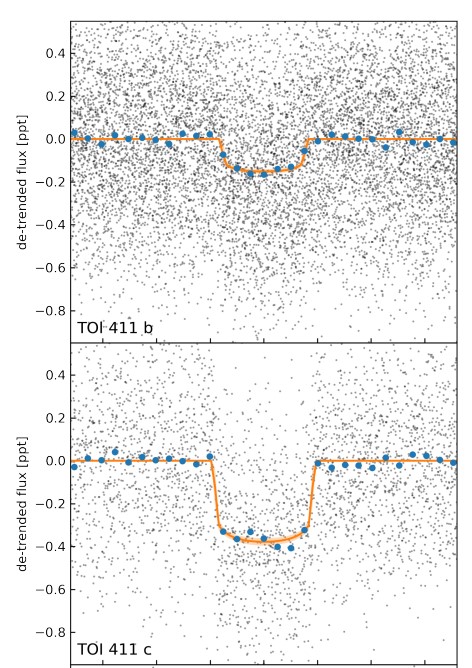 Change in the brightness of the star TOI 411 during the passage of gas giants. Image: Luca Cacciapuoti et al., arXiv
In their study, astronomers found thatthree planets revolve around the Sun-like star HD 22946 or TOI 411. The first of these are the gas dwarfs TOI 411.01 and 411.02. They resemble Neptune, but are slightly smaller in size. At the same time, these planets rotate very close to their star. One "year" on them lasts 9.57 and 4.04 Earth days, respectively.
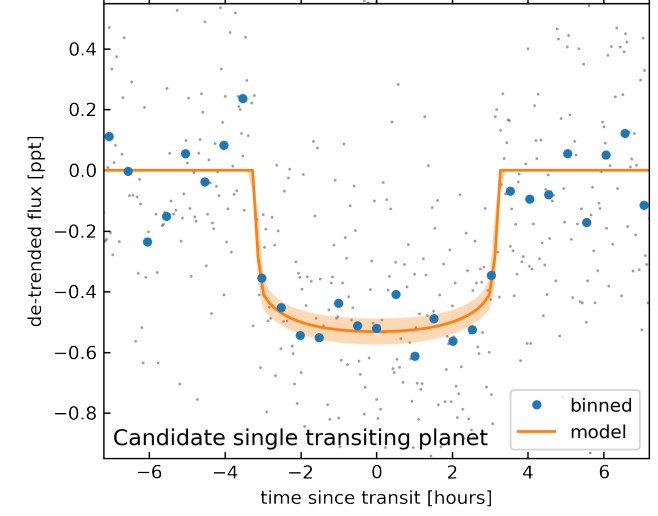 The change in the brightness of the star TOI 411 during the passage of a super-Earth candidate. Image: Luca Cacciapuoti et al., arXiv
The third find is a rocky super-earth.This is the name given to rocky planets that are larger than Earth but smaller than Neptune. Its rotation period is about 46 days. Unlike the other two planets in this system, it was not unambiguously identified during the automatic search by the TESS satellite. However, scientists ruled out all alternative options and also conducted a computer simulation that confirmed that this system has enough mass to form a third planet.
Researchers believe that the TOI 411 system canbe further studied using direct observations from the James Webb Telescope. It contains several exoplanets at once, and the star resembles the Sun in many characteristics. Such research will help to understand whether planets have atmospheres and whether life can exist there.
Previously, Hi-Tech talked about how planetary scientists are looking for new worlds outside the solar system.
Read more:
It turned out what happens to the human brain after one hour in the forest
It became known which tea destroys protein in the brain
Strange sea creatures in the depths of the ocean turned out to be similar to humans