The research team induced pluripotent stem cells from rhinoceroses. Based on saved
The researchers used genetic materialpreserved from the last male of the Malaysian rhino population, who died in 2019. The formed induced pluripotent stem cells (iPS) were able to develop into cells of all three germ layers.
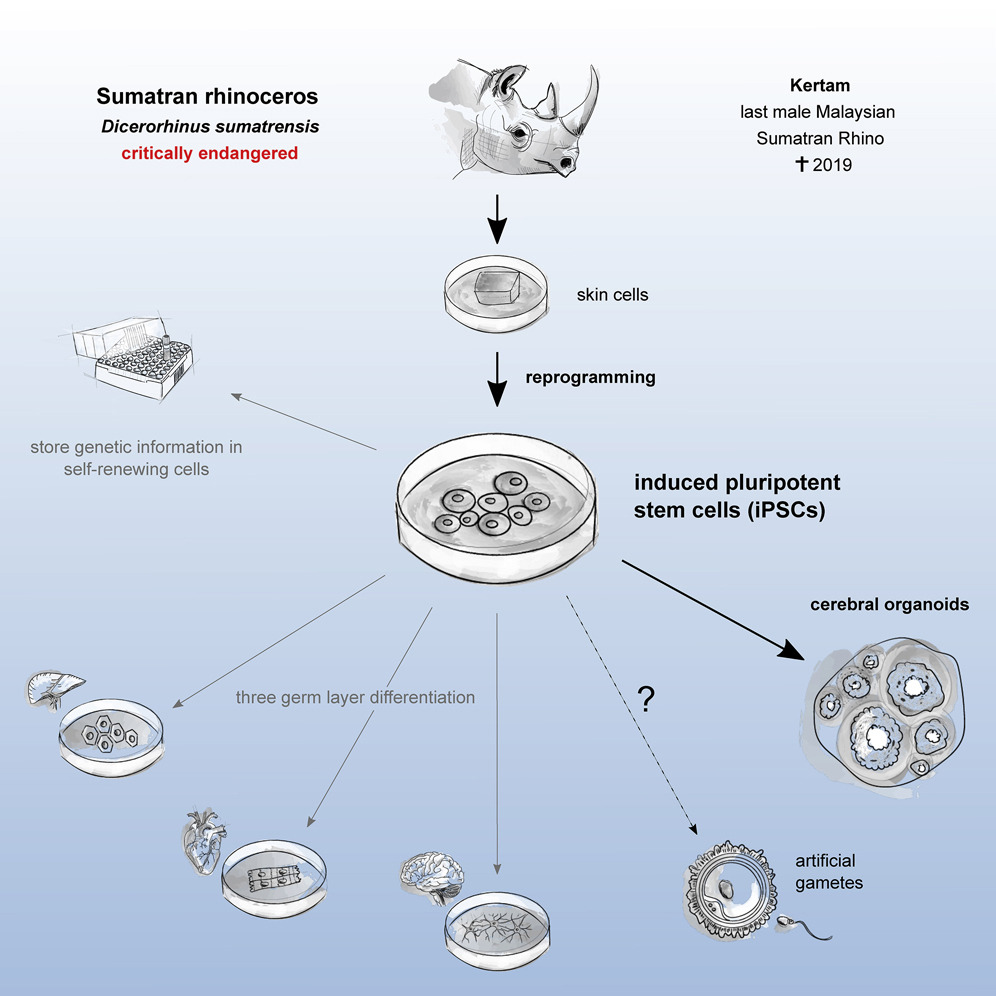 Scheme of the experiment. Image: Vera Zywitza et al., Cell
Recall that iPS are stem cells thatwere obtained by reprogramming adult cells and can again differentiate into different types. The creation of a brain organoid confirms that the formed iPS can still form complex three-dimensional tissues.
We have stored his genetic information andcreated the possibility of producing viable spermatozoa for future reproduction purposes. Because the quality of semen collected from Sumatran rhinos is poor immediately after retrieval and even worse after cryopreservation and thawing, in vitro obtained spermatozoa are an excellent alternative for assisted breeding of Sumatran rhinos in general.
Vera Zhivitsa, study co-author
Rhinos are one of the most affected species,subject to extinction. Five existing rhino species have been particularly affected by poaching and habitat destruction and fragmentation. The Sumatran rhinoceros is the smallest and oldest extant species. It plays a key role in the formation of forests and the dispersal of seeds of at least 79 different plant species.
There are fewer than 80 Sumatran rhinos left on Earth.Once they inhabited a continuous vast territory in East and Southeast Asia. But now only small scattered populations remain across Sumatra and Indonesian Borneo. Habitat loss and limited breeding opportunities are the biggest threat to the species and lead to permanent population decline.
Read more:
Named the consequences of the last solar storm that hit the Earth
A huge tunnel under the Egyptian temple “hidden” mysterious artifacts
A massive impact from a space object triggered the Earth's magnetic field
On the cover: Sumatran rhinoceros. Image: Ltshears, CC BY-SA 3.0, via Wikimedia Commons