The three best startups according to the expert council at the final pitch of projects - virtual finance
Application for monitoring the condition of the teeth "ON THE TEETH"
Team of Belgorod State National Research University
Development by Belgorod students - a set forcaries detection and bite determination at home in five minutes without a dentist. The authors of the project have created two kits for adults and children, which include alginate mass, impression trays, a bioindicator and an application.
To check the condition of your teeth, you needmix the alginate mass with water, put it on the impression spoon, bite, apply the bioindicator on the impression and upload the image of the processed impression to the application. The program will analyze the image and give recommendations for treatment. If necessary, the application will remind you to brush your teeth or go to the doctor. The project was created in collaboration with doctors and passed four laboratory tests.
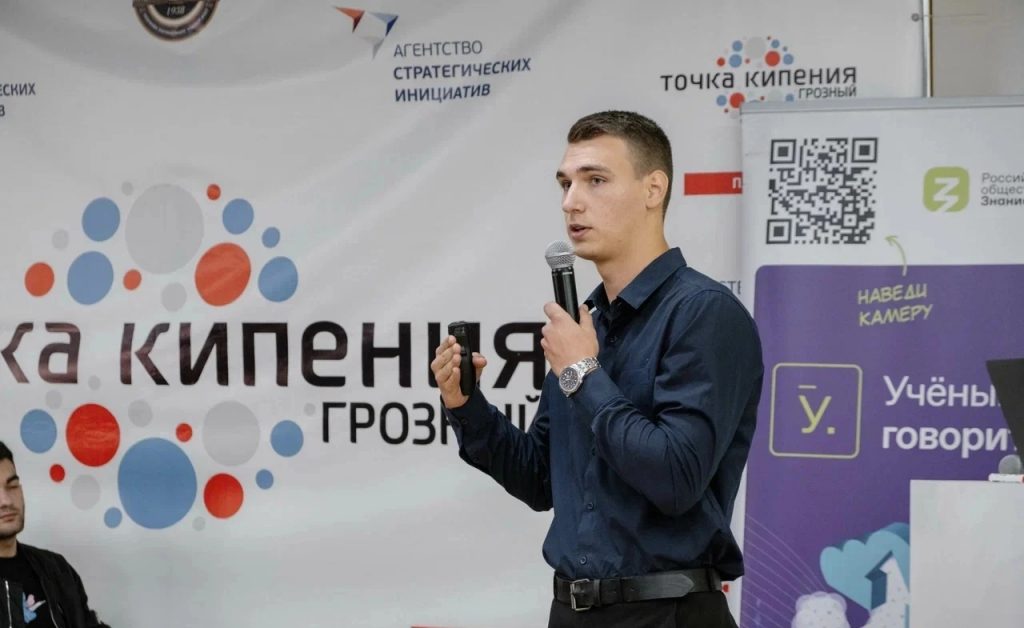
Students noted that their application is 27%more accurate than analogues and, unlike them, diagnoses the condition of the teeth at home without going to the dentist, determines the pH of saliva, supports remote consultation and is adapted for children. By December 2022, they have sold 1,000 sets.
Fin App Virtual Financial Simulator
Team from Vladivostok State University
The developers claim that their educationalTelegram-bot Fin App pumps financial literacy in 15 minutes a day. The bot uses the microlearning format - it gives out short blocks of information and practical tasks in a playful way that help you learn how to keep track of your own finances, set and achieve financial goals and buy your own apartment, receive money from the state and reduce taxes.
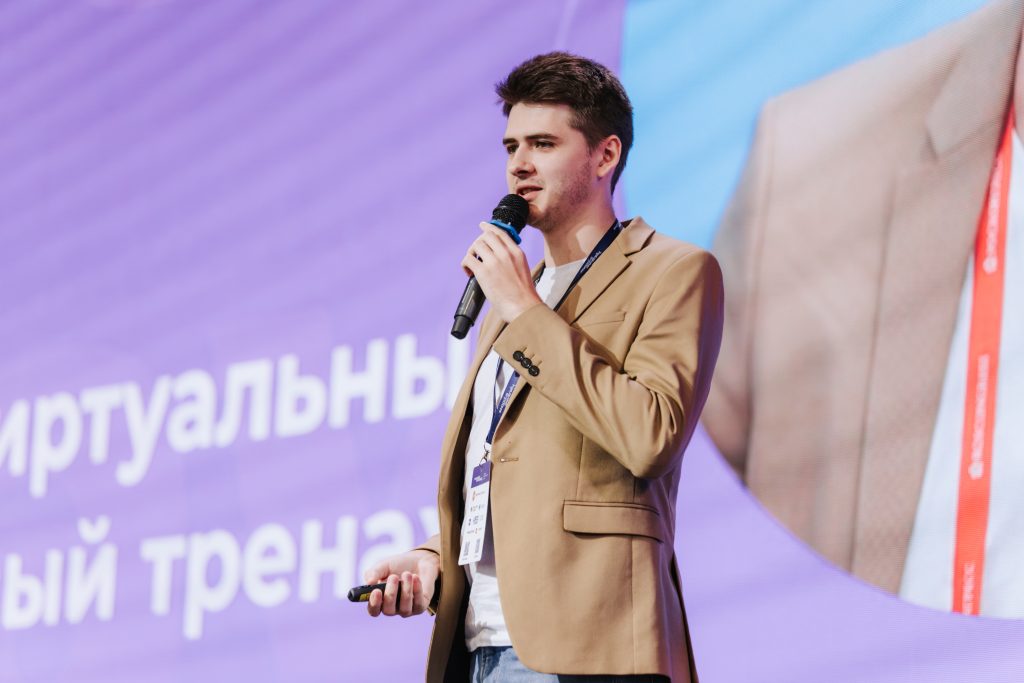
Students developed two courses: a full program and a demo version - a three-day workshop. The bot first conducts a survey and helps determine the course.
The simulator is already used by 1,200 people; in November 2022, the first users from non-CIS countries appeared.
“Gaze” to block the ability of attackers to use the user’s gaze to protect personal data
Team of Moscow Technical University of Communications and Informatics
MTUSI students developed a method thatwill confuse the eye tracker using gaze data. The developers explained that AppleFaceID, Windows Hello, FaceUnlock use a person's gaze to unlock devices, applications, confirm transactions and fill in passwords. View data is collected by companies every day, but, according to the authors of the project, it is protected only by the honest word of the manufacturers and, by law, is not personal data.
The team figured out how to preventgaze data recognition and make it impossible to identify the user, because with incorrect data, an attacker cannot build a gaze map, use it and find out the identity of the user. Students have developed a technology for anonymizing gaze data received through a webcam using machine learning, an artificial vision model, and neural networks.
Determining the likelihood of oncology based on skin melanomas using a mobile phone
MSTU team N.E. Bauman
The authors of the project decided to pay attention tomelanoma is a skin cancer that develops from pigment-producing cells. The number of cases of melanoma has increased 15 times over 40 years, and 40% of patients cannot be saved due to late detection of the problem.
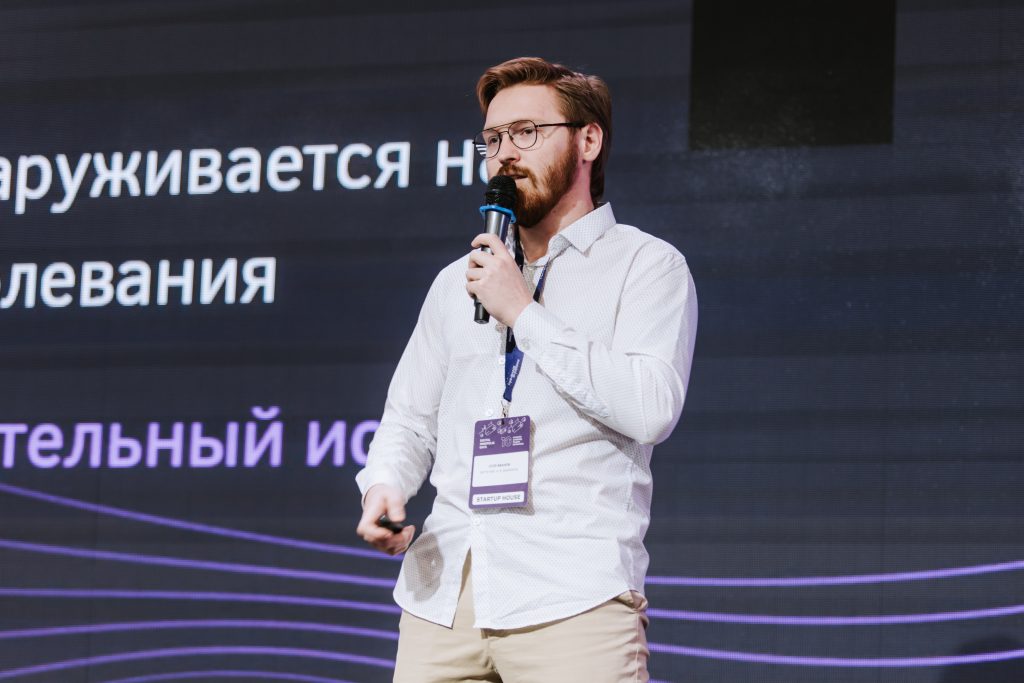
Students have created a mobile application thathelps to identify potentially dangerous formations on the skin. The user needs to upload a photo to the application, the neural network will process it and give a result with a percentage probability of melanoma.
Model installation of the main pipeline for the study of anti-turbulent additives
Team KNRTU
Students design a model standmain pipeline for laboratory testing of reagents, which minimizes unsuccessful pilot experiments on a real pipeline. On the unit, you can test the pumping of heavy and viscous oils, the pump, thermal control, analyze the destruction and pressure drops.
Compared with competitors, the price of one seriesexperiments on the model of the team from KNRTU are 5-10 thousand higher, but the reliability of studies is also higher - more than 75%, for analogues this figure is less than 35%. Savings due to successful pilot experiments at the booth of startups amount to 24 million rubles a year, which is also the highest figure among similar installations.
The first production tests are planned for 2024.
Plastic filament for 3D printing from recycled material
The team of St. Petersburg State University of Telecommunications. prof. M.A. Bonch-Bruevich
A team from St. Petersburg came up with a projectReBottle, in which they recycle plastic bottles into filament - a filament for 3D printing. According to their calculations, a kilogram of such thread can be sold for 600 rubles at a cost of 128 rubles. Competitors sell a kilogram for 1,000–3,000 rubles.
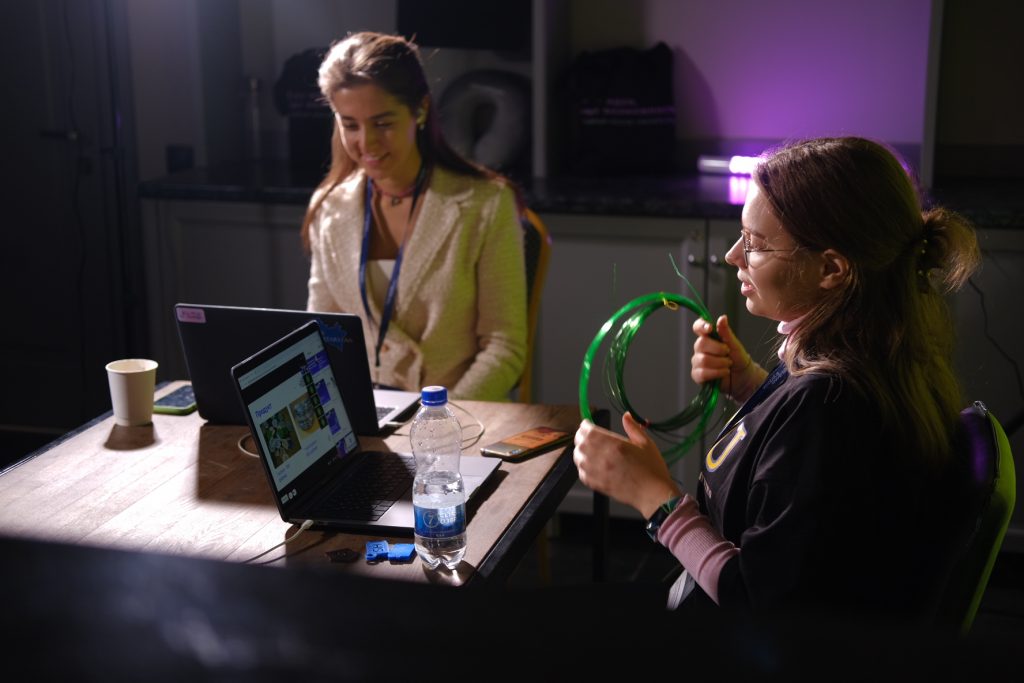
Now the authors of the project are looking for the best waycollecting PET bottles, modernizing the production line and working to increase the output. Their goal for the next year is to produce 200 kg of filament per month.
In addition to the production of filament, the ReBottle project also includes the printing of various products. For accelerator participants, the team printed souvenirs from recycled bottles.
Creams for accelerated skin regeneration SilkInS
NRU ITMO team
Chemists, technologists and biologists from ITMO have developedthe composition of the cream for the skin from the proteins of the web of tarantula spiders spidroins - DDN-01, DDN-02 and DDN-03, which increase the healing rate without leaving scars. According to the team's own study, a cream using a solution of cobwebs doubles the growth of human cells. According to students, this is the first Russian-made healing cream.
The developers noted that their cream would be usefulyoung people 15–21 years old with problem skin to get rid of acne, from 21 to 35 years old to tone the skin and people of any age to heal wounds and scars after them.
The team perfected the method of cream production, successfully conducted research on cells and created the first product line.
Read more:
See the most powerful volcanic eruption on Jupiter's moon
A new kind of quantum entanglement has been discovered: photons "remember" the structure of atoms
The metallicity of the Sun turned out to be higher than it was thought: what astrophysicists learned