The Cassini-Huygens probe has detected salty plumes erupting from the surface of Saturn's moon, Enceladus.
In addition, most of Enceladus is covered by a vast ocean that is hidden under a thick layer of ice. Scientists suggest that in the bottom areas of this ocean,However, the cause of the gas may be the cause of the gas. to be different.
For example, it can be formed by the chemical decomposition of primary organic matter, which canpresent in the core of Enceladus and which can be partially converted into dihydrogen, methane and carbon dioxide as a result of the hydrothermal process.
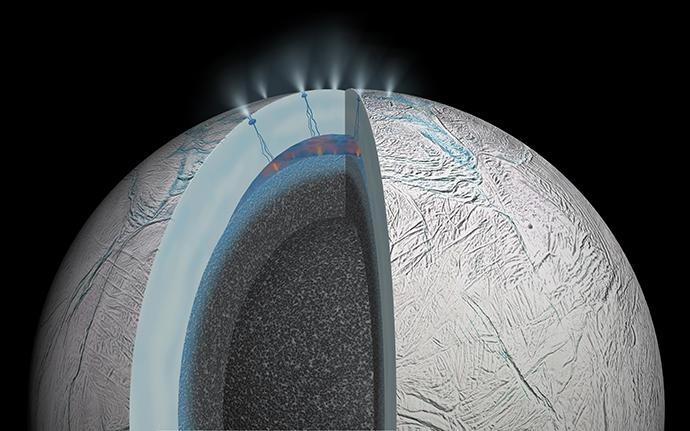 Artistic rendering that depictspossible hydrothermal activity that could occur on the ocean floor below and below the lunar surface, based on the results of NASA's Cassini mission. NASA / JPL-Caltech
Scientists performed mathematical calculations to understand whether bacteria like Earth's methanogens could produce enough methane to create plumes seen from the satellite.After quantitative research methods, scientists came to the conclusion that the vital activity of bacteria is not enough for this.The researchers speculate that either the methane came from geochemical processes, or that the bacteria on Enceladus are not known to science, and "alternative abiotic mechanisms" are possible on Saturn's moon.
Read more
A resident of Turkey accidentally found traces of an unknown civilization in the courtyard of the house
How an underwater fire broke out in the Gulf of Mexico and what it could lead to
Data from spy satellites helped to find out the cause of melting glaciers in Asia