What do scientists know about Saturn's moon Rhea?
Rhea is the second largest satellite of Saturn, but with the average
Rhea is located at a distance of 527 thousand.km further from Saturn than Dion and Tethys. Because of this, Rhea does not receive enough tidal vibrations from Saturn for internal heating. In addition, Rhea is more affected by craters than Dione and Tethys.
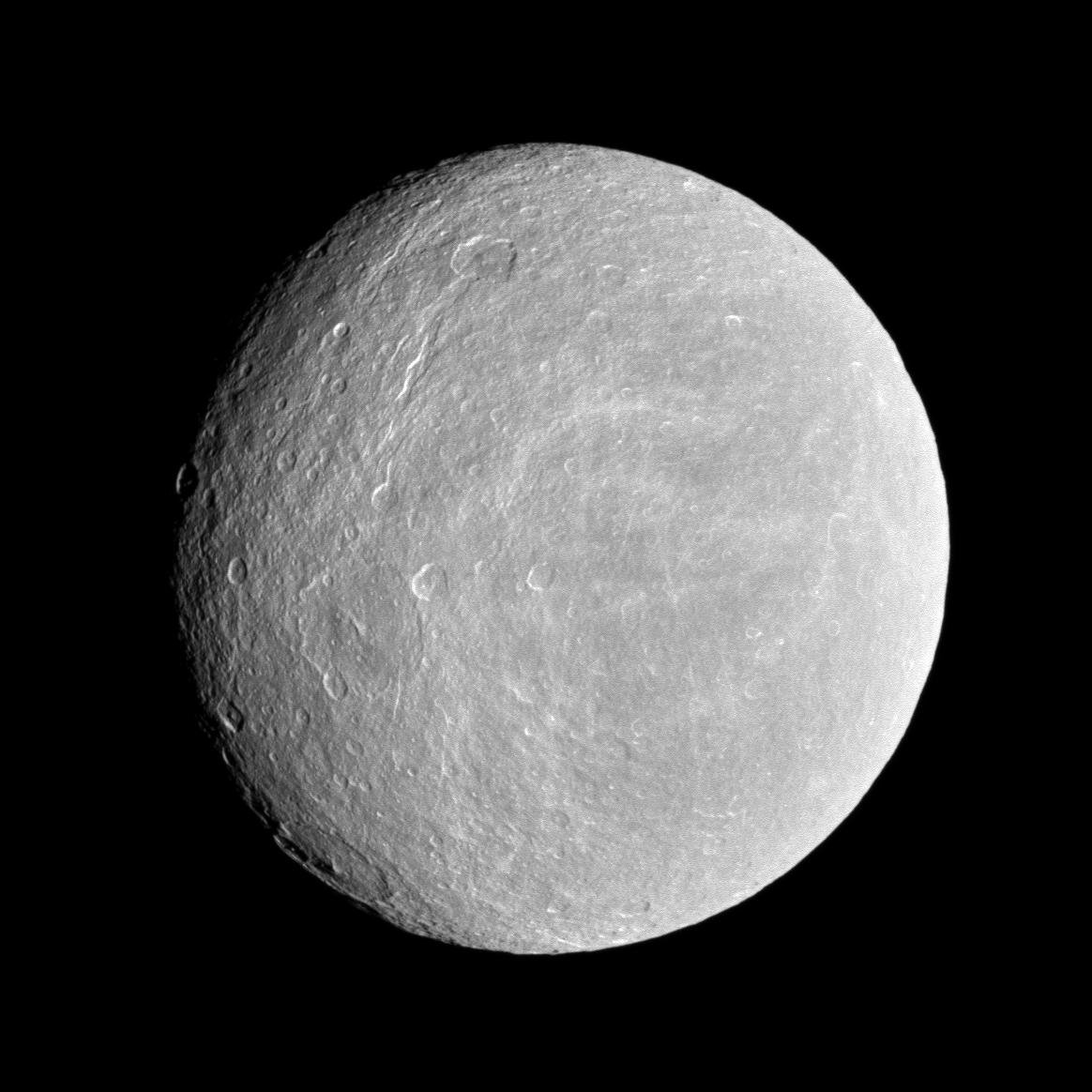
Surface and atmospheric features
Rhea seemed like a tiny dot to astronomersbefore Voyager observations (1 and 2) in 1980 and 1981. The spacecraft's images showed that Rhea's surface could be divided into two regions: an illuminated area riddled with craters over 40 km in diameter, and a second type of region in parts of the polar and equatorial regions with smaller diameter craters. It seems that a “resurfacing” occurred long ago in Rhea’s history. However, this would have been a long time ago; the average age of the plains is believed to be about 4 billion years.
Voyager images also showed mysteriouslinear “thin” lines ranging from tens to hundreds of miles, often cutting through plains and craters. In 2006, images from the Cassini spacecraft showed that these areas were fissures, like canyons. Such rocks indicate that Rhea could have been tectonically active in the past. This type of surface feature is also found on Dione and Tethys.
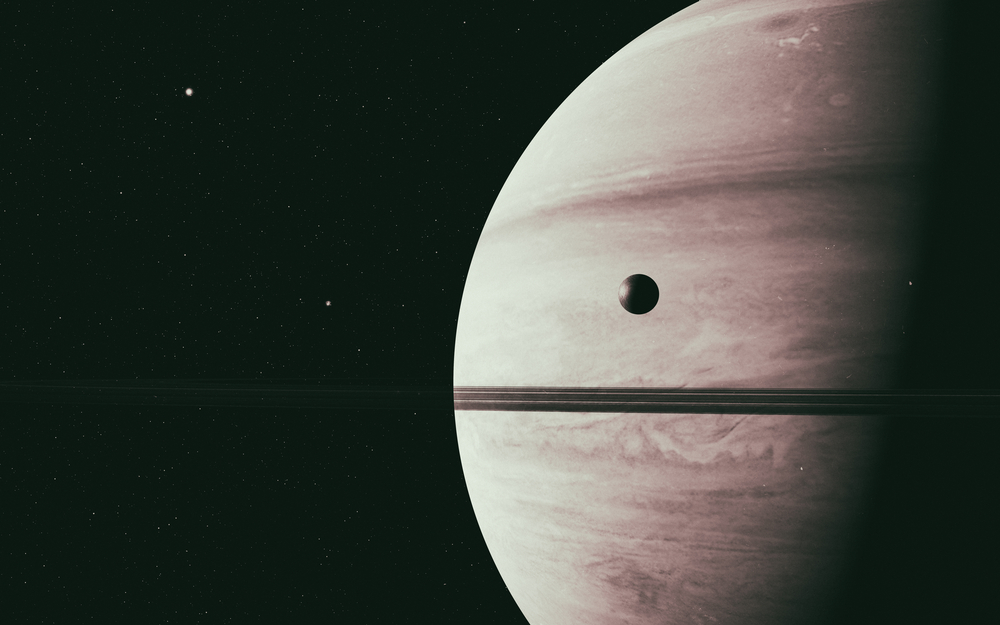
The Cassini spacecraft discovered a verythin atmosphere - an exosphere filled with oxygen and carbon dioxide around Rhea in 2010. This was the first time a spacecraft had directly captured molecules of an oxygen atmosphere—albeit a very thin one—on a world other than Earth.
The oxygen on Rhea's surface is about 5 trillion times less dense than what we have on Earth.
How did Rhea get her name?
The moon of Saturn was named after the Titanides in ancient Greek mythology - Rhea, the mother of the Olympian gods (including Zeus), daughter of Uranus and Gaia. Her husband was Kronos (Roman Saturn).
Cassini called Rhea one of the four SideraLodoicea (Stars of Louis) after King Louis XIV (the other three were Tethys, Dione and Iapetus). Astronomers also call Rhea Saturn V, which means the fifth moon at a distance from Saturn. Geological sites in Rhea usually derive their names from people and places from creation myths. The International Astronomical Union currently controls the naming of astronomical bodies.
Rhea's main mystery
The second largest moon of Saturn is Rhea, one ofthe strangest celestial bodies. This moon has soybeans rings like Saturn. These rings are the first ever discovered around the moon. However, the unique features of Rhea do not end there - previous spectroscopic studies have indicated an unidentifiable substance on its surface.
And now the old Cassini data can solve this long-standing mystery. The new findings are detailed in a study published in Science Advances.

The mystery of Rhea's surface began somewhatdecades ago, when NASA's Cassini spacecraft flew over Rhea as part of its mission to explore Saturn and its moons. He performed spectrographic analysis, collecting data from ultraviolet images of the moon and its chemical composition, confirming that its surface is composed of ice. But the data also showed the presence of unidentifiable material.
How did scientists make the discovery?
Bhalamurugan Sivaraman - Associate Professor of the LaboratoryPhysics Research in India and co-author of the new study. In her interview with Inverse, she explained how the team tried to investigate the chemical nature of this mysterious signal. To do this, scientists returned to the original Cassini data.
“We used data from the Cassini archive to understand exactly what was going on,” says Sivaraman.
The team behind the new researchAnalyzed the data collected by the Cassini flyby and conducted laboratory experiments to test different molecules to see which ones might produce the unknown signal.
What did they find?
PHaving examined possible candidates, researchers inThey eventually found the likely culprit: hydrazine. Hydrazine is an inorganic compound, a colorless liquid with the same pungent odor as ammonia. H₂N—NH₂ is an extremely toxic, highly hygroscopic liquid. Here on Earth, it is used in pharmaceuticals, agrochemicals and as rocket fuel for spacecraft. According to the study, this is the first time such a compound has been detected on the moon.
To understand where the hydrazine might have come from, Sivaraman and his colleagues essentially tried to recreate the conditions of Rhea's surface in a laboratory.
Curiously, this simulation suggeststhat Rhea's lunar neighbor, Titan, Saturn's largest moon, may be related to the presence of hydrazine. The researchers speculate that Titan may emit nitrogen (N) molecules towards Rhea, which are then converted to hydrazine through moon interactions.
This interaction of two moons is a biga rarity in our solar system. But given Titan's size, it is likely that the Moon will have some influence on the objects around it.
What's the bottom line?
Considering this is the first detection of hydrazineon the moon, the team behind the study wants to continue observing other moons to see if hydrazine is formed elsewhere in the solar system. They also suspect that there may be an as-yet unknown chemical composition yet to be discovered.
This particular work helps us identify another molecule that scientists did not know existed before.
Read more
Look at an 8 trillion pixel image of Mars
A nuclear rocket engine is being built for flights to Mars. How is it dangerous?
Abortion and science: what will happen to the children who will give birth