German engineers from the Jülich Research Center have developed a new type of transistor made from an alloy
For some time now, researchers around the worldare looking for a replacement for silicon, the main material used in the semiconductor industry. Part of the work is focused on the use of germanium as a new material. The electrons in such a material move faster than in silicon.
German scientists have found a way even moreoptimize the electronic properties of the material. To do this, they included tin atoms in the crystal lattice of germanium. In experiments, a transistor made of this alloy showed an electron mobility 2.5 times higher than that of a similar device made of pure germanium.
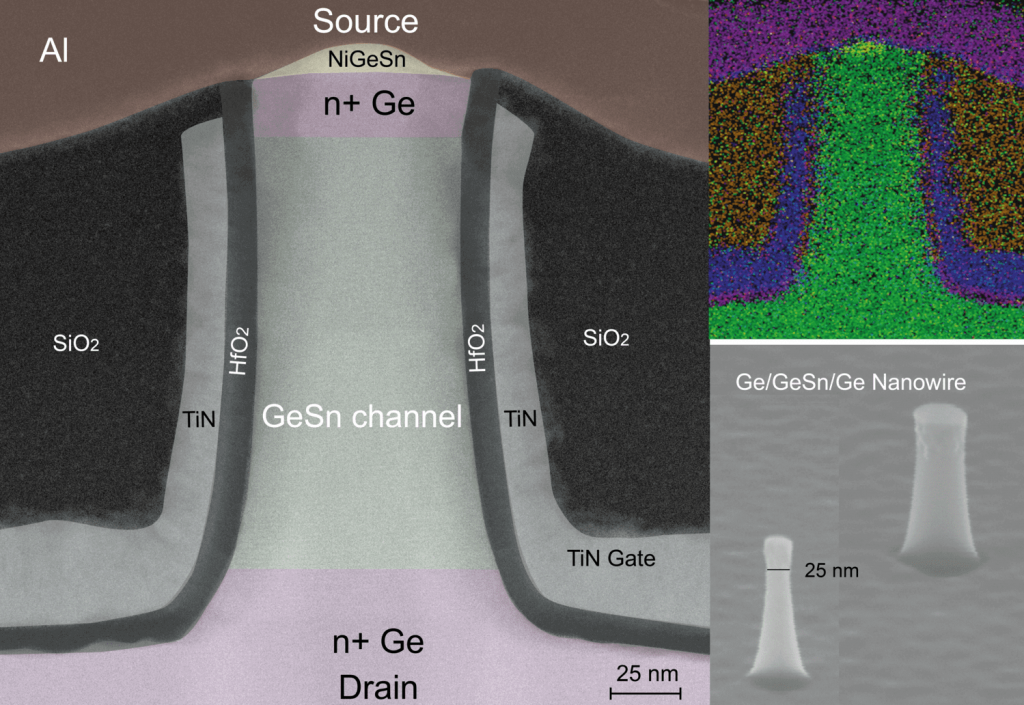 Pictures of a transistor made of germanium and tin underelectron microscope: the structure repeats the geometry of the three-dimensional nanowire used in the latest generation of computer processors. Image: Forschungszentrum Julich
Another advantage of the new material alloyis that it is compatible with the existing CMOS chip fabrication process. Germanium and tin belong to the same main group on the periodic table as silicon. Therefore, transistors from this alloy can be integrated into conventional silicon microcircuits on existing production lines, the engineers say.
Silicon microelectronics is approachinglimit of possibilities: the number of transistors on a chip has doubled approximately every two years and further scaling is limited by physical capabilities. An alternative semiconductor, in which charge carriers move faster, will allow the creation of larger devices with the same properties. If the production technology is successfully scaled up, the germanium-tin transistor could become such an alternative.
Previously, Hi-Tech talked about the most popular semiconductors currently in use and those that are being developed to replace them.
Read more:
Bears separated in childhood reunited: the zoo told how it all went
A photo appeared inside the second deepest underwater sinkhole in the world
Light in the early universe: a new theory changes the way it was