Notre Dame Cathedral caught fire three years ago. The next day after the fire, archaeologists were called to the site to
After conducting additional research, expertsThey found out that the sarcophagi contained the remains of two wealthy men. One was a church leader who may have suffered from the “disease of kings,” and the other was young and noble, but his remains hinted that he had a hard life.
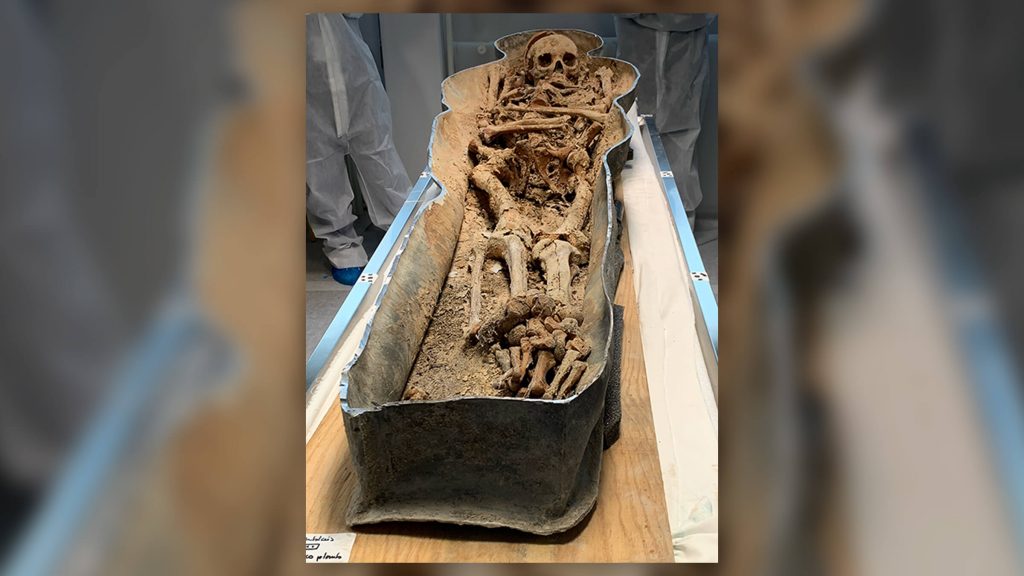 The skeletal remains of a young man, probably a nobleman, hinted at his hard life. Image courtesy © DR UT3
Eric Krubezi, professor of biologyanthropology at the University of Toulouse III, watched the opening of the coffins last month and studied the bones to learn more about the men's age at death and lifestyle. "The first subject was identified by a brass plaque on his coffin," he told Live Science in an email. The remains are those of Antoine de la Porte, who died at the age of 83 on December 24, 1710.
De la Porte was a canon, or member of the clergy,responsible for the cathedral. He used his wealth to help strengthen the choir of Notre Dame, which may explain his burial under the central part of the transept. This place was intended to be the final resting place of the elite.
The canon's teeth were in excellent shape, and on hisThe body showed almost no signs of physical activity. This means that the person probably led a sedentary lifestyle. In addition, signs of gout, a type of inflammatory arthritis, were found on the man's thumb. Because it can be caused by excessive consumption of alcohol and food, it is often called the “disease of kings.”
There was no name on the second lead sarcophagussigns, so its occupant remains unknown at this time. This man was between 25 and 40 years old at the time of his death, but scientists found traces of a hard life on his body. There are indications that he rode horses from a young age and lost most of his teeth in the years and months leading up to his death. The man's cause of death was chronic meningitis as a result of tuberculosis.
Read more:
Scientists from the permafrost zone: how they develop smart clothes and a cancer vaccine
Scientists "cheated" time and sent a photon into the past: how this breakthrough will change physics
10 scientific facts that turned out to be fakes. Cards
On the cover: scientists from the Toulouse forensic laboratory open a sarcophagus.
Image courtesy © DR UT3