The Hubble Space Telescope recently discovered a rare double quasar glowing in distant corners.
A newly discovered pair of quasars formedabout 10 billion years ago. Scientists suggest that it was precisely such objects that inhabited the early Universe. The fact that the two quasars found form a pair makes them especially exciting.
A newly discovered pair of quasars formedabout 10 billion years ago. Scientists suggest that it was precisely such objects that inhabited the early Universe. The fact that the two discovered quasars form a pair makes them especially exciting, scientists write.
Because of the way light bends around a massive sourcegravity (the effect of gravitational lensing), scientists may have difficulty determining whether a visible double quasar is genuine or an optical illusion. But in this case, astronomers used ground-based telescopes to double-check Hubble's work. Data from the W. M. Keck Observatory in Hawaii helped confirm that quasars are indeed a binary system; This is not a trick of the light.
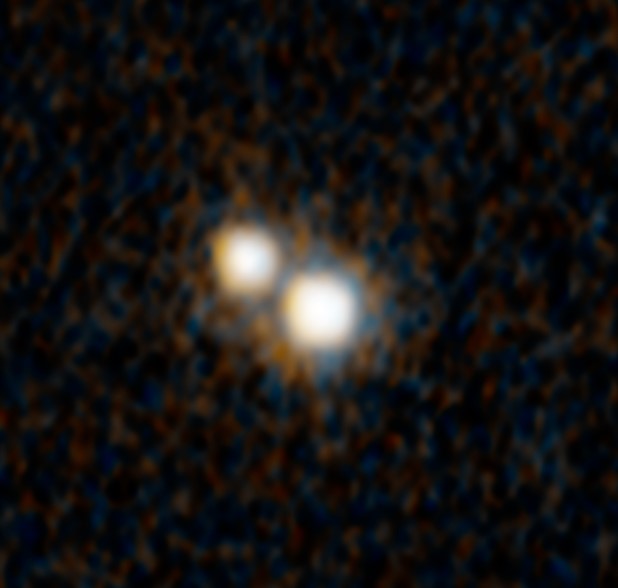 Actual observations of a double quasar. Image credit: NASA, ESA, Yu-Chin Chen (UIUC), Xiang-Chi Hwang (IAS), Nadia Zakamska (JHU), Yue Shen (UIUC)
Scientists believe these double quasars are largerdo not exist: over the past epochs, while the light from the objects flew to Hubble and the Earth, they collided and merged with each other into a single black hole. However, for the inhabitants of our planet, this association will be available for observation only in the future.
Exactly the same as the galaxies revolving aroundThey probably became one giant elliptical galaxy. Astronomers believe that studying such mergers can help us better understand how galaxies like ours came to be.
Quasars are some of the brightest objectsin the Universe, they emit more light than the entire Milky Way. They are formed when gas, dust and other particles of matter fall into a supermassive black hole at the center of a galaxy, according to the European Space Agency. The glow of some of these particles increases exponentially as they are accelerated to near light speeds by friction and the powerful gravity exerted by the black hole.
Read more:
Special diet triggers self-destruction of brain cancer cells in mice
Scientists have deciphered the mysterious manuscript of Ptolemy. It was hidden under other text
New image of Hubble puzzled scientists
On the cover: an artistic illustration of two sparkling blue quasars
Image courtesy of NASA, ESA, Joseph Olmsted (STScI)