Nitrogen dioxide comes into the air from fossil fuel and natural gas vehicles.
Nitrogen dioxide is odorless and invisible,therefore, a special sensor will be needed to detect gas. It must accurately detect dangerous concentrations of toxic gas. The problem is that most of the sensors available today are power hungry. They operate at high temperatures to achieve proper performance.
Ultra-thin sensor developed by a team of researchers from the National Laboratory. Lawrence (Berkeley Lab) and the University of California at Berkeley can solve this problem.
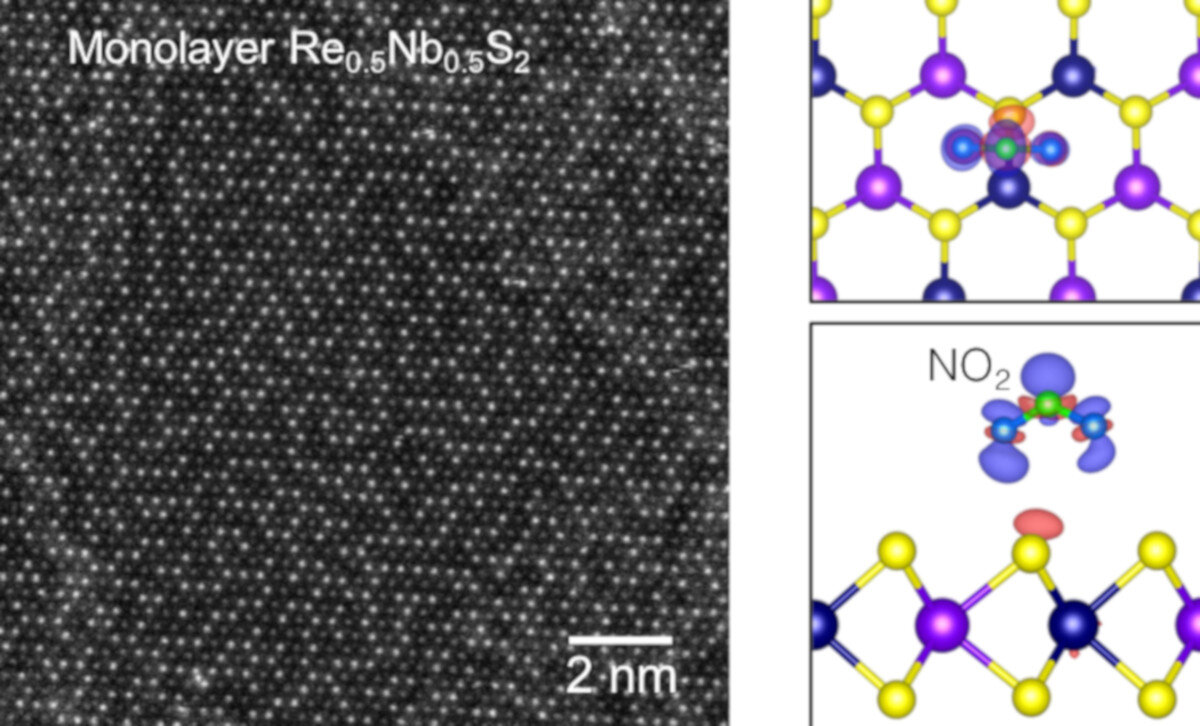 Left:atomic resolution electron microscopic image of two- and three-layer regions of Re0.5Nb0.5S2, showing the order of its packing. Right: Real-space charge transfer plot showing charge transfer from Re0.5Nb0.5S2 to NO2. Color Key: Re is shown in dark blue; Nb in purple; S yellow; N in green; H in gray; About in blue; and C in red. Credit: Alex Zettle / Berkeley Lab.
In his article published in the magazineNano letters, the research team talked about atomicallythin 2D sensor. Its peculiarity is that it works at room temperature and, therefore, consumes less energy than analogs. The authors of the development emphasize that the device, created from a single-layer alloy of rhenium disulfide and niobium, also has excellent chemical specificity and recovery time.
Unlike other 2D devices manufacturedMade from materials such as graphene, the new sensor reacts selectively to nitrogen dioxide molecules with minimal response to other toxic gases such as ammonia and formaldehyde. In addition, it is capable of detecting ultra-low nitrogen dioxide concentrations of at least 50 ppb.
Read more
The most stormy place on Earth: why Drake Passage is the most dangerous route to Antarctica
New uranium compound breaks record for anomalous conductivity
Mars Express helped find out where and how the water disappeared from the Red Planet