On which satellites did you find water?
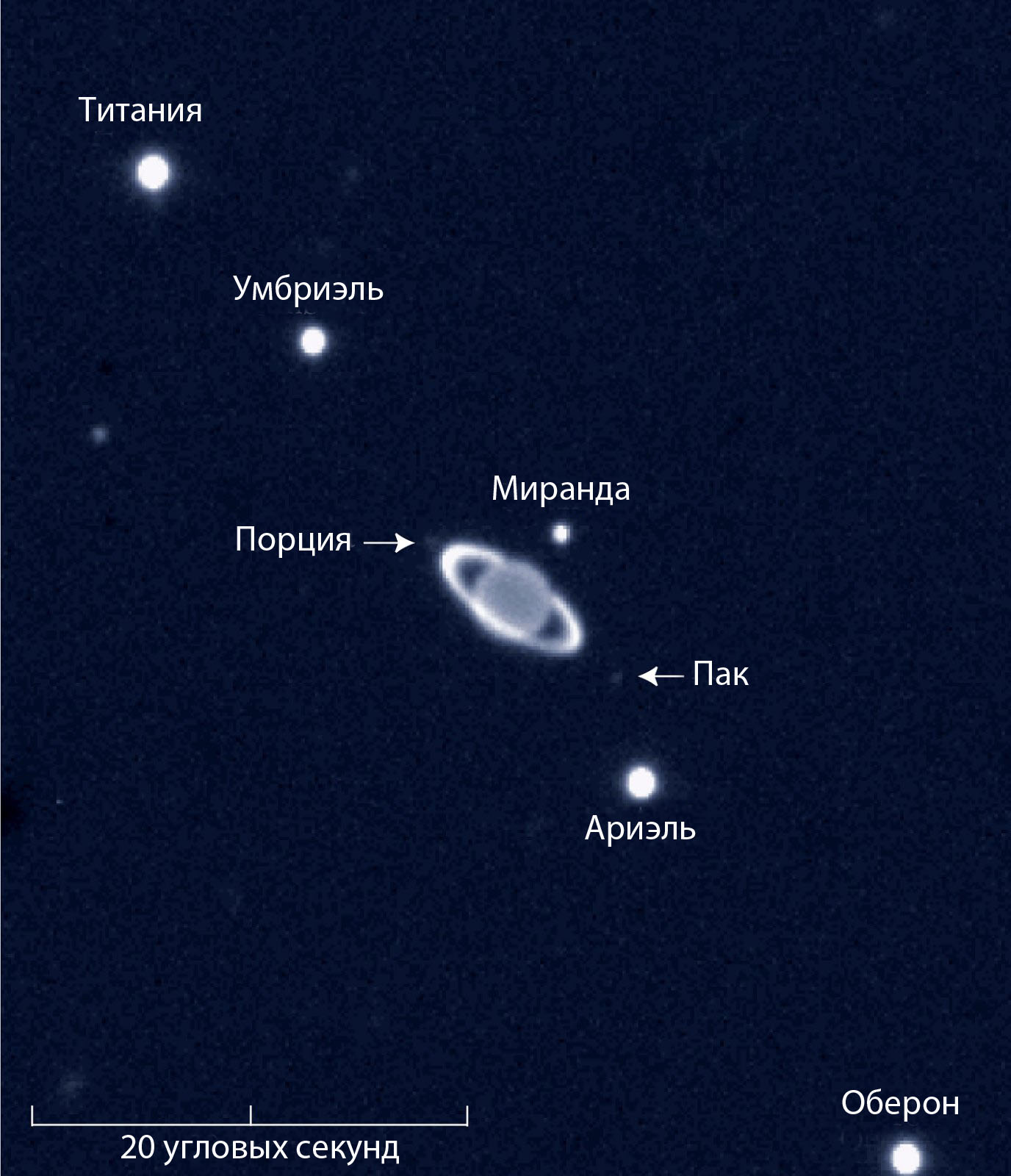
Uranus has 27 moons, including five particularly large satellites - Titania, Oberon,
These images also showed physical signs of liquid water erupting from the bowels and freezing at the surface, a process called cryovolcanism.
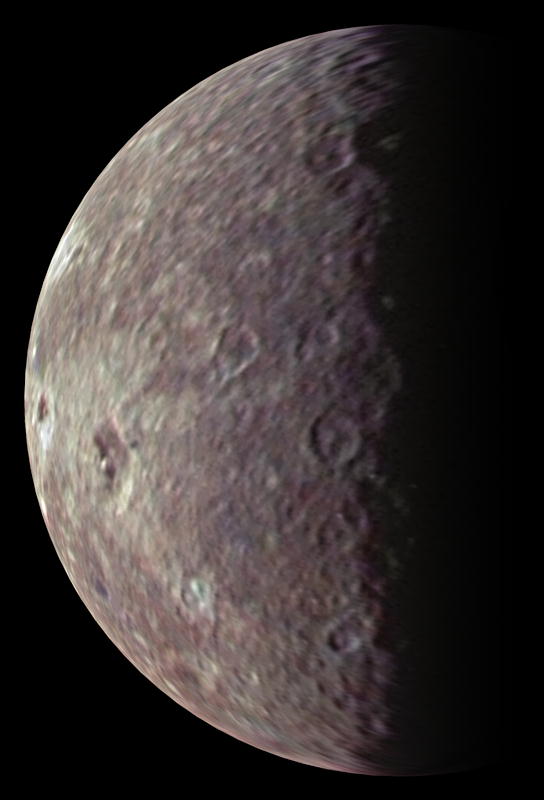
- Titania
Titania is the largest satellite of Uranus and the eighth largest satellite in the solar system. Discovered by William Herschel on January 11, 1787 (six years after his discovery of Uranus).
Like all of Uranus' largest moons, Titania,likely formed from an accretion disk that surrounded the planet during its formation. Titania is composed of roughly equal amounts of rock and ice, and is likely differentiated into a rocky core and an ice mantle.
Titania's surface is relatively dark withreddish tint. Its relief was formed both by impacts of asteroids and comets, and by endogenous processes. The satellite is covered with numerous craters, reaching 326 kilometers in diameter.
It is likely that an early endogenousrestoration of the surface, which erased its old, heavily cratered surface. The surface of Titania is cut by a system of huge canyons and cliffs formed during the stretching of the crust as a result of the expansion of the bowels at an early stage in its history.

- Oberon
Oberon is the second largest and most massive satellite of Uranus and the ninth most massive satellite in the solar system. Also known as Uranus IV. Discovered by William Herschel in 1787.
It is likely that Oberon formed fromthe accretion disk that surrounded Uranus immediately after its formation. The companion consists of approximately equal amounts of rock and ice and is probably differentiated into a rocky core and an ice mantle. There may be a layer of liquid water on their border.
Oberon's surface is dark with a red tint.Its relief was formed mainly by the impacts of asteroids and comets, which created numerous craters up to 210 km in diameter. Oberon possesses a system of canyons (grabens) formed during crustal extension as a result of the expansion of the bowels at an early stage in its history.
Oberon consists of approximately equal amounts ofwater ice and heavy non-ice components, which may include rock and organic matter. The presence of water ice (in the form of crystals on the surface of the satellite) was also shown by spectrographic observations. At ultra-low temperatures, characteristic of the satellites of Uranus, ice becomes like stone.
Its absorption bands on the slave hemispherestronger than on the leader, while the other satellites of Uranus have the opposite. The reason for this hemispheric difference is unknown. Perhaps the fact is that the leading hemisphere is more susceptible to meteor impacts, which remove ice from it. The dark material could be formed as a result of the effect of ionizing radiation on organic matter, in particular, on the methane present there in the composition of clathrates.
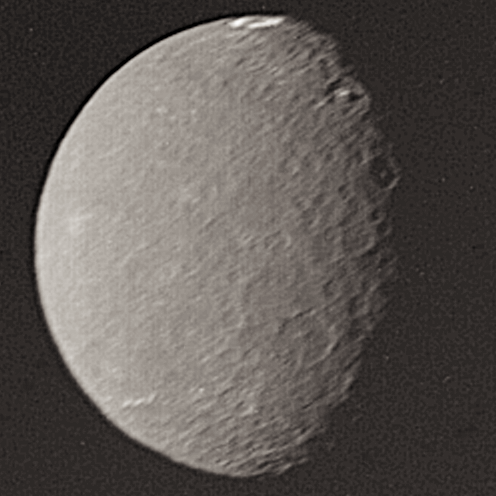
- Umbriel
Umbriel is a satellite of the planet Uranus, discoveredby William Lassell on October 24, 1851. Umbriel is mainly composed of ice with a significant proportion of rock. It may have a rocky core covered with an icy mantle. In terms of size, Umbriel ranks third among the moons of Uranus and has the darkest surface, reflecting only 16% of the incident light.
Umbriel covered with numerous percussionwith craters reaching 210 kilometers in diameter, it ranks second among the satellites of Uranus in the number of craters (after Oberon). Umbriel, like all the moons of Uranus, was presumably formed in the accretion disk that surrounded the planet immediately after its formation.
Umbriel is the third largest and fourth largestsatellite of Uranus. Its density is 1.39 g/cm3. This suggests that the satellite is largely composed of water ice, with denser components making up about 40% of its mass. These components can be stones, as well as high molecular weight organic compounds known as tholins.
Using infrared spectroscopy onWater ice was found on the surface. Its absorption bands on the anterior hemisphere are more pronounced than on the posterior hemisphere. The reasons for this asymmetry are unknown, but it is assumed that this may be caused by the bombardment of the surface by charged particles from the magnetosphere of Uranus, which acts specifically on the rear hemisphere (due to the combined rotation of the planet and plasma).
These particles spray the ice, decomposing the methane contained in it (forming a clathrate) and attacking other organic matter, leaving a dark residue rich in carbon.
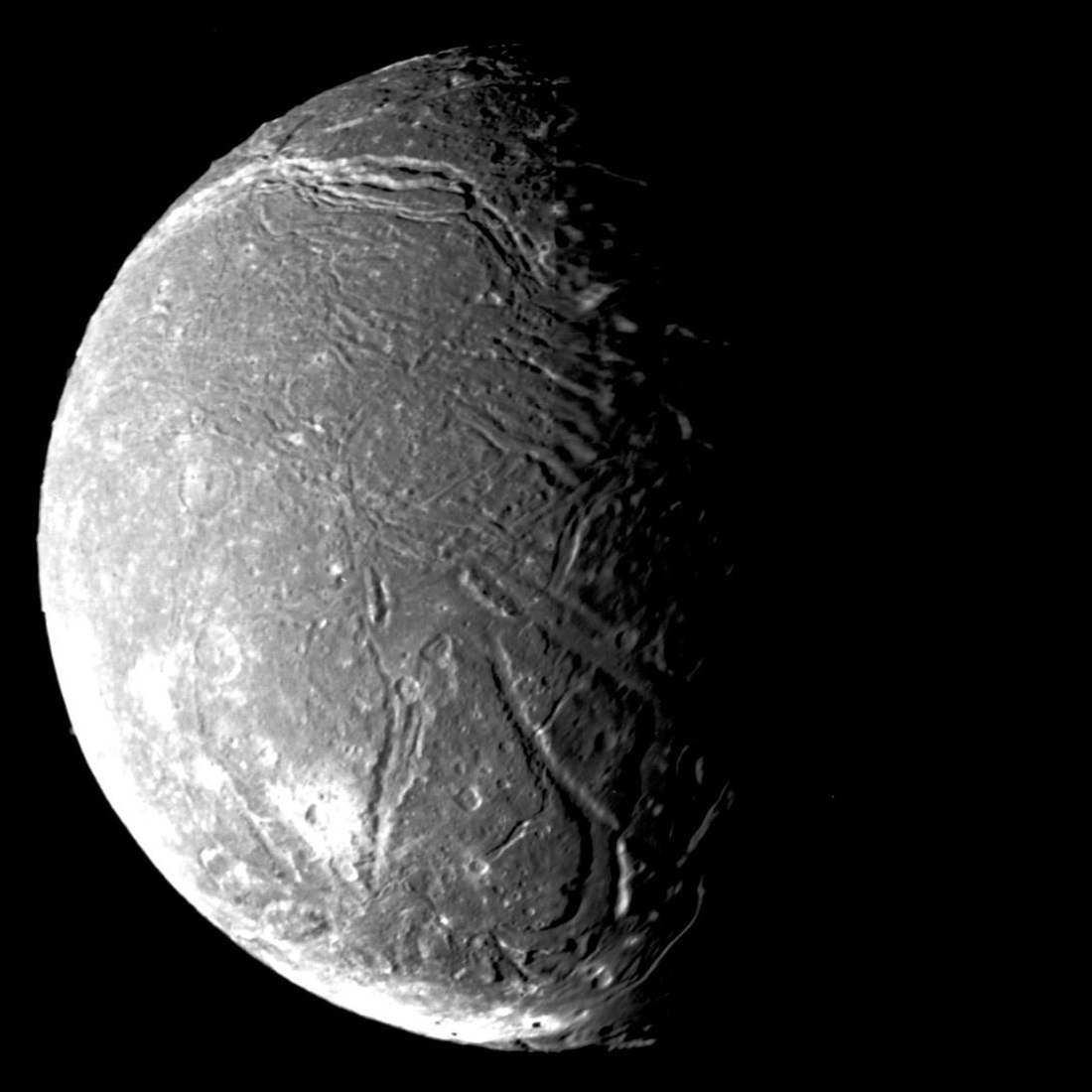
- Ariel
Ariel is the fourth largest satellite of Uranus. Opened October 24, 1851 by William Lassell.
Ariel is one of the smallest sphericalsatellites in the Solar System (14th largest out of 19). Among the satellites of Uranus, it is the fourth largest (of the five large satellites, only Miranda is smaller) and has a record albedo.
It consists of approximately half ice andhalf made of stone and quite possibly differentiated into a rocky core and an icy mantle. Like all large satellites of Uranus, Ariel was probably formed from an accretion disk that surrounded the planet during the first time after its formation.
Ariel has a complex surface relief - strongcrater areas are crossed by cliffs, canyons and mountain ranges. It has younger traces of geological activity than other moons of Uranus. The source of energy for it, most likely, was tidal heating.
The orbit of Ariel, like other large satellites of Uranus, lies in the plane of the planet's equator. Therefore, these satellites are subject to extreme seasonal variations in illumination.
In addition to water ice, using infraredSpectroscopy on Ariel revealed carbon dioxide (CO2), which is concentrated mainly in the trailing hemisphere. On this satellite of Uranus it is visible during such observations better (and was discovered earlier) than on all the others.
The origin of carbon dioxide is not entirely clear.It could have formed on the surface from carbonates or organic matter under the influence of solar ultraviolet radiation or ions arriving from the magnetosphere of Uranus.
The latter can explain the asymmetry indistribution of carbon dioxide over the surface of the satellite, because these ions are bombarding exactly the slave hemisphere. Another possible source is the degassing of water ice in the bowels of Ariel. In such a case, the release of CO2 may be due to past geological activity of the satellite.
- Miranda
Miranda (Uranus V) is the closest and smallest of the five large moons of Uranus. Discovered in 1948 by Gerard Kuiper.
The axis of rotation of Miranda, like other largeUranus' satellites lie almost in the plane of the planet's orbit, and this leads to very peculiar seasonal cycles. Miranda most likely formed from an accretion disk (or nebula) that either existed around Uranus for some time after the formation of the planet, or was formed during a powerful collision, which probably gave Uranus a large rotation axis tilt (97.86 °).
Meanwhile, Miranda has the largest among the largesatellites of Uranus orbital inclination to the equator of the planet: 4.338°. The moon's surface likely consists of water ice mixed with silicates, carbonates and ammonia.
It's amazing that this little satellite hasa wide variety of relief forms (usually bodies of this size have a more uniform surface due to the lack of endogenous activity). There are vast, rolling plains dotted with craters and criss-crossed by a network of faults, canyons and steep cliffs.
Three unusual areas are visible on the surfacemore than 200 km in size (the so-called crowns). These geologic formations, as well as the surprisingly large inclination of the orbit, point to Miranda's complex geologic history. It could be influenced by orbital resonances, tidal forces, convection in the bowels, partial gravitational differentiation and expansion of their matter, as well as episodes of cryovolcanism.
Its density is the lowest among the main onessatellites of Uranus: 1.15 ± 0.15 g/cm3, which is quite close to the density of ice. Observations of the surface in the infrared revealed water ice mixed with silicates and carbonates, as well as ammonia (NH3) in an amount of 3%. Based on data obtained by Voyager 2, it was concluded that the rocks make up 20-40% of the satellite's mass.
According to one hypothesis, the ice on Miranda formsclathrate with methane. In addition to methane, aqueous clathrates can capture carbon monoxide and other molecules, forming a substance with good thermal insulation properties - the thermal conductivity of clathrates will be only 2 to 10% of the thermal conductivity of ordinary ice.
Thus, they can impede the outflow fromthe interior of the satellite is heat, which is released there during the decay of radioactive elements. In this case, it would take about 100 million years for the ice to heat up to 100 ° C. Thermal expansion of the core could reach 1%, which would lead to surface cracking. Its heterogeneity is possibly due to the heterogeneity of the flow of thermal energy from the bowels.

Could there be life on these satellites?
New research suggests yes.He was introduced to the AGU meeting: scientists led by Benjamin Weiss, a planetary scientist at MIT, have developed a method for future missions to confirm the existence of subsurface oceans on worlds like Uranus. Through this work, the team also hopes to deepen our understanding and knowledge of potentially inhabited worlds.
The main question here is whereare habitable environments in the solar system? The discovery of the subsurface oceans on Europa and Enceladus leaves many of us wondering if there are still moons that, while small, may still be warm.
Benjamin Weiss, planetary scientist at MIT
How did the author of the work find water on the satellites?
The authors of the work believe that ridges, valleys andfolds on the surface of satellites can be frozen water jets from hidden oceans. Scientists also conducted research and measured the magnetic field of Uranus. As a result, it became clear that if there is water in the depths of the satellites, an electric current can be generated there under the influence of a magnetic field.
Five satellites, scientists say, they demonstratesigns of cryovolcanism, when, under extremely low ambient temperatures, not molten lava erupts from a volcano, but water, ammonia, mixtures of methane with hydrocarbons, nitrogen and other substances or their mixtures, both in liquid and gaseous states.
Examining images sent by spacecraftVoyager 2 in 1986, researchers noticed that these five satellites are made of equal parts of rock and ice and are heavily pitted with craters, which is evidence of liquid water that may be hiding in the bowels of celestial bodies.
What else is there besides water?
Scientists have calculated the strength of the magnetic field of Uranus and that,how it will affect any oceans below the surface of its satellites. Studies have shown that if there is liquid salt water in the depths of the satellites, then under the influence of a magnetic field, an electric current can be generated in it.
Weiss and his team used theoreticalmodels of the magnetic field of Uranus to calculate the possible induced magnetic fields of the five largest satellites of the planet. Miranda's induced magnetic field was determined to be the strongest—300 nanotesla. While this does not confirm the presence of oceans on the planets, Miranda, as well as Ariel, Umbriel and Titania, likely induced magnetic fields strong enough to be detected by existing spacecraft technology, Weiss said in a statement.
Scientists also said that the oceans on the moons of Uranus are probably deeper than on the moons of Jupiter, because the ice shell is thicker. But this does not mean that they cannot be detected.
Where are the most suitable conditions for life?
Weiss, discussing potentially habitable environments insolar system, called the moons of Uranus most suitable in the event that “if there is liquid water there and it is a little salty, like ocean water on Earth.”
Scientists will be able to draw more accurate conclusions in 2042, when a scientific mission will go to Uranus.
Read also:
See the ISS flying between Jupiter and Saturn
The brightest blazar shines on the Earth. What does this mean for the planet?
"Study failed": Sputnik V testers will no longer receive placebo