When the glass frog falls asleep, it becomes invisible. The bright green back of the frog merges
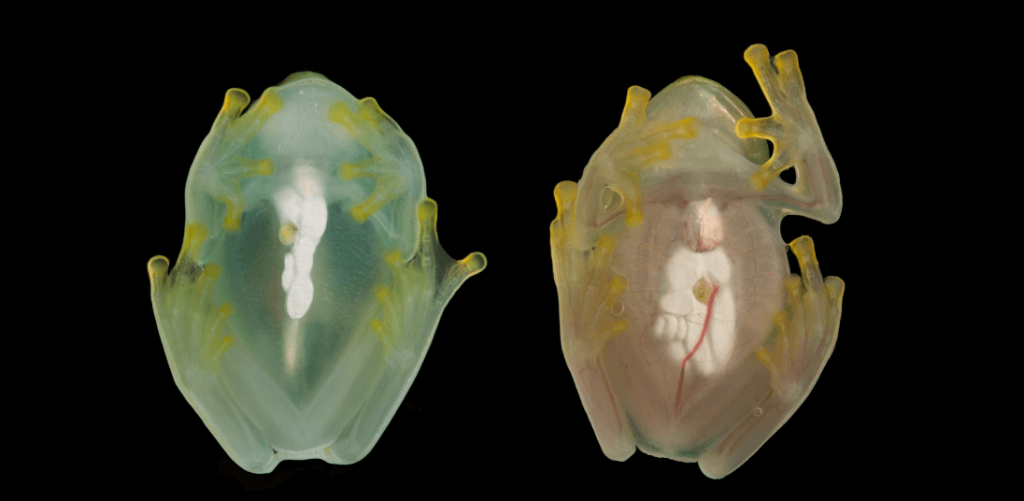 Parallel comparison of the glass frog,photographed while sleeping and active using a flash to show the difference in red blood cell perfusion in the circulatory system. Image courtesy of Jessie Delia
"Somehow the frogs filter outred blood cells from the blood and “pack” them into the liver so tightly that a clot should form. But this doesn't happen. Marvelous. How this happens, we don’t know,” explains Sönke Johnsen, co-author of the study and professor of biology at Duke University in North Carolina. According to the biologist, understanding why clots do not form in this process has implications for treating human diseases.
Northern glass frogs rarely grow larger than2.54 cm long and spend most of their lives sitting on leaves in the forest canopies of Central and South America, high above fast-flowing streams in which they lay their eggs. Their underbelly is translucent, even when the frogs are not sleeping. Thanks to this, it is possible to observe how the hearts of animals pump red blood throughout the body. But scientists have been trying to understand how frogs' bellies become transparent while they sleep, making them nearly invisible to predators.
 Photos of other frogs used for comparative research show the uniqueness of glass frogs.
Image courtesy of Jessie Delia
To better understand this phenomenon, biologists have trackedred blood cells circulating in the body of a glass frog using photoacoustic microscopy. Scientists shined a bright light on the frog's body and picked up the sound waves generated whenever the light hit hemoglobin, the protein in red blood cells that carries oxygen and gives blood its characteristic color.
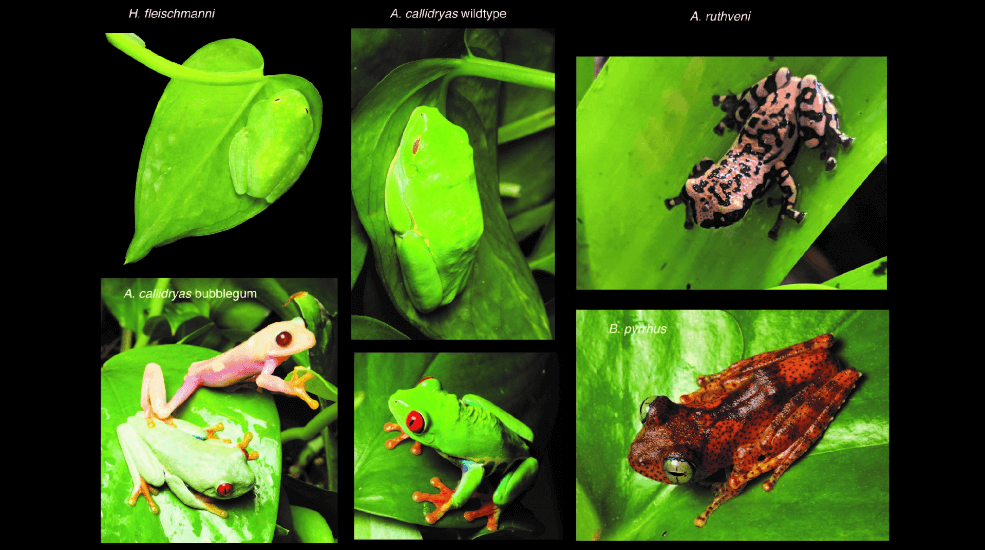 Images showing the frog species used for the comparative study.
Image Credit: Jessie Delia
During the experiment, the researchers gave the frogrest, then nudged her several times to wake her up, and then she went back to sleep. By tracking hemoglobin levels, scientists realized that animals pull 89% of red blood cells from the bloodstream and hide them in the liver. Because frogs' skin reflects very little light and blood without hemoglobin does not absorb it, they become almost completely transparent.
“What these frogs are doing is equivalent to a person taking all his blood and stuffing it into a lunch bag inside his body,” the scientists conclude.
Read more:
It turned out how old the water we drink today
17-year-old engineer came up with a magnetless motor: it can be used in electric vehicles
Two planets have been found not far from Earth. Perhaps they are inhabited
</ p>