Researchers have developed a robot that can adapt to move in different environments.
Engineers have created a low stocky robot -about 30 cm wide and 20 cm long - with four wavy telescopic limbs. Each limb consists of six nested concentric tubes. Connected with springs, these leg segments will automatically contract when the robot moves through a narrow space, and then stretch back out.
Robots that change the length of their limbs. Video: E. Lathrop et al., Advanced Intelligent Systems
The authors note that the device does not usetouch sensors and complex calculations. Changing body parameters is regulated only by mechanics. This reduces the size of the robot by eliminating additional equipment and speeds up movement: a mechanical robot does not need to calculate the path and trajectory of the limbs.
In a series of experiments, the engineers showed thatchanging segments of the legs allow the robot to make its way through narrow tunnels and crawl under low ceilings. With adaptability, it can fit into a space that is only 72% of its full width and 68% of its full height.
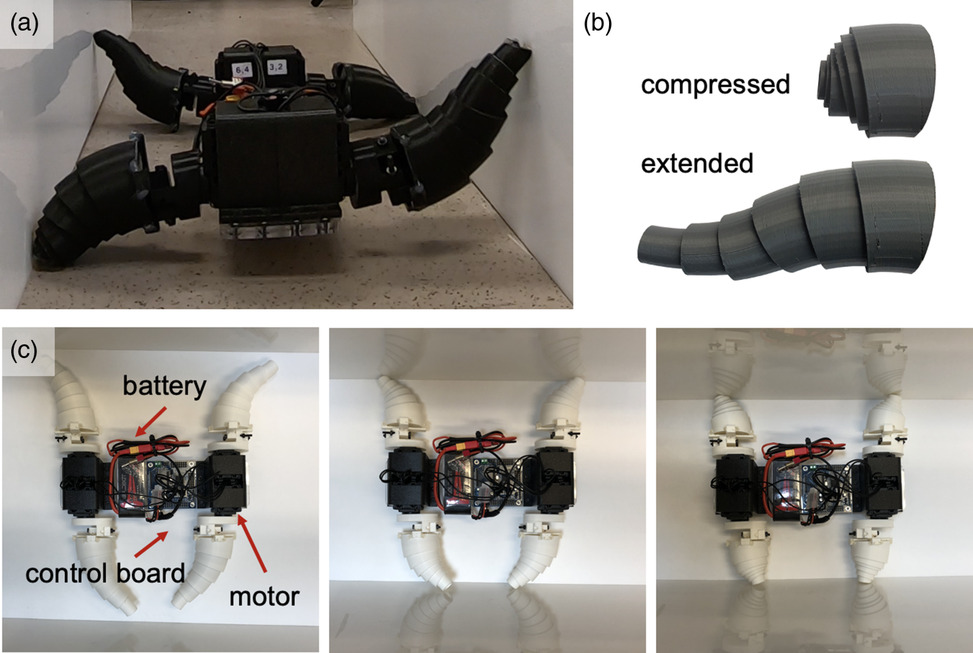 Robot device. Image: E. Lathrop et al., Advanced Intelligent Systems
The idea used in the development is borrowedat the ants. These insects adapt their posture to crawl through tiny spaces. And they are not bothered by uneven terrain or small obstacles. For example, their legs buckle a little when they hit a small obstacle, while the insects continue to move forward quickly.
Small robots without sophisticated equipmenteasy enough to produce, scientists say. In the future, they can be used to explore complex environments and conduct rescue operations. Unfortunately, while their key drawback is fragility. Engineers will continue to work to increase the strength of the devices and expand the possibilities for applying the technology.
Read more:
Land in China drilled to a record depth
It's not about the Earth: scientists explained why the solar system is the rarest
200-year-old biology mystery finally solved