What do we know about Uranus?
Uranus is the seventh planet from the Sun and the first discovered by scientists. Although he is visible
British astronomer William Herschel discovered UranusMarch 13, 1781, studying all the stars. Even those that were 10 times dimmer than the naked eye can see. One of the stars that Herschel studied seemed different, and a year later the astronomer realized that the observed object was moving in a planetary orbit.
Uranus (as it was commonly called after 1850)named after the Greek celestial deity Uranus, the earliest of the lords of the heavens. It is the only planet named after a Greek god and not a Roman one. Before the name was accepted, many names were proposed for the new planet, including Hypercronium (“above Saturn”), Minerva (the Roman goddess of wisdom), and Herschel in honor of its discoverer. To flatter King George III of England, Herschel proposed the name "Georgium Sidus" ("George's Planet"), but this idea was unpopular outside England.
German astronomer Johann Bode, who described in detailthe orbit of Uranus, gave the planet its final name. Bode argued that since Saturn was the father of Jupiter, the new planet should be named after Saturn's father.
Top 5 weird facts about Uranus
The more scientists learn about Uranus, the more often it is called a strange planet. Here's why:
- Uranus has strange rotation and tilt
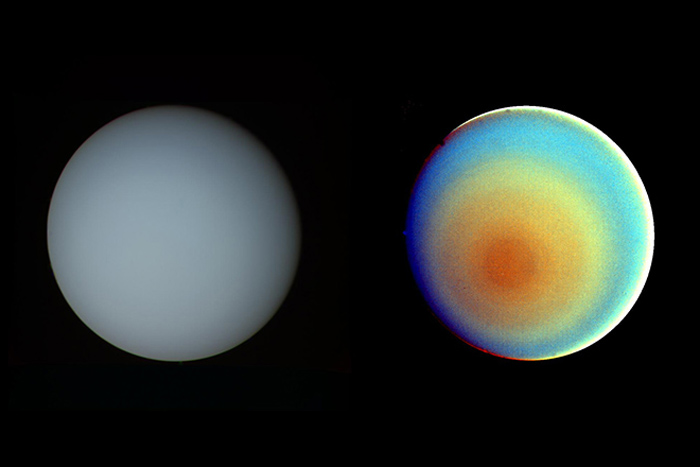
In unlike other planets of the Solarsystem, Uranus is tilted so strongly that its axis of rotation is almost directed toward the star. This unusual orientation may be due to a collision with a planet-sized body or several small objects shortly after its formation. A 2018 study found that the colliding object could have been twice the size of Earth.
 NASA / JPL-Caltech
This unusual tilt gives rise to extremeseasons that last about 20 years. This means that for almost a quarter of a Uranian year, equal to 84 Earth years, the Sun shines directly above each pole, leaving the other half of the planet to experience a long, dark and cold winter.
- Unusual storms on Uranus
The extreme tilt of the axis of Uranus could causeunusual weather. According to NASA, when sunlight reaches certain areas for the first time in years, it heats up the atmosphere, causing giant spring storms.
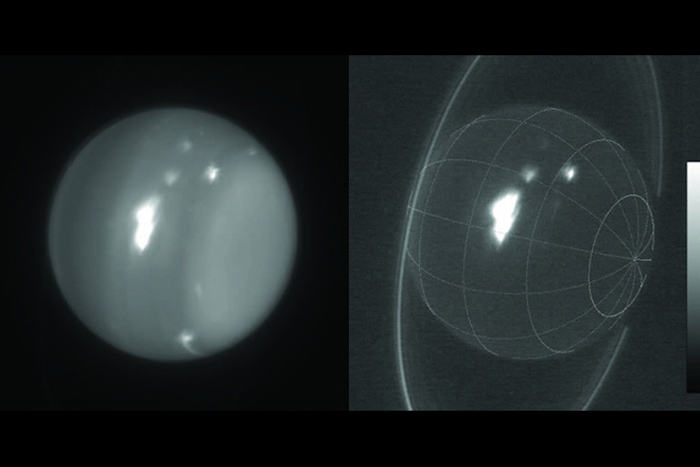
However, when Voyager 2 first photographedUranus in 1986, at the height of summer in its south, the spacecraft saw a nondescript, colorless sphere with about 10 visible clouds. This has led to it being dubbed "the most boring planet". Decades later, advanced telescopes like Hubble came into play. The long seasons on Uranus have changed and scientists have witnessed extreme weather on the planet.
 Imke de Pater (UC Berkeley) and Keck Observatory
In 2014, astronomers saw there for the first timesummer storms. Oddly enough, these massive storms occurred seven years after the planet approached the Sun. It is still a mystery why hurricanes occurred after solar heating on the planet was at its maximum.
In addition, diamond rains occur on Uranus.It is believed that carbon and hydrogen are compressed by extreme temperature and pressure deep in the planet's atmosphere to form diamonds. Then they fall down, eventually settling around the cores of these worlds.
- Uranus has rings
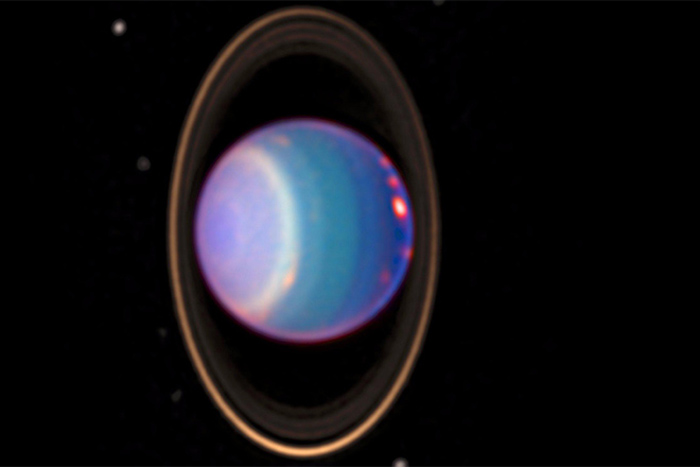
The rings of Uranus were the first to be seen since Saturn. This is how astronomers realized that rings are a common feature of planets, and not just a feature of one planet in the solar system.
Uranus has two sets of rings.The inner ring system is mostly narrow, dark, while the outer ring is made up of two more distant rings discovered by the Hubble Space Telescope and is brightly colored: one red, one blue. Scientists have identified 13 known rings around Uranus.
 NASA / JPL / STSCI
A 2016 study found that ringsUranus, Saturn and Neptune may be remnants of dwarf planets similar to Pluto. Perhaps a long time ago they strayed too close to the giant worlds. These dwarf planets were torn apart due to the enormous force of gravity and are preserved today in the form of rings.
- Uranus also has satellites
Uranus has 27 known moons.Rather than being named after figures from Greek or Roman mythology, its first four moons were named after magical spirits in English literature, such as William Shakespeare's A Midsummer Night's Dream and Alexander's The Rape of the Lock Pope. Since then, astronomers have continued this tradition, drawing the names of the moons from the works of Shakespeare or Pope.
Oberon and Titania are the largestthe moons of Uranus, and they were the first to be discovered by Herschel in 1787. William Lassell, who was also the first to see a moon orbiting Neptune, discovered the next two moons of Uranus, Ariel and Umbriel. Almost a century passed before Dutch-American astronomer Gerard Kuiper, of Kuiper Belt fame, found Miranda in 1948.
In 1986, Voyager 2 visited the Uranus system anddiscovered 10 more moons, all from 26 to 154 km in diameter: Juliet, Pak, Cordelia, Ophelia, Bianca, Desdemona, Portia, Rosalind, Cressida and Belinda. Each of these moons is roughly half water ice and half stone.
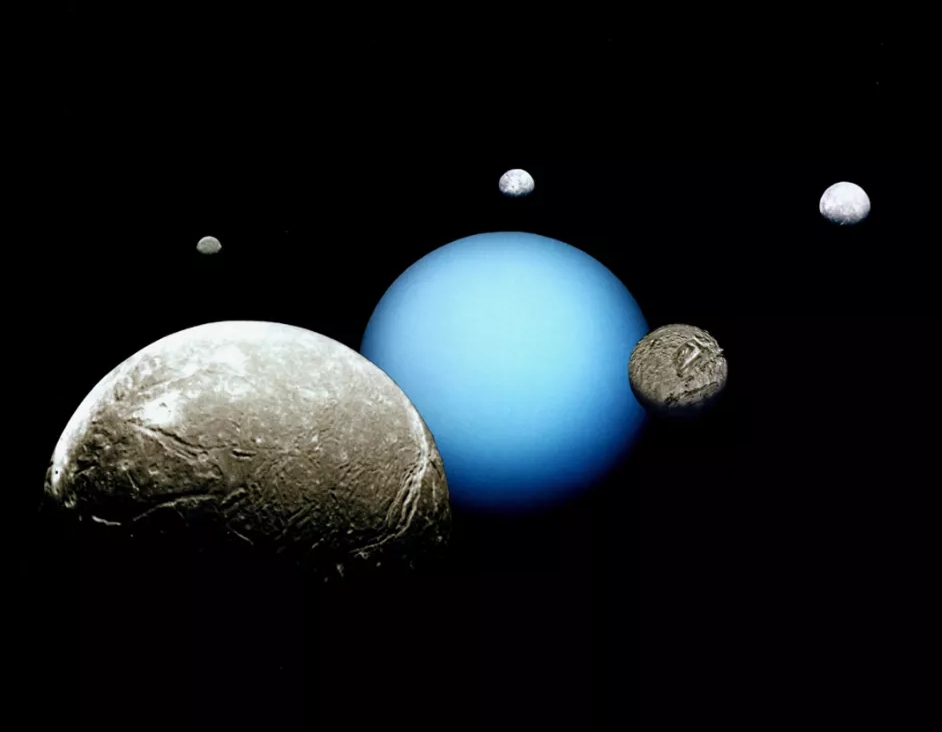 Uranus and its five main moons are depicted inThis montage of images taken by the Voyager 2 spacecraft. Moons, from largest to smallest, as they appear here, — these are Ariel, Miranda, Titania, Oberon and Umbriel. (Image credit: NASA/JPL)
Since then, astronomers using Hubbleand ground observatories, increased the total number of known satellites to 27, and discovering them was not easy—they are only 12 to 16 km across, blacker than asphalt and almost 4.8 billion km.
Between Cordelia, Ophelia and MirandaThere is a swarm of eight small satellites closely packed together that astronomers do not yet understand how the small satellites managed to avoid colliding with each other. Anomalies in the rings of Uranus lead scientists to suspect that there may be more moons.
In in addition to its moons, Uranus canhave a set of Trojan asteroids—objects located in the same orbit as the planet—in a special region known as the Lagrange point. The first was discovered in 2013, despite claims that the planet's Lagrange point would be too unstable to host such bodies.
- Uranus is not the farthest planet, but the coldest
As many schoolchildren know, Uranus —outer planet of the solar system. Neptune is the next known planet beyond its reach, and perhaps there may be another large planet further away (dubbed "Planet Nine" by the astronomers who proposed its existence). To the surprise of planetary scientists, it turned out that Neptune is not the coldest planet known in our solar system; this is Uranus. This is because Uranus does not have an internal heat source to supplement the sun's heat.
 NASA / JPL
New exploration of Uranus
Even in the context of the solar system, educationUranus and Neptune remain a mystery. Scientists from the Universities of Zurich and Cambridge, affiliated with the Swiss NCCR PlanetS, have proposed an interesting explanation, backed by extensive modeling. Their results were published in the scientific journal Nature astronomy.
Despite the fact that all the planets of the solar systemknown, this does not mean that scientists know everything about them. Moreover, thanks to data obtained from various satellites and probes, experts continue to make discoveries almost every day.
In 1977, NASA launched a space probeVoyager 2, designed to explore the distant planets of the solar system. In 1986, he reached Uranus, and in the hands of scientists were incredible data about this planet. Moreover, the study of these data, even today, allows astronomers to make new discoveries.
Recently, Uranus has once again confirmed itsthe status of the original planet, reports Planet Today. Its rotation around its own axis is retrograde. If other planets look like a spinning top, then Uranus is more like a ball rolling in place. This state of affairs affects not only the special change of day and night on the planet, but also its magnetic poles.
One of the most recent studies by astronomers inGeorgia has shown that Uranus's magnetic field rotates with it. Simply put, there is a daily change of magnetic poles on the planet. If we assume that there will be a change of poles on Earth, then the planet is threatened with a complete collapse. On Uranus, such a catastrophe occurs daily.
For a detailed study of this and other features of the most unusual planet in the solar system, NASA scientists plan to develop a project to organize an unmanned mission to Uranus.
Read more
Physicists have created an analogue of a black hole and confirmed Hawking's theory. Where it leads?
Algorithm has discovered a new mysterious layer inside the Earth
Because of the Sun, the Earth's atmosphere will lose all free oxygen
Lagrange points, libration points or L-points -points in a system of two massive bodies, in which a third body with negligible mass, not experiencing any other forces, except for gravitational forces from the first two bodies, can remain motionless relative to these bodies.
Astronomer Heidi Hummel in The Ice Giant Systems of Uranus and Neptune, a chapter in Renewing the Solar System (Springer, 2007), a collection of surveys in solar system science.
Portia Cato - Roman matron, daughter of MarkPortia of Cato the Younger, who headed the conservative part of the Senate at the end of the Roman Republic. According to one of the versions of ancient tradition, Gneus Pompey the Great wooed Portia, but failed.