Content
- Video review
- Equipment and design
- Software
- Camera
- Performance and Benchmarks
- findings
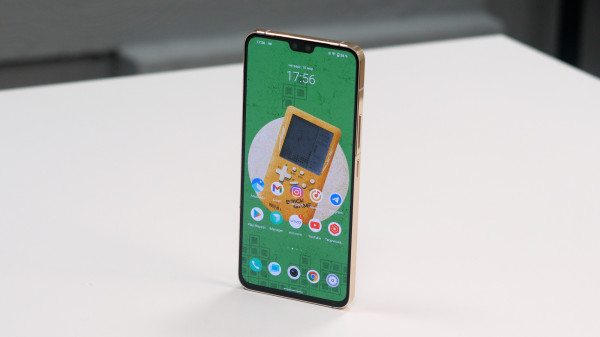
vivo started 2022 in Russia with an updateV-series - its main international line of mid-range smartphones. The main model, vivo V23, was announced in Russia in mid-February with very invigorating price tags: 40,990 rubles for the 128 GB version and 49,990 rubles for the 256 GB model. This is still without adjustments due to changes in the ruble exchange rate! How does the company justify this price? The main focus is on a cool front camera and, of course, a design that sets vivo apart from any Android competitors. But is this enough? Let's try to answer the question.
 |
Vivo V23 Specifications |
|---|---|
| Network | 2G, 3G, 4G, 5G |
| Firmware | Android 12 with Funtouch OS 12 |
| Screen | 6.44″, 2400×1080 pixels, 20:9, 409 ppi, AMOLED, 90 Hz, 180 Hz touch |
| Chipset | MediaTek Dimensity 920, 6 nm CPU: 2 x A78 x 2.5 GHz + 6 x A55 x 2 GHz GPU: Mali-G68MC4 |
| Ram | 8/12 GB |
| ROM | 128/256 GB |
| SIM and memory card | Dual SIM slots, no memory card |
| Camera | Triple Main: 64 MP, Samsung GW1, 0.8 micron, 1/1.72″, f/1.89, video recording 2160p@30fps Wide Angle: 8 MP, f/2.2, 1080p@30fps video recording Macro: 2MP, f/2.4 |
| Selfie | Double Main: 50 MP, Samsung JN1, 0.64 micron, 1/2.76″, f/2.0, video recording 2160p@30fps Wide: 8 MP, f/2.28, 1080p@30fps video recording |
| Battery | 4200 mAh |
| Charging | 44W USB Type-C |
| Wireless interfaces | WiFi 5 Bluetooth 5.2 GPS |
| NFC | there is |
| Biometrics | Fingerprint scanner (on screen) |
| Sound | Mono |
| Water protection | Not declared |
| Dimensions and weight | 157.2 x 72.42 x 7.39..7.55 mm 179..181 g |
| Price |
Video review
Equipment and design
By today's standards, vivo puts in a box tothe smartphone has an unusually large number of accessories: a protective case, 44-watt charging, a USB cable, wired headphones and a 3.5 mm -> USB-C adapter. The last element of the kit is necessary to use the penultimate one - according to the already established tradition, complete headphones cannot be directly inserted into a smartphone. Perhaps someday vivo will switch to Type-C ears, but I don’t really believe in it. Well, in general - a very cool set, I like it. I will add that a protective film is applied to the glass from the factory, which is also pleasing.
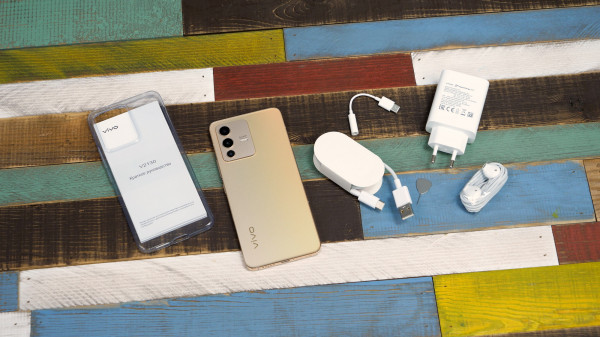
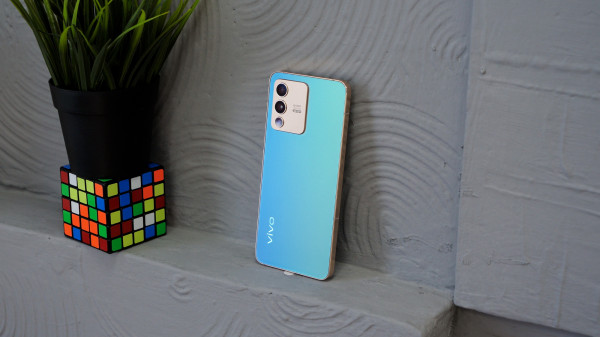
The standard case sits very tightly on the phone,removing it is torment, so it definitely won’t fly off when it falls. And I don’t advise you to use any other covers: you can’t hide such beauty. The frosted glass back of the vivo V23 is unique in its photochromic coating, which changes color when exposed to sunlight. In low light, the phone is completely golden, under the lights it begins to cast green, and in the street under the bright sun it becomes completely green-blue. Moreover, only those parts of the case that are exposed to light change color - so you can, for example, put your phone against a chain-link fence for a couple of minutes, and then you will have a checkered phone. The scope for imagination is unlimited.
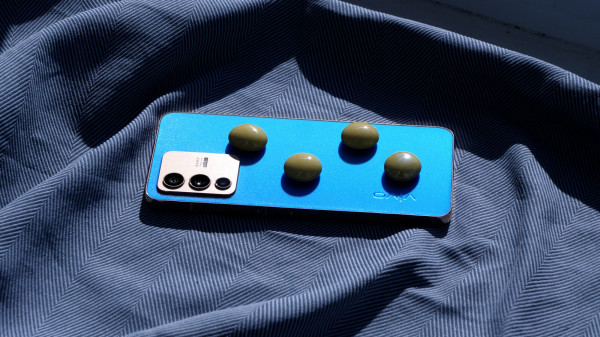
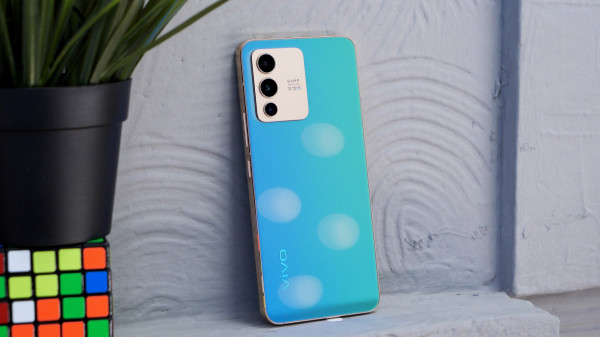
In fairness, vivo did not come up with this -the first photochrome in a smartphone was used by Smartisan. Her white R2 flagship had text on the back that showed under the light. But the invisible text on the lid is cool, but not as chameleon-like as the vivo V23. A device that changes color and retains patterns is cool. But I must say that all my enthusiasm relates to only one color of the smartphone: “solar spectrum”. Stardust is the classic black variant.
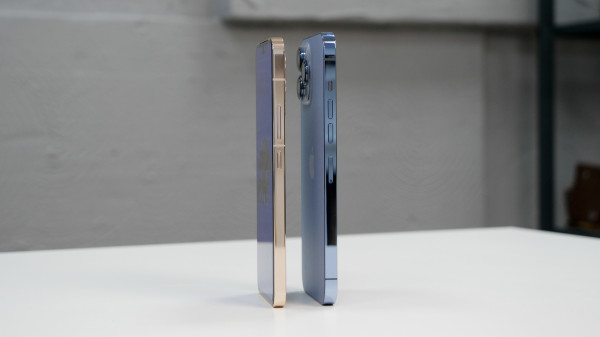
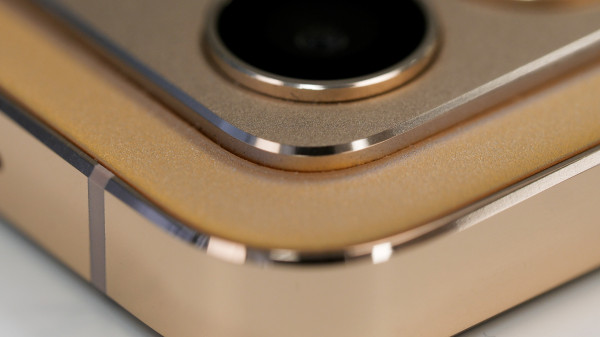
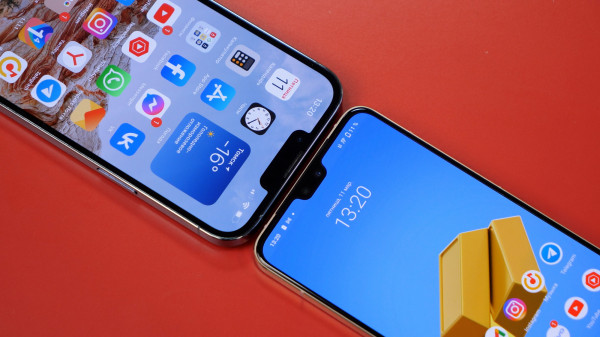
vivo V23-iPhone 13 Pro Max
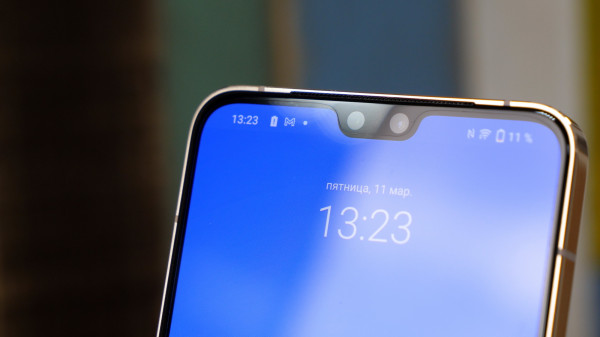
However, there are interesting things in the design of vivo V23solutions that do not depend on color. These include flat ends, made of aluminum polished to a high shine, and a BANG. Nobody makes such a long cutout from Android manufacturers anymore. Well, that is, literally no one, only vivo continues to make devices with this design: V23, V23 Pro that did not reach Russia, their Chinese analogues S12 / S12 Pro… that's all. No one else. It's easy to see why. But I have to admit, the vivo V23's notch didn't irritate me at all during use. And the design, in general, caused only delight.
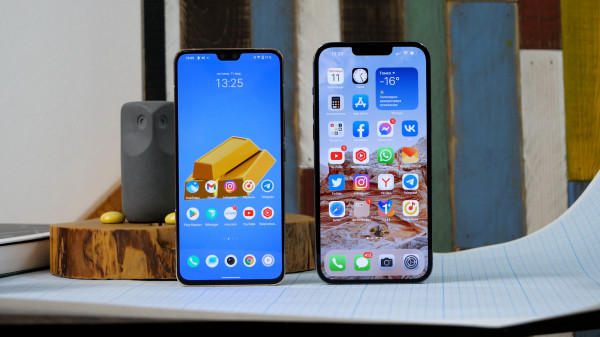
vivo V23-iPhone 13 Pro Max
Now about the rest of the screen.It is quite small (6.44″), with a standard resolution (2400x1080 pixels) and a rather conservative refresh rate of 90 Hz. The minimum frequency is 60 Hz, that is, autohertz can be turned on without fear that the phone will suddenly decide to operate at 10 Hz (say hello to OnePlus). However, the autohertz frequency here is quite evil, and in many applications it switches to 60 Hz unnecessarily. So, if you want smoothness everywhere, turn on constant 90 Hz. Overall the panel is good: bright, rich, with excellent viewing angles.
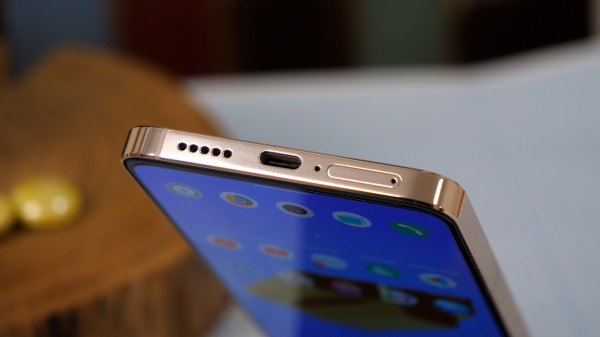
A fingerprint scanner is hidden inside the screen.It works quite accurately, but it feels like it was saved on it. Even by the standards of optical fingerprint scanners, it takes quite a long time to recognize. Saved not only on it: the smartphone does not have stereo speakers (even "one and a half") and a linear vibration motor ("taptika") - music is played only from the lower speaker, and buzzing will be a response to your touches.
Software
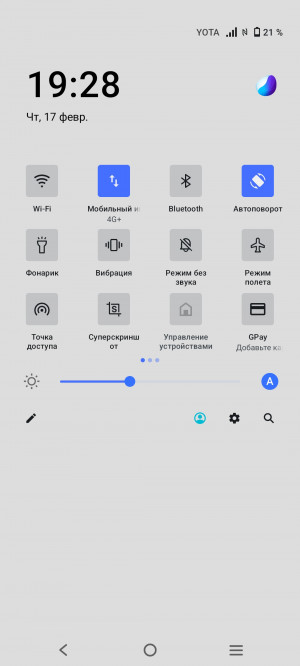
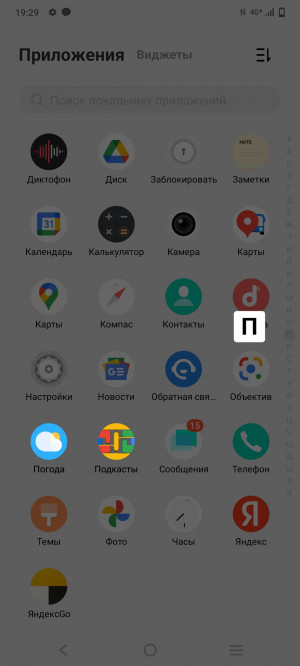
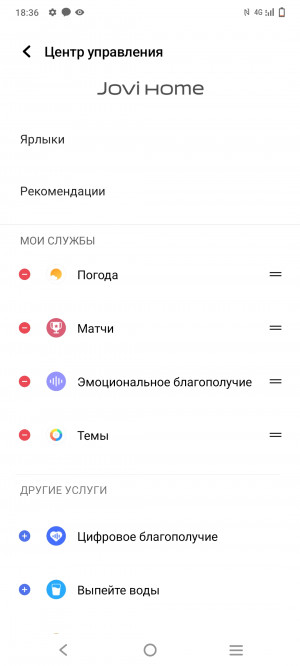
Once upon a time, I regularly scolded Funtouch OS inreviews. Then the shell took a huge step forward, and I began to call it almost one of the best Android firmware. But the pendulum must, literally must, swing back: Funtouch OS 12, on which the vivo V23 is based, raises more questions than it answers. Localization problems have begun to multiply again, and strangely designed interfaces are found at every turn. It is clear that vivo threw all its forces into OriginOS, but hey, you actually still have international markets. Either develop your “fantach” with dignity, or bring Origin to the world.

Cameras
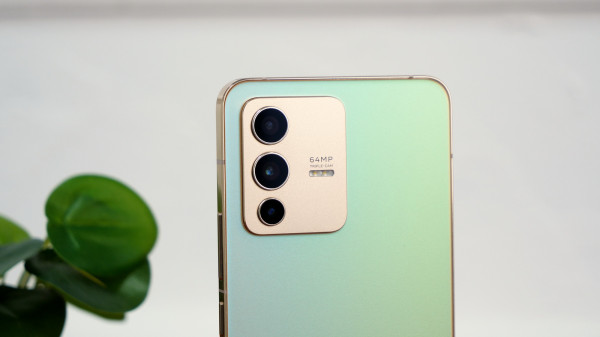
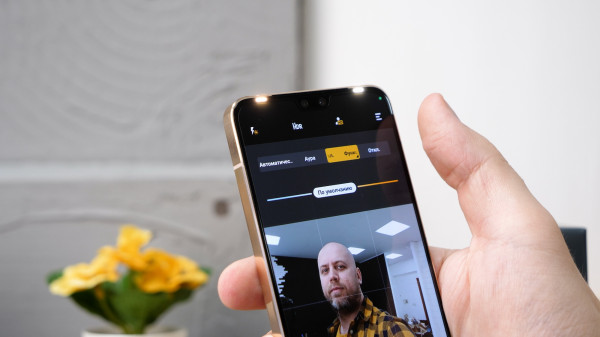
The vivo V23 rear camera is triple.The main module is 64 MP based on the Samsung GW1 sensor (used in Realme XT and Redmi Note 8 Pro, the first 64 MP smartphones in the world), it is complemented by an 8 MP wide camera and a 2 MP macro camera. Additional lighting can be provided by two LEDs, collectively referred to as a flash. The front collection is very similar, except that the macro camera was removed and the main matrix was replaced with a more modest 50-megapixel Samsung JN1 sensor (wide from OnePlus 10 Pro and Xiaomi 12 Pro). Thus, the front also has a width of 8 megapixels (it was not in vain that the bangs were made!) And a double LED flash - one diode each on the left and right for symmetrical face illumination. First, let's look at the photos from the rear cameras:














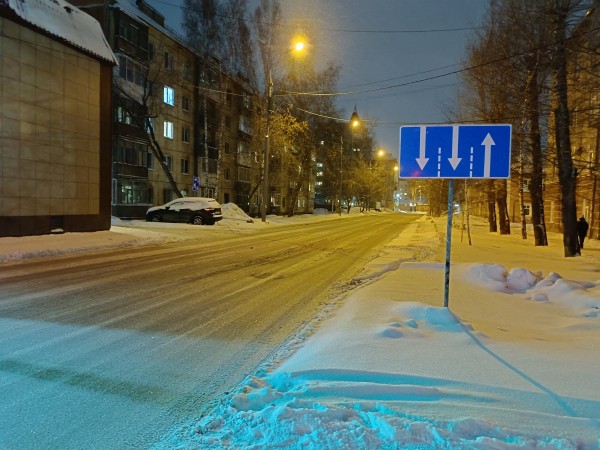
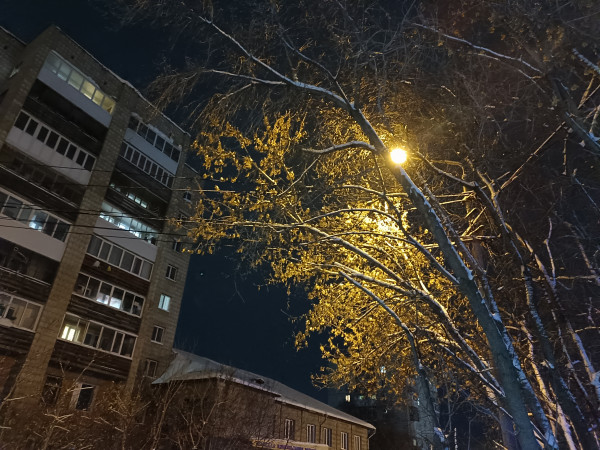
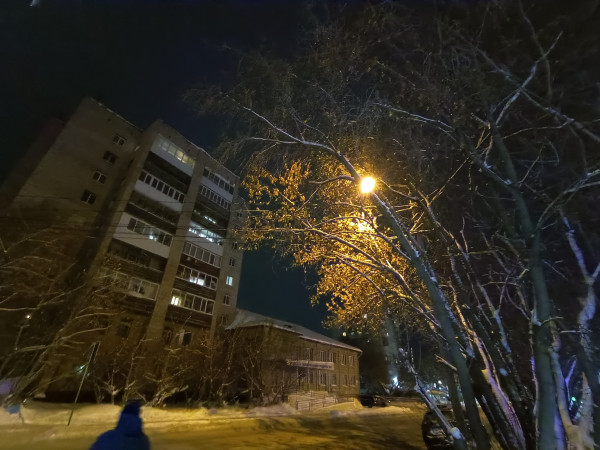

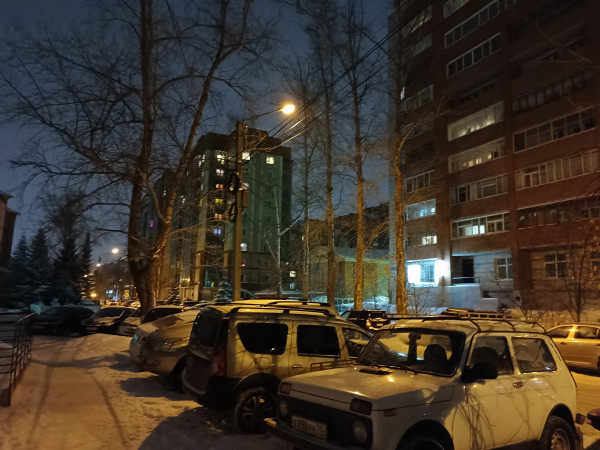

Good intermediate level.With sufficient lighting, most photographs turn out well. You can note a not very wide dynamic range (even with HDR turned on) and an overly aggressive noise reduction, due to which some details are lost. And on early firmware, autofocus failed. At night, both the width and GW1 weaken as expected, but the result is still quite good (for an average). You can, of course, activate the night mode, but it clearly "replays", and the result is obtained for an amateur. In general, decide for yourself what you like best. The macro camera, surprisingly, is not quite a gag, and sometimes it really shoots better than the main one.

I'm used to using the front camera on itsintended purpose, but given the steepness of the modules standing here, this is not at all necessary. The main 50-megapixel front camera has autofocus, so you don’t have to adjust to a fixed focusing distance. Selfies are excellent, this is really one of the best front cameras in modern smartphones. The 8-megapixel front camera allows you to take very cool pictures against the background of large objects - the quality is cool. It's nice that vivo put it in the bangs, and not a 2-megapixel plug or sensors in general, as sometimes happens with competitors.
All examples of photos and videos from vivo v23 cameras
Video capabilities for rear and front camerasthe same: 4K@30fps or FHD@60fps on the main camera, FHD@30fps on the wide. I’ll scold a little for low detail: if 1080p looks like 1080p, then 4K is no longer pulling (although the bitrate seems to be rather big - 50 Mbps). At the same time, I can't help but praise EIS: the video sequence is really smooth, and ghosting is minimal. But there are other artifacts; take a closer look at the road in the "Very strange video.mp4" example from the link above, for example. By the way, on early firmware, autofocus was also weird in the video, but then it was corrected. In general, vivo can fix camera jambs in updates (we also judge by vivo X70 Pro +), which pleases.
Performance and tests
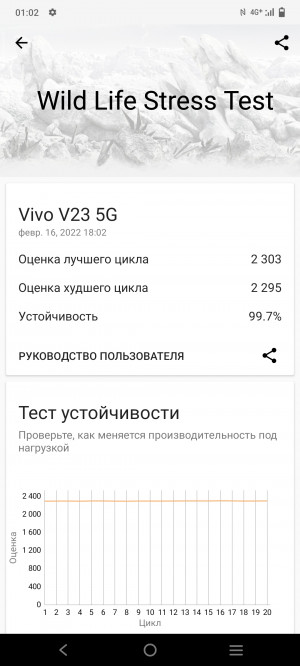
vivo V23 hardware base - dialingthe popularity of the MediaTek Dimensity 920 chipset. It debuted last fall in the Chinese version of Redmi Note 11 Pro, and this year it appeared in the international vivo (V23) and Realme (9 Pro +) models. This is a fairly standard mid-range chipset: two powerful cores (A78 at 2.5 GHz) plus six power efficient ones (A55 at 2 GHz). Graphics - Mali-G68MC4. In general, this is a slightly overclocked version of the Dimensity 900, and in terms of CPU structure it is very close to the Snapdragon 695 (except that the snap has lower frequencies). Here are screenshots from benchmarks:
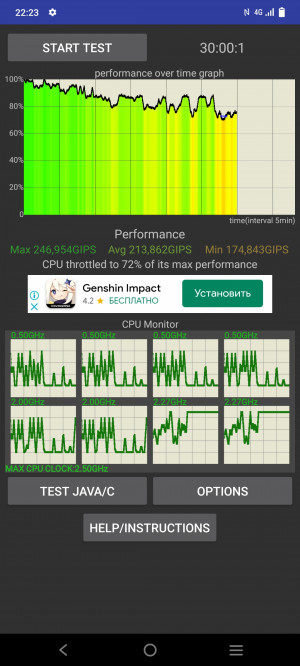
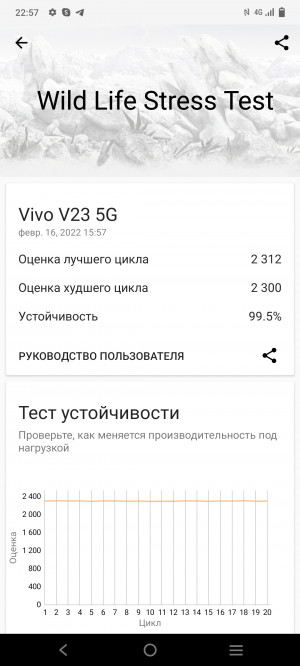
normal mode
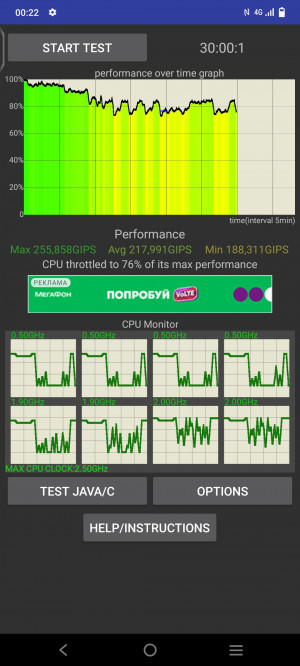
Game Mode
Okay, even very good!We are pleased with the results in absolute terms, and the minimum decrease in performance under load. Judging by the graphs, Dimensity 900 is not much inferior to the successful Snapdragon 778G, and judging by the games, too. The difference can only be felt in Genshin Impact - here the frame rate at maximum speeds is lower than that of Realme GT Master or Xiaomi 11 Lite 5G NE, but still enough to play without much discomfort. From other games, problems arose only with ARK, which for some reason crashes at startup. All the other games we tested run great.
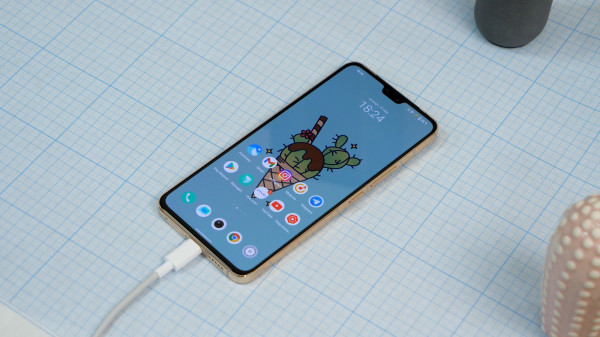
In addition, there are no problems with hertz.When auto refresh rate is disabled, 90Hz is active in all games (but may transition to 60Hz if the screen is not touched for a long time). The touch frequency is 120 Hz in the interface and 180 Hz in games. The smartphone heats up noticeably, but not much - I have never had any discomfort from holding the phone in my hands. But the lack of stereo sound is sad, the impressions in many games can be spoiled.




Slim case vivo V23 (7.39 mm in blackvariant and 7.55 mm for the chameleon) could not accommodate a large battery. The battery capacity is only 4200 mAh. However, this is not so little, so in combination with energy-efficient hardware and a 90-Hz AMOLED screen, the autonomy is quite good: in standard tasks (browsing, calls, camera) - about six hours of screen in a day and a half. So you don’t have to worry that the smartphone will not survive until the night, but it will be difficult to stretch two days on one charge. Synthetic: minus 13% for two hours of video (about 15 hours on a full charge), minus 19% for an hour in the game (about 5 hours on a full charge).
Conclusions
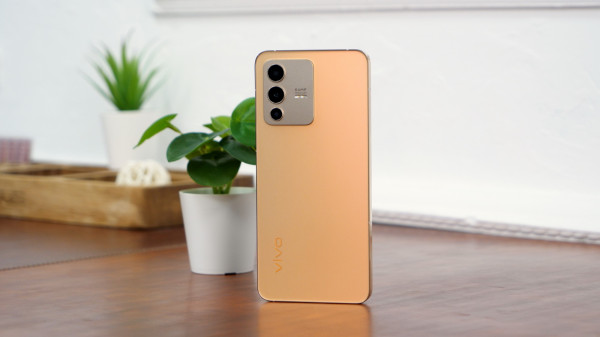
Official description of vivo V23 on the websiteThe manufacturer begins with a quote from Pushkin: “I remember a wonderful moment.” You may not believe me, but I didn’t know this when I came up with the title for the review in the form of another Pushkin quote (in which, alas, I had to change the gender of the adjective). And this quote seems to me to more accurately describe the vivo V23 - it is certainly one of the most beautiful smartphones on the market, with excellently crafted materials and an absolutely extraordinary chameleon color scheme. But there is no linear vibration motor, no stereo, and the main camera lacks the OIS that the V21 had. Therefore, the issue of price is important here. If vivo manages to leave the price the same as it was at the start, then more or less. And if the price is increased, adjusted for the dollar exchange rate, then ouch.
Read us on Telegram
© Oleg Lazarev.