Researchers from the University of Manchester used the work of volunteers from the Galaxy Zoo project to
Galaxies live a chaotic life.Collisions with other galaxies and outbursts of energy from supermassive black holes change the colors and orbits of billions of stars, leaving telltale markers, the scientists explain. Volunteers from the Galaxy Zoo project are looking for such footprints to help scientists explore the universe. The difficulty is that you need to study millions of images in order to understand which events correspond to each marker.
To increase the speed of work, a scientist fromThe University of Manchester used data collected over ten years of the Galaxy Zoo project to train an assistant algorithm. In total, more than 96 million records were collected in the set. The system can answer 50 different questions from users, helping to correctly identify the events found and identify volunteers' mistakes.
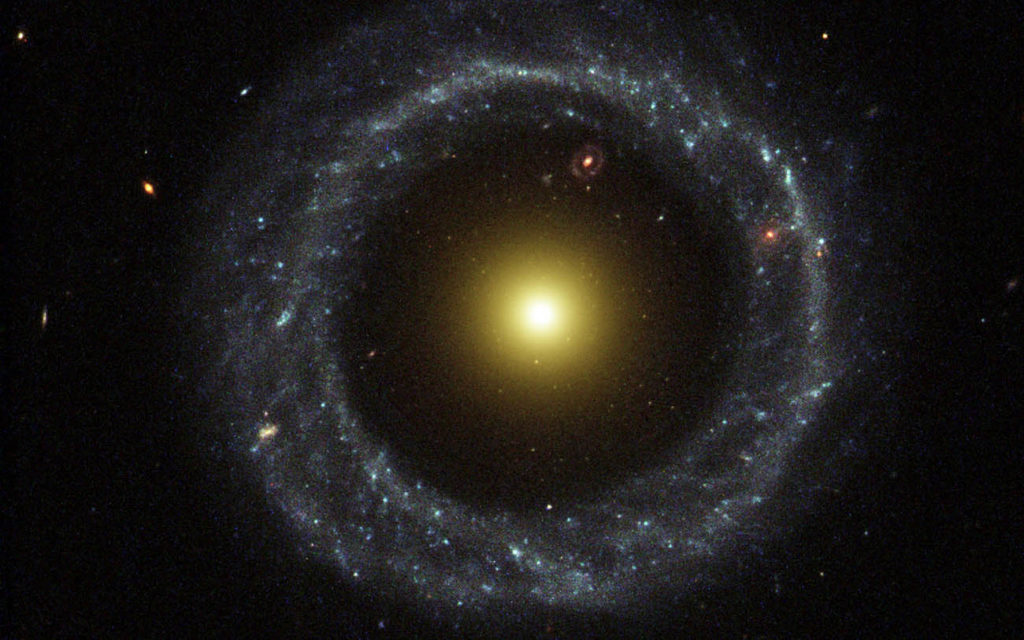 Hoag's Object is a ring-shaped galaxy in the constellation Serpens. Photo: NASA/ESA and The Hubble Heritage Team (STScI/AURA)
The researchers note that thanks to the joint work of the project participants and the algorithm, 40 thousand rare ring-shaped galaxies have already been found. This is six times more than previously known.
The ring galaxy isa dense core surrounded by a ring of bright young stars separated from the core by some distance. The formation of such rings takes billions of years. However, they are easily destroyed when colliding with other objects. A huge array of new data will help to study the development and aging of isolated galaxies.
Cover image: Ring galaxy AM 0644-741. Source: NASA, ESA, and The Hubble Heritage Team (AURA/STScI)
Read more:
The oldest Voyager 1 mission has a strange glitch that cannot be fixed
The James Webb telescope took the first picture of Jupiter: it shows 9 moving targets at once
Scientists have found a "Pandora's box" in the bowels of the Earth: the energy from there feeds life on the planet