A team of chemists from the University of Illinois at Urbana-Champaign, the University of California at Santa Barbara and
Polyethylene ((C₂H₄)n) is the most popular type,which accounts for up to 29% of the total plastic consumption in the world. Conventional recycling methods convert #2 plastic (HDPE) and #4 plastic (LDPE) into many low-value organic molecules for which there is limited demand.
In a paper published in the AmericanChemical Society, the researchers propose an alternative: to create from polyethylene propylene, a key component of polypropylene ((C₃H₆)n) or No. 5 plastic (PP). This is the second most popular plastic, which occupies up to 25% of the market.
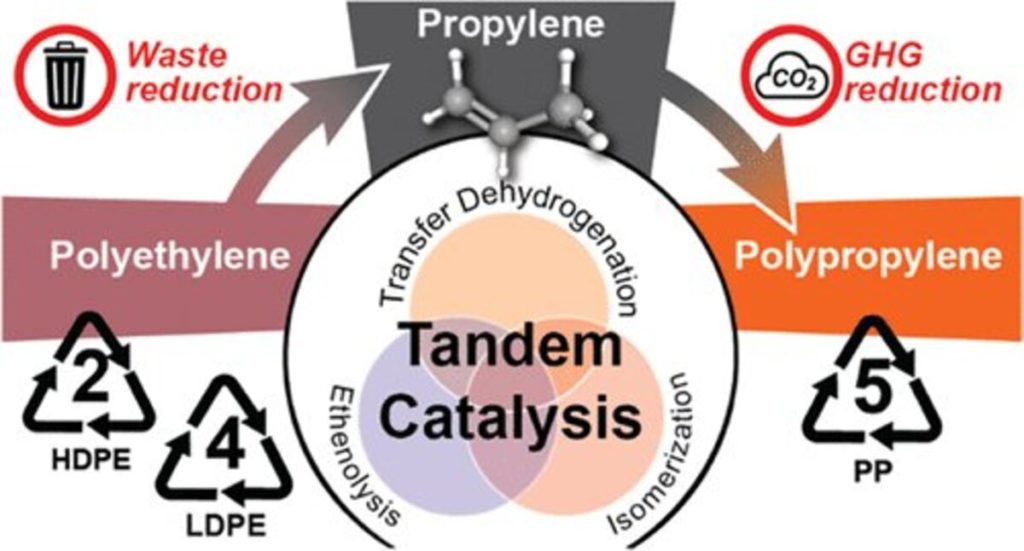 The principle of processing. Image: Nicholas M. Wang et al., American Chemical Society
The essence of the technology is to cuteach very long PE molecule many times to get many small pieces. Three catalysts are enough for this, the authors of the study explain. The first catalyst removes hydrogen from the polyethylene, creating a reaction site in the chain. The second one splits the chain into two parts and closes the ends with ethylene, and the third one moves the reaction site along the polymer until only individual propylene molecules remain from it.
The researchers note that theirThe method does not require significant energy costs. At the same time, as a result of tests, a scalable reactor was created, which ensures the conversion of polyethylene into polypropylene with a yield of up to 95%.
Read more:
Catapult sends NASA satellites into the sky
A giant magnetic storm is approaching Earth
Recreate the Sun on Earth: how physicists solved the main problem of thermonuclear fusion