The European Space Agency and NASA used the capabilities of the James Webb Space Telescope,
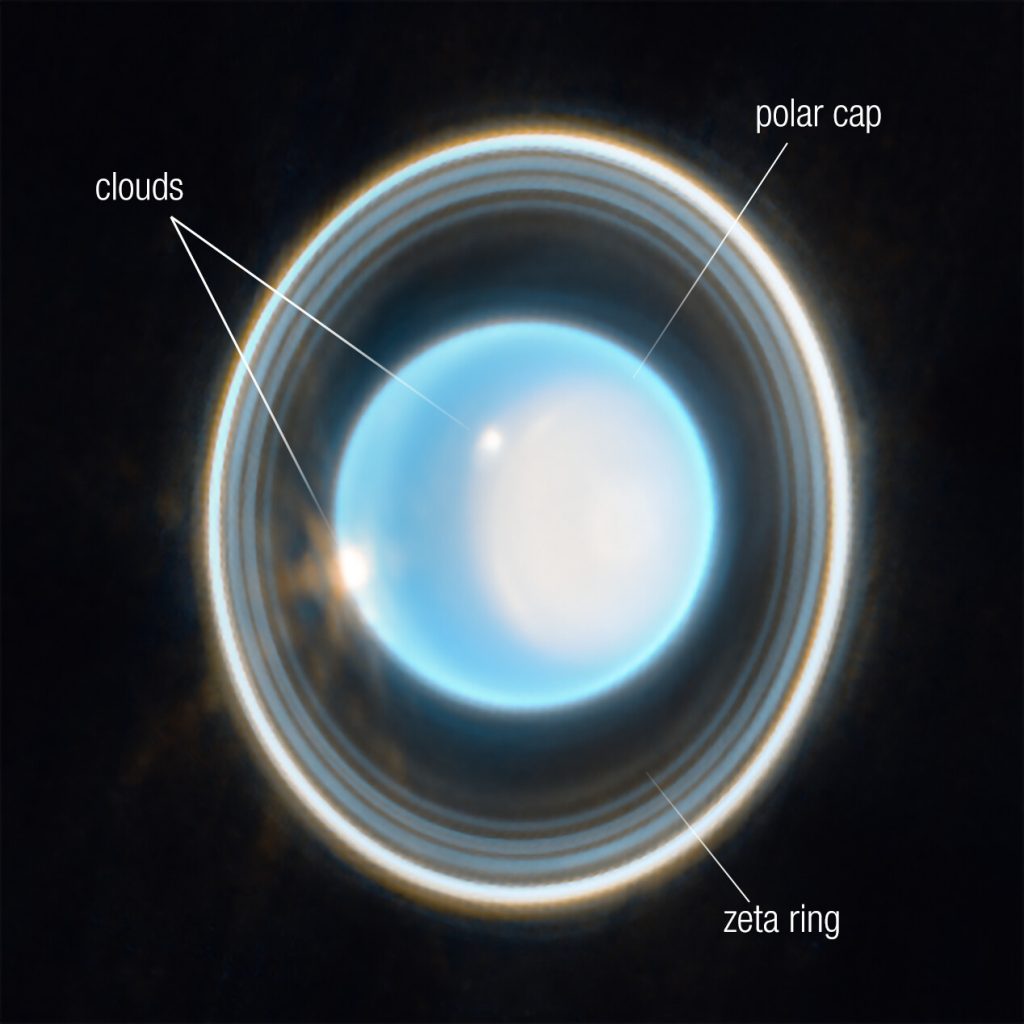 A near-infrared image of Uranus taken by the James Webb Space Telescope. Image: NASA, ESA, CSA, STScI, J. DePasquale (STScI)
Uranus is a unique planet in the solar system.Unlike all other planets, it rotates almost on its side: the tilt of its axis of rotation is 97.77 ° (for comparison, the Earth has 23 °). This leads to extreme conditions: the planet's poles experience constant sunshine for more than 40 years, followed by the same number of years of complete darkness.
On the right side of the planet, a brightthe region near the north pole is the polar cap. Such areas form when the pole is exposed to direct sunlight in summer and disappear in autumn. The Webb shots show an increase in brightness in the center of the cap. The researchers believe that the infrared sensitivity of the telescope will help to better understand the mysterious mechanism of formation of such structures.
 Uranus and six of its moons as seen by the James Webb Space Telescope. Image: NASA, ESA, CSA, STScI, J. DePasquale (STScI)
There is a bright cloud at the edge of the polar cap, andalso a few fainter extended elements next to it. Another such bright "spot" is visible on the left edge of the image. Such clouds are typical of Uranus in the infrared and are thought to be associated with storm activity. In addition, the telescope's sensitive optics show thin dust rings surrounding the planet.
Earlier this year, scientists published imagesice giant in the solar system, taken by the Hubble Space Telescope. Unlike Webb, it uses a combination of visible and ultraviolet light for observation. Data collected by various instruments will help to better understand this unusual planet.
 Uranus in Hubble images in November 2014 and November 2022. Image: NASA, ESA, STScI, A. Simon (NASA-GSFC), M. H. Wong (UC Berkeley), J. DePasquale (STScI)
Read more:
Scientists have figured out the nature of strange radio signals from a planet similar to Earth
A red halo flared up over Italy. Now its nature has been explained
Webb has found the oldest black hole in the universe