Planetary scientists from the University of Leicester's School of Physics and Astronomy have unveiled new images of Europa
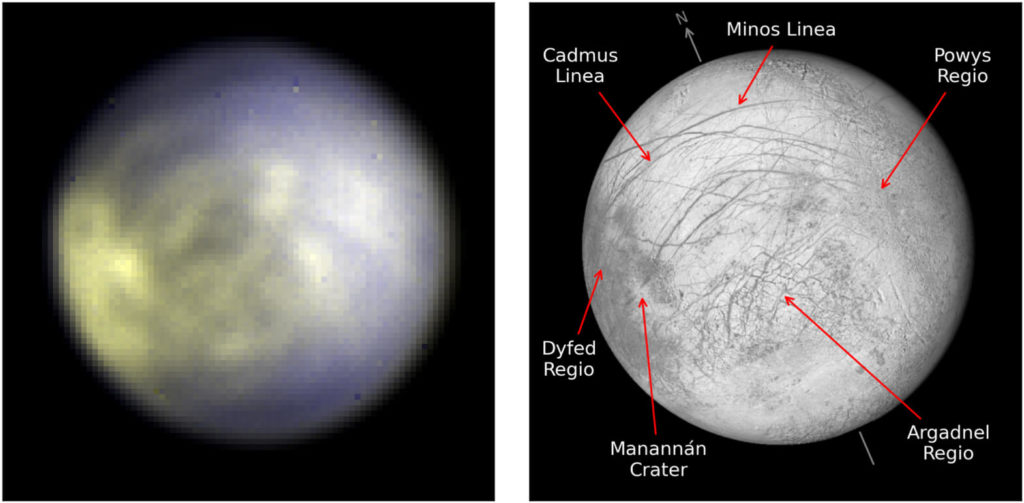 Distribution of water ice on Europa's surface(left, dark blue areas show ice thickening) and a simulated visible-light image of this moon's crust (right). Image: Oliver King et al., Planet. sci. J.
An analysis of the reflected light spectrum showed thatEuropa's crust is primarily composed of frozen water ice, with non-glacial materials contaminating the surface. At the same time, from the side facing Jupiter, it is covered with frost from salts of sulfuric acid.
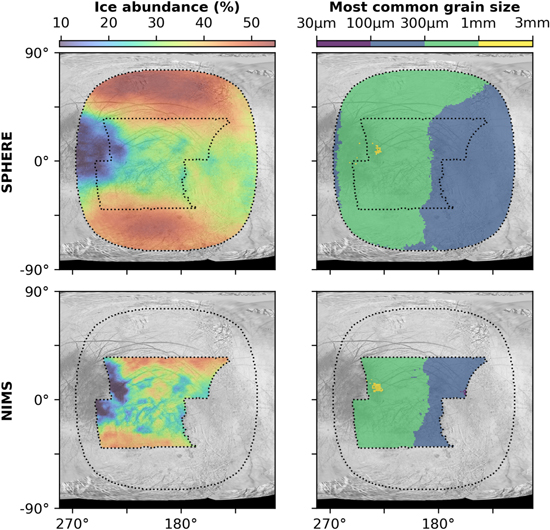
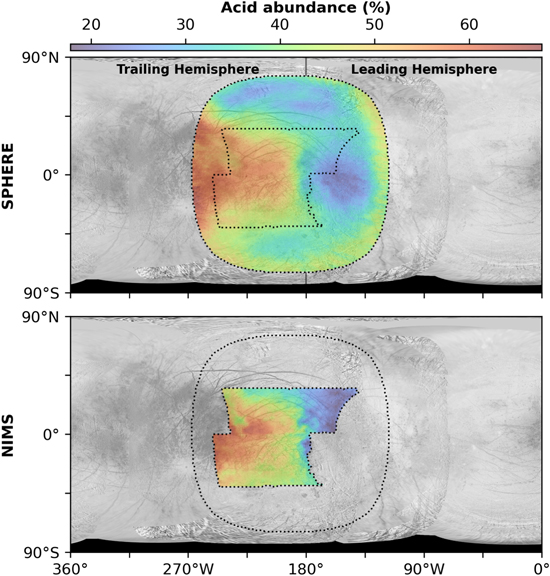
Distribution of water ice (left) and sulfuric acid (right) on the surface of Europa. Image: Oliver King et al., Planet. Sci. J.
Exploration of Ganymede, the largest satellite inThe solar system showed that the surface consists of two main types of relief. Young areas of the crust contain large amounts of water ice. Ancient sites are dark formations on the surface, the composition of which has not yet been determined.
Young ice regions include the polar caps andthe craters of Ganymede, where the impact exposed the fresh, clean ice of Jupiter's moon's crust. Scientists have mapped how the size of ice grains on Ganymede varies across the surface, and the possible distribution of various salts.
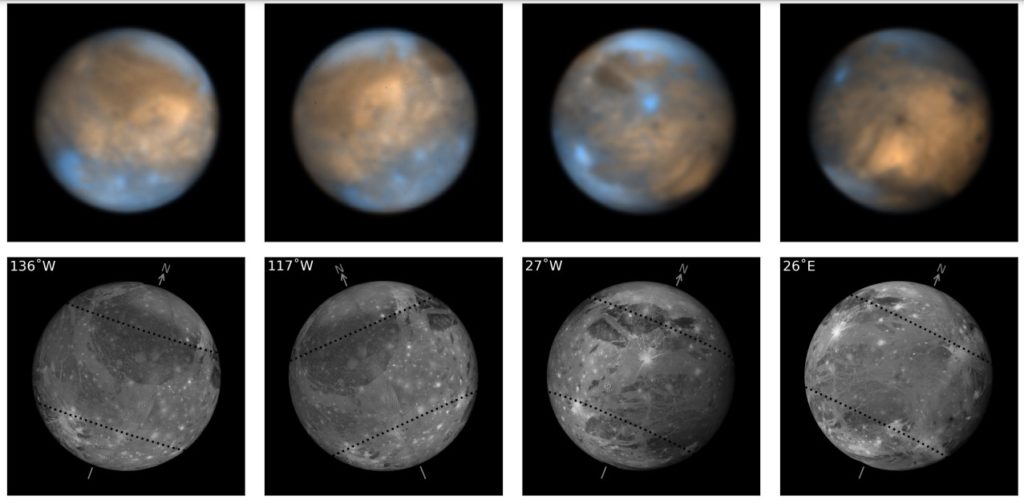 Distribution of water ice on the surface of Ganymede (top) and simulated visible light image of the moon's crust (top). Image: Oliver King et al., JGR: Planets
Both satellites were studied withwith the Very Large Telescope (VLT) located in Chile and operated by the European Southern Observatory. Scientists recorded the amount of sunlight reflected from the surfaces of Europa and Ganymede at different wavelengths of infrared radiation, which made it possible to form reflection spectra.
With this approach, planetary scientists were able toperform detailed mapping of Europa and Ganymede, observing the features of their surfaces less than 150 km across from a distance of more than 600 million km. Mapping at such a small scale was previously only possible by sending a spacecraft to Jupiter, the authors say.
Read more:
An unknown species of winged insect "hidden" in amber for more than 35 million years
Gas leak from Nord Stream was shown from space
See how Jupiter and the Moon approached in the night sky