Whether it came on a meteorite, appeared after the Big Bang, or has always been with us – theoretically, water
Water was on earth from the beginning
In 2015, researchers from the University of Glasgow studied the oldest rocks of the Earth from a Canadian island in the Arctic and found that water has always existed on the surface of our planet.
The researchers studied fragments of the earth withinclusions are small crystalline formations of refractory rocks that formed at the dawn of the life of the solar system, about 4.5-4.4 billion years ago. This means that they never left the bowels of the Earth and did not mix with other rocks and, accordingly, contain the primary matter of our planet.
During the analysis, the researchers found in the moleculeswater few atoms of deuterium, heavy hydrogen. This means that the liquid did not hit the Earth after it formed and cooled, but along with the dust from which our planet was formed. Most of the water in this dust evaporated, but the rest was enough to form the oceans.
 In 2015, researchers from the University of Glasgow studied the oldest rocks of the Earth from a Canadian island in the Arctic and found that water has always existed on the surface of our planet.
Came to Earth on a meteorite that fell to Earth
The theory is that water was brought to Earthmeteorites, existed for a long time, but there was a problem in the lack of evidence. Its essence is that initially our planet was dry, and then comets and asteroids containing water began to fall on it. These bodies are called carbonaceous chondrites - they are rich in water minerals.
But there was a problem - the chemical composition of chondrites is notcoincides with the composition of the mountain complexes of the Earth. Also, chondrites formed in the outer part of the solar system, with a small probability, could get to our planet.
There is another group of meteorites - enstatitechondrites - it is much closer in chemical composition to terrestrial rocks, and also includes similar isotopes (types) of oxygen, titanium and calcium. They could constitute the outer part of the Earth and other planets. But there is a problem here - these celestial bodies were formed not far from the Sun, so they could not be rich in water.
To find out extraterrestrial mechanisms of formationwater, researchers from the Center de Recherches Petrographiques et Geochimiques used mass spectrometry and studied the quantitative content of hydrogen in 13 enstatite chondrites. They found that this material contained enough hydrogen, which in total was three times the volume of all Earth's oceans. In addition, their isotopic composition coincides with 95% of water on Earth.
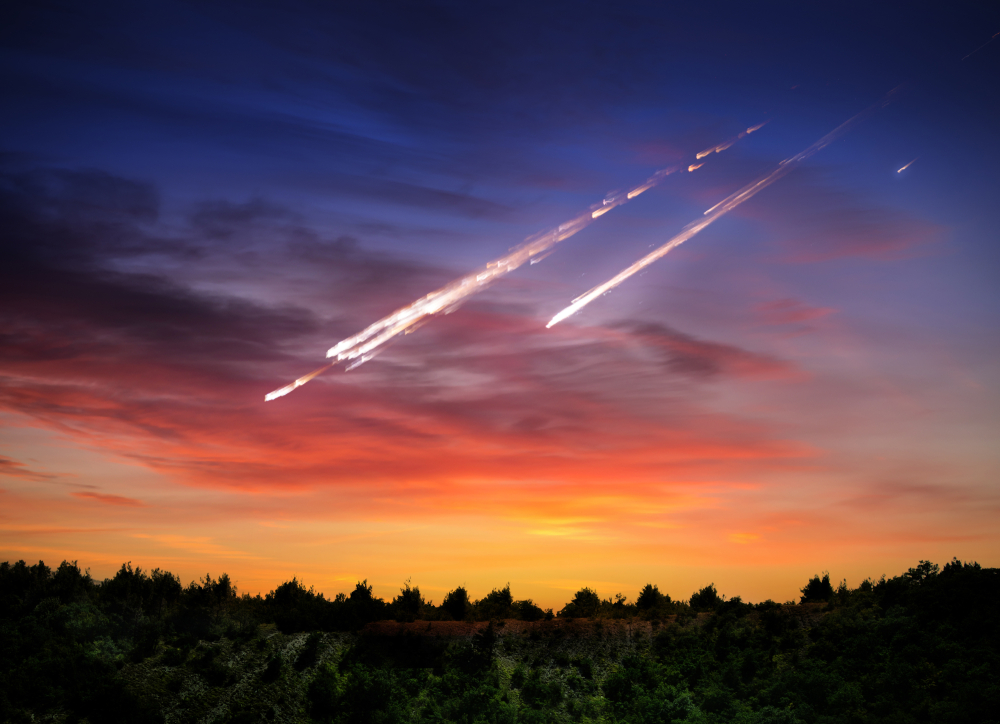 The theory is that water was brought to Earthmeteorites, existed for a long time, but there was a problem in the lack of evidence. Its essence is that initially our planet was dry, and then comets and asteroids containing water began to fall on it.
Water could have appeared after the Big Bang
The age of hydrogen can be compared with the ageUniverse: its atoms appeared as soon as the ambient temperature for the first time dropped enough that protons and electrons could exist. Since then, hydrogen has been the most abundant element in the universe for 14.5 billion years, both in terms of mass and number of atoms. Clouds of gas, composed mostly of hydrogen, fill the entire cosmos.
In 2011, astronomers found a nascent starwhich throws out gigantic volumes of water at great speed. They believe that this process can occur with many similar bodies. The object was found in the constellation Perseus, its name is L1448-MM. Water is ejected in portions at a speed of 50 km/sec. This process generates a shock wave, which is recorded by telescopes.
 The age of hydrogen can be compared with the ageUniverse: its atoms appeared as soon as the ambient temperature for the first time dropped enough that protons and electrons could exist. Since then, hydrogen has been the most abundant element in the universe for 14.5 billion years, both in terms of mass and number of atoms. Clouds of gas, composed mostly of hydrogen, fill the entire cosmos.
Stars contain a huge amount of water
In 2015, approximately 12 billion light-years fromOn our planet, researchers have discovered a black hole quasar APM 08279+5255 surrounded by the largest reservoir of water astronomers have ever found. The volume of liquid is 140 trillion times greater than that contained on Earth.
This discovery is another proof of the existencehuge reserves of water in the universe, and not only on the planets. These reserves appeared at the very dawn of existence - the age of the found formation is estimated at 1.6 billion years.
There is water around the stars
There is still water that was in the generativestar cloud of gas. It passes into the substance of the protoplanetary disk and objects that form from it - planets and asteroids. At the end of life, stars explode and in their place are nebulae, in which new stars appear.
Where else is there water?
- Mars. Astronomers have found irrefutable evidence of the presence of liquid water.
- Ganymede. In 2021, astronomers using Hubble for the first time discovered traces of water on Jupiter's largest moon Ganymede.
- Enceladus. American scientists have come to the conclusion that on the satellite of Saturn, which is believed to have a subglacial ocean, there may be currents similar to those on Earth.
- Titanium. It is analogous to the very early Earth. It's so cold on Titan that all water is frozen—lakes and seas are made up of liquid methane and ethane.
- Callisto. The ocean is under a ten-kilometer layer of ice.
An unequivocal answer to where on Earththere was water, no. So far, astronomers are studying all theories of its mass appearance on our planet, since there are a lot of ways to spread. But it is already known for sure that this is not a unique liquid, it is found on completely different celestial bodies, so it was probably a multi-stage process.
Read more
Scientists have figured out how the world's largest mushroom survives. It weighs over 35,000 tons
China used AI to improve technology. This is how the most powerful Gauss pistol appeared
It was a lightning strike, and Darwin was wrong: strange theories about the origin of life on Earth